








You are losing money every minute your crew stands around waiting for a batch of concrete. On a busy construction site, the concrete mixing equipment you choose dictates the entire pace of your project. We see contractors constantly debating whether to save upfront capital on a basic drum mixer or invest in a heavy-duty JS series twin-shaft mixer.
Let’s cut the sales brochure fluff. After managing commercial pours for over a decade, I can tell you that picking the right concrete mixer isn’t about looking at spec sheets; it is about knowing exactly what happens inside that mixing chamber when you throw in abrasive aggregate, cement, and water. Today, we are breaking down the brutal realities of the JS series versus the traditional drum concrete setups.
The Core Problem in Concrete Mixing
Achieving a uniform mix sounds simple until you actually try to combine two tons of dry cement powder with wet sand and heavy crushed rock. You need to coat every single particle of aggregate with cement paste. If your mixer fails to do this efficiently, you get weak spots, honeycombing in your finished concrete, and eventually, structural failure.
Different types of concrete mixers tackle this physical problem in entirely different ways. Some rely on gravity. Others use sheer brute force. Understanding this distinction is the only way to choose the right equipment for your specific pour.
Drum Mixer: The Old Reliable Heavyweight
The drum mixer is the most recognizable type of mixer in the construction industry. The design is straightforward: a large, steel rotating drum equipped with internal fins.
How Drum Mixers Actually Work
When the drum rotates, the internal fins catch the aggregate, cement, and water, lifting them up the sides. Once the material reaches a certain height, gravity takes over, and the mixture drops back down into the bottom of the drum. This is a passive mixing process. The drum spins, and the materials essentially fold over each other.
Where Drum Mixers Make Sense
Drum mixers are generally cost-effective and rugged. They handle large aggregate well because there are no high-speed internal blades for the rocks to smash against. If you are running a smaller site, pouring footings, or doing residential flatwork, smaller mixers powered by diesel engines offer excellent mobility. Portable concrete operations lean heavily on them.
The Downside of Gravity
Because drum mixers rely heavily on gravity, they are incredibly slow. A standard batch can take three to five minutes to achieve anything close to a uniform mix. Furthermore, if you are trying to produce high-strength concrete with a low water-to-cement ratio (low slump), a drum mixer will struggle. The stiff mix just rolls around the bottom without actually blending. You also have the headache of discharge. Reversing the drum to push the concrete out takes time, and you often end up with residual mix stuck to the blades, requiring your guys to hammer the drum clean at the end of the shift.
The JS Series Twin Shaft Concrete Mixer: Brute Force Efficiency
If you want to produce high-quality concrete at scale, passive gravity mixing simply does not work. This is where the compulsory mixer steps in, specifically the JS series twin shaft concrete mixer.
The Mechanics of the Twin Shaft
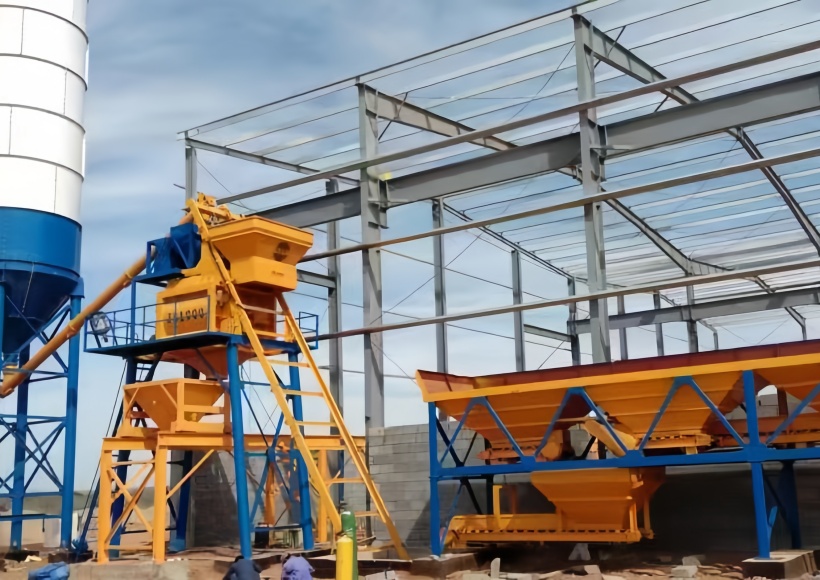
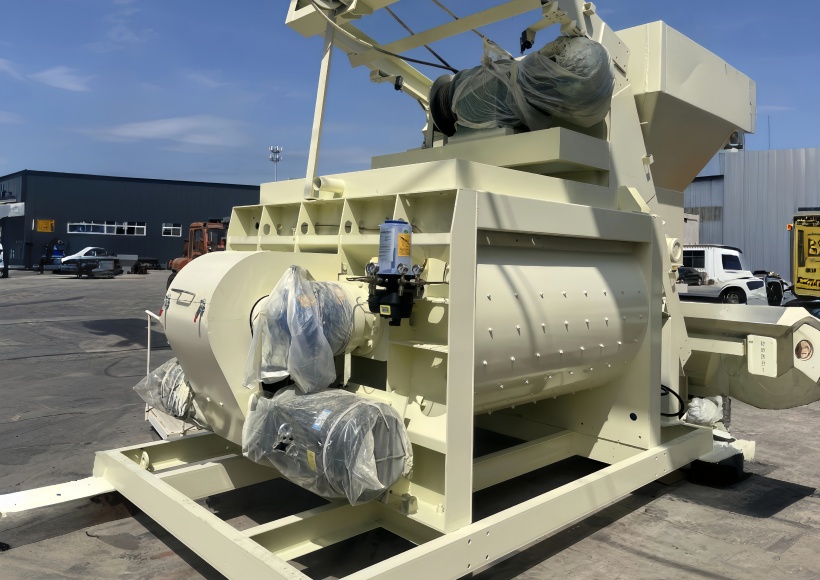
Instead of tumbling materials, a twin shaft mixer uses active intermixing. Inside the stationary mixing tank, you have two horizontal mixing shafts. These horizontal shafts are fitted with heavy-duty cast alloy arms and blades. The shafts rotate in opposite directions at high speeds.
When you drop your batch into this machine, the blades cut through the material, forcing it into a highly turbulent zone in the center of the tank. The materials are sheared, compressed, and folded simultaneously. This powerful mixing action guarantees that every grain of sand and piece of gravel is thoroughly coated with cement in a fraction of the time.
Why High-Volume Sites Demand Twin Shafts
When you are supplying a major commercial slab or infrastructure projects, you need a steady flow of concrete. A quality Twin Shaft Concrete Mixer can completely homogenize a heavy batch of concrete in 30 to 60 seconds. That speed translates directly to higher daily production rates.
Furthermore, the consistency is unmatched. For high-performance concrete where slump tolerances are extremely tight, the compulsory shearing action ensures there are no dry pockets or cement balls. Discharge is also vastly superior. A pneumatic or hydraulic discharge door opens at the bottom, dumping the finished concrete out in seconds, leaving very little residue behind.
Specialized Equipment: Pan Mixer and Planetary Mixer
While the twin shaft dominates general commercial batching, precast concrete plants often look to vertical shaft designs.
The Pan Mixer
A pan mixer features a flat cylindrical pan. The blades rotate around a central vertical shaft, scraping the sides and bottom. They are decent for producing small batches of concrete quickly, especially for colored concrete or mortar. However, they struggle with larger aggregate and generally lack the aggressive 3D mixing matrix of a twin shaft.
Planetary Concrete Mixers
Planetary mixers take the vertical shaft concept and complicate it. The mixing stars revolve around their own vertical axes while simultaneously rotating around the center of the mixing pan. This creates a complex, overlapping mixing path that leaves no dead zones. If you are manufacturing high-end precast architectural elements, blocks, or tiles where you need concrete with consistent properties and zero color streaking, planetary mixers are often the go-to. However, they are expensive to buy and maintain compared to standard twin-shaft designs.
Integrating the Concrete Mixer Truck
Mixing the concrete is only half the battle; you still need to get it to the pour site before it sets. This is where the concrete mixer truck comes in.
Many people confuse the mixer truck with the primary batch plant mixer. In a standard ready-mix concrete operation, the plant uses a large stationary batch mixer (like a JS series) to rapidly mix concrete. That freshly mixed concrete is then dumped into the mixer truck. The truck’s rotating drum is not there to mix the raw materials from scratch (though transit mixers can do this in a pinch); its job is to agitate the supply of fresh concrete, keeping it perfectly mixed and preventing segregation while driving to the construction site.
Hidden Operational Costs: Wear and Tear
This is the part that burns inexperienced buyers. You cannot just look at the purchase price of concrete mixing equipment. You have to calculate the maintenance downtime.
The Reality of Drum Maintenance
Drum concrete mixers are cheap to maintain because there are very few moving parts. You grease the main rollers, keep the drive ring clean, and occasionally weld patches onto the internal fins as they wear down. The main cost is labor—specifically, the labor required to chip hardened concrete out of the drum because the discharge is never 100% clean.
The Twin Shaft Maintenance Curve
A twin shaft mixer is a high-performance machine, and it requires strict maintenance. Those two horizontal shafts are passing right through the walls of the mixing tank containing highly abrasive, watery slurry. The shaft seals are the most critical component. If cement grout breaches the seals, it destroys the main bearings, shutting down your entire batch plant.
When specifying equipment from suppliers like Tongxin Machinery, you must look at their seal design. You want multiple layers of floating seals and an automated pressure greasing system to keep the grout out.
Furthermore, the mixing blades and liners take a massive beating. You must regularly crawl inside the machine to adjust the blade clearances. If the gap between the blade and the liner gets too wide, large rocks will jam in the gap, potentially snapping a mixing arm or burning out the main electric motor. It requires a more disciplined maintenance crew, but the trade-off in massive output volume is absolutely worth it.
Selecting the Right Equipment for Your Reality
Choosing the right concrete mixer comes down to output demands, mix specifications, and your maintenance capabilities.
If you are running a remote site, mixing basic structural concrete, and dealing with unpredictable power supplies, mobile mixers with rotating drums are bulletproof. They are forgiving, easy to fix, and get the job done.
However, if you are setting up a commercial batching plant, paving highways, or supplying a massive infrastructure project, you cannot afford the slow cycle times of a drum. You need the aggressive output of a Twin Shaft Concrete Mixer. The ability to churn out massive volumes of high-strength concrete with exact precision is non-negotiable in modern heavy construction.
Batch Mixer vs Continuous Mixer Decisions
Remember that both the drum and the twin shaft are batch mixers. They mix one specific load, dump it, and start over. If you are doing continuous slip-form paving or soil stabilization, you might look at volumetric mixers or continuous mixing setups. But for 90% of structural concrete supply, a high-speed batch system gives you the best control over the recipe.
Do not cheap out on the core of your operation. Talk to experienced engineers at manufacturers like Tongxin Machinery to match the exact KW power, liner material, and capacity to the aggregate you are actually using in your local area. A customized Twin Shaft Concrete Mixer will pay for its initial premium within the first few months of high-volume pouring simply through reduced cycle times and zero rejected batches. Make the heavy investment upfront, keep your grease pumps full, and keep your pour schedule moving.
Frequently Asked Questions (FAQ)
Why does my drum mixer leave dry cement clumps in the corners?
Gravity mixing struggles with low-slump or sticky formulas. The material just slides instead of folding over itself. If you are mixing anything below a 100mm slump, you need the compulsory shearing action of a twin shaft to force the water into the dry powder.
How often do I need to replace twin shaft mixing blades?
It entirely depends on your aggregate. High-silica river gravel will eat standard cast blades fast, sometimes within 30,000 cubic meters. Always upgrade to high-chromium wear plates and adjust the blade clearance weekly to extend their lifespan.
Can a pan mixer handle large aggregate sizes?
Not effectively. Pan mixers are designed for smaller aggregate, usually under 20mm. If you drop heavy 40mm crushed rock into a pan mixer, it will severely damage the scraper blades and put extreme strain on the vertical drive gearbox.
What is the real daily output of a JS500 twin shaft?
The factory nameplate says 25 cubic meters per hour. Ignore that. In real-world conditions on a site, factoring in truck positioning, material weighing delays, and cleanout, expect a steady, reliable output of about 18 to 20 cubic meters per hour.
Are shaft seal leaks a dealbreaker on modern JS mixers?
They used to be a nightmare, but not anymore. Quality manufacturers like Tongxin Machinery use advanced multi-stage pneumatic seals. As long as your automatic grease pump is actually filled with grease and functioning, bearing failure from slurry leaks is very rare today.