








Concrete quality is decided at the scale, not at the truck mixer. Under ASTM C94 and EN 206, the tolerance on cementitious batching sits at ±1% of batch weight, while aggregate proportioning allows a wider band – and a batching plant weighing system that cannot hold those bands will scatter compressive strength results across a pour no matter how good the mix design is. Every high-quality concrete traceability file ultimately rests on one component: the load cell, the transducer that converts hopper load into the signal the control systems act on.
That chain is short but unforgiving. Strain gauge load cells, excitation voltage, signal cabling, junction box, batching terminal – any weak link shows up as deviation in the concrete mix, as rejected batches, and eventually as project delays. This article works through that chain as engineered and calibrated in practice.
How do strain gauge load cells work in concrete batching?
A strain gauge load cell is an elastic element – usually alloy steel or stainless steel – instrumented with foil gauges wired into a Wheatstone bridge. As material loads the weighing hopper, the element micro-deforms, the bridge loses balance, and the mV/V output signal is proportional to the applied force. A compression load cell under an aggregate batcher sees the full dead load of the hopper plus live material; a tension load cell hangs the cement scale from the plant structure instead.
Three details separate industrial weighing from a laboratory scale. First, the output is only as stable as the excitation voltage, so the batching terminal regulates it. Second, on a plant with 40-60 m of cabling between hopper and cabinet, the junction box must be sealed and dry – moisture ingress there is the single most common cause of drifting readings. Third, load cells for outdoor service carry at least IP67, hermetically sealed, with surge protection on the lines.
Two terms are worth keeping straight. Creep is the slow output change under sustained load – the reason a hopper should not sit full overnight before the next batch is zeroed. Temperature effect on output is compensated at the factory, but rapid ambient swings at a winter site still show up in the last digit.
Which load cell types suit cement, aggregate, and admixture scales?
Cement weighing: high-precision strain gauge units on smaller scale capacity
Cement and supplementary cementitious materials are dosed within the tightest tolerance in the plant, so cement weighing runs on high-precision strain gauge load cells – typical capacities sit between 0.5 t and 5 t per unit, with an output of 2 mV/V or 3 mV/V combined error trimmed well below the scale divisions the terminal resolves. Because cement scales are relative to aggregate, this is where measurement accuracy is bought cheapest.
Aggregate weighing: compression load cells built for shock and overload
Aggregate service is brutal. Stone dropping from a belt or batcher imposes shock loads far above the static weight, so aggregate weighing relies on compression load cells with 150-300% overload margins mounted in self-aligning rocker or anti-lift hardware that absorbs vehicle vibration and thermal expansion of the support steel. Rocking the cells also keeps side loads from contaminating the vertical force path.
Admixture and water: fine divisions, aggressive media
Admixture scales carry the finest scale divisions in the plant – batching a few kilograms of water-reducer against a 50 kg capacity – and the load cells are usually stainless, hermetically sealed units rated for washdown. Shear-sensitive? No. Corrosion-sensitive, absolutely: a pinhole in the potting lets a superplasticizer wreck a gauge grid quietly.
What components make up an accurate weighing system?
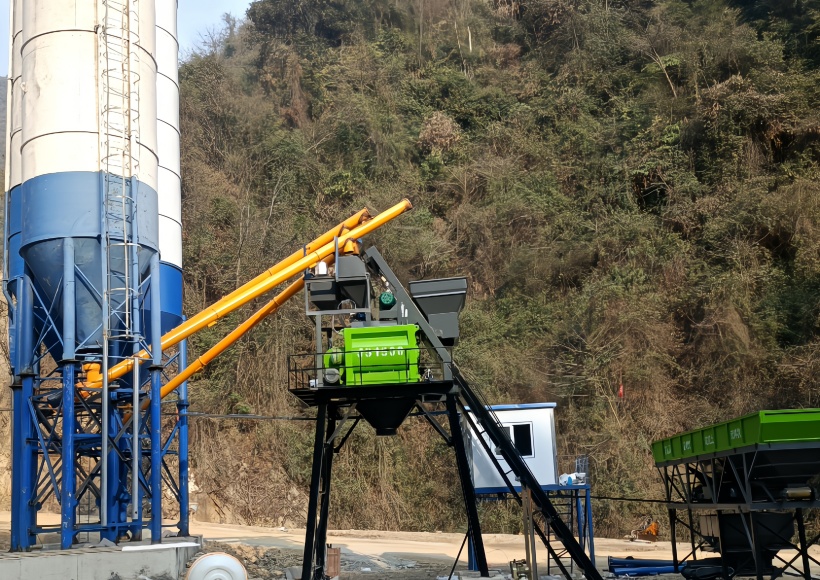
Beyond the load cells themselves, batching accuracy depends on the assembly working as one system:
- Weighing hoppers – separate weighing hoppers for aggregate and cement, each supported on its own load cell set, isolated from conveyors and silos with flexible or soft connections that cannot transmit force.
- Silos and screw conveyors – bulk cement storage feeding the scale by screw, with the interface decoupled so silo weight never biases the hopper reading.
- Admixture dispensing systems – metering the chemical dosing line into the mix water or directly into the mixer.
- Control systems – the batching terminal reading every scale in real time, executing the mix design, and logging each batching cycle.
- Conveyor system – belt feeders and aggregate batchers charging the hoppers at controlled rates.
The flexible connections deserve a note of caution: a hardened cement build-up inside a sock effectively rigidizes the joint and pulls weight off the scale. It reads light on cement – the worst direction the error can go.
How does plant calibration protect weighing accuracy?
Plant calibration is the procedure that turns a set of load cells into a trustworthy plant-scale reference, and it is performed against certified test weights traceable to national standards. With the hopper empty and clean, weights are stacked in increments across the usable range, readings are logged at each step, and span is adjusted until displayed and true load agree. Five points across the range is a reasonable minimum; three is cutting corners.
One nuance of scale accuracy: a batching scale rarely works near full span. Cement is batched into a scale sized for peak demand, so the working portion of the range sits low – exactly where percent-of-reading errors look worst. Calibrating only at full capacity therefore proves the wrong half of the scale.
Three calibration mistakes that quietly cost money
First, using unverified test weights. An uncertified weight set folds its own unknown error into every adjustment made afterward.
Second, dead-loading only at full scale while ignoring the low end, as above.
Third, skipping re-zero and re-span after mechanical work. Any gearbox change, discharge-door cylinder adjustment, or conveyor re-tracking on plant steel can shift the mechanical zero the load cells reference. Calibration records should follow the maintenance log, not the calendar alone – and where a plant lacks the weight sets or the certified reference, accredited scale companies handle periodic checks against their own traceable standards.
How do hopper design and material flow affect batching accuracy?
Weighing hopper geometry is a weighing problem as much as a flow problem. Aggregate hoppers handling damp sand need steep wall angles and generous discharge openings; a shallower angle passes a flow test with dry material then hangs up on the first humid week, and retained material falsifies the tare of every batch that follows. Cement hoppers vibrate or aerate to prevent build-up on the walls, and dead regions above the discharge door are where build-up accumulates unseen.
Load cell placement matters as much as geometry. Three cells at 120° or four cells in a symmetric pattern cancel eccentric loading from off-center charging; a charging point that always throws material to one side loads the cells unevenly and invites weighing errors even when each cell itself is healthy. Suspension-mounted scales add check rods and stay cables to keep the hopper from swaying under mixer vibration – hardware that must be slack-adjusted, never preloaded.
How does accurate proportioning control concrete strength and reduce waste?
A mix design is a ratio, and the scale is what enforces it. Under-batching cement drops strength; over-batching cement burns material costs and raises heat of hydration. Water admixture dosing swings slump and setting time; a one-kilogram error in a retarder dose across a full day of batching is a scheduling problem, not a chemistry footnote. Consistent concrete comes from consistent proportioning – there is no downstream correction once the truck leaves the plant.
This is where the control loop earns its keep. Because material keeps falling after a gate closes, the terminal reads the scale in real time and pre-cuts each gate by the in-flight quantity it has learned from the previous batching cycle. Free-fall compensation, coarse/fine feed speeds, and catch limits on over-batching are the difference between a plant that holds tolerance and one that trims every batch by hand. The payoff is fewer rejected batches, lower material costs, and a quality control file where strength results track the mix design instead of drifting.
What should buyers expect from a batching plant supplier on weighing performance?
Weighing accuracy is specified, not assumed, and ماكينات تونغشين treats the burden of proof as part of the delivery: load cell technology per scale, certified scale capacity and divisions, the calibration procedure performed at commissioning with test weights, and the ingress and surge protection applied to outdoor electronics. Producers running higher-spec work – infrastructure projects, precast, high-performance concrete – should ask for those numbers in writing as part of the acceptance protocol, and verify against their own contract tolerances rather than accepting generic accuracy claims.
ماكينات تونغشين builds this discipline into the full line of محطات خلط الخرسانة – from aggregate batcher geometry and load cell selection through control systems, commissioning calibration, and documented acceptance – with load cell and spare support sized for continuous batching operations. The مصنع خلط الخرسانة range covers stationary, mobile, and compact configurations, and the weighing system of each plant is calibrated and documented before shipment, because a plant is only as accurate as the scale it ships with.
الأسئلة الشائعة
How often should concrete batching plant calibration be performed?
A practical cycle is monthly verification with test weights on the cement and admixture scales, a full multi-point calibration quarterly, and an immediate re-check after any mechanical work on the hopper, gates, or conveyor system. Plants under audit should keep the records – reviewers ask for the calibration log first.
Which common mistakes cause weighing errors in a batching plant?
Unverified test weights, span calibration at full scale only, neglecting the low end of scale capacity, skipping re-zero after maintenance, and rigidized flexible connections between silo and hopper. All five are detectable in the batching records before they show up in cube strength.
Should cement and aggregate use different load cell types?
Yes. Cement weighing uses high-precision strain gauge units on a smaller scale capacity; aggregate weighing uses compression load cells with high overload margins and self-aligning mounts to survive shock loading. Tension load cells suit suspended hopper arrangements where the plant layout favors hanging scales.
Why do batches vary when the load cells read correctly?
Usually the process, not the cell. Free-fall material between gate closure and scale settlement, feed rates that outrun the pre-cut logic, and material hang-up in the weighing hopper all create deviation with a perfectly healthy load cell underneath.
What weighing accuracy can a concrete plant realistically hold?
A properly calibrated concrete batching plant weighing system holds cementitious batching around ±0.25-1% of batch weight and aggregate within the wider bands the relevant standards allow. Exact acceptance values should be confirmed against the project specification – but plants whose scales are certified and maintained to that level produce reliable concrete batch after batch.