


Ask any contractor who runs a 90 m³/h station and the conversation always lands on the same number: the HZS90 concrete batching plant price, and what that figure actually buys on site.
We build these plants at Tongxin Machinery and keep commissioning records from every delivery, so this guide walks through the machine itself — the JS1500 forced twin-shaft mixer (https://www.txmixing.com/concrete-mixer/JS1500-Concrete-Mixer.html), the PLD2400 batcher。
the silos and the control room — then breaks down why quotes for a 90 m³/h station differ so much, and what a realistic budget looks like for a working plant.
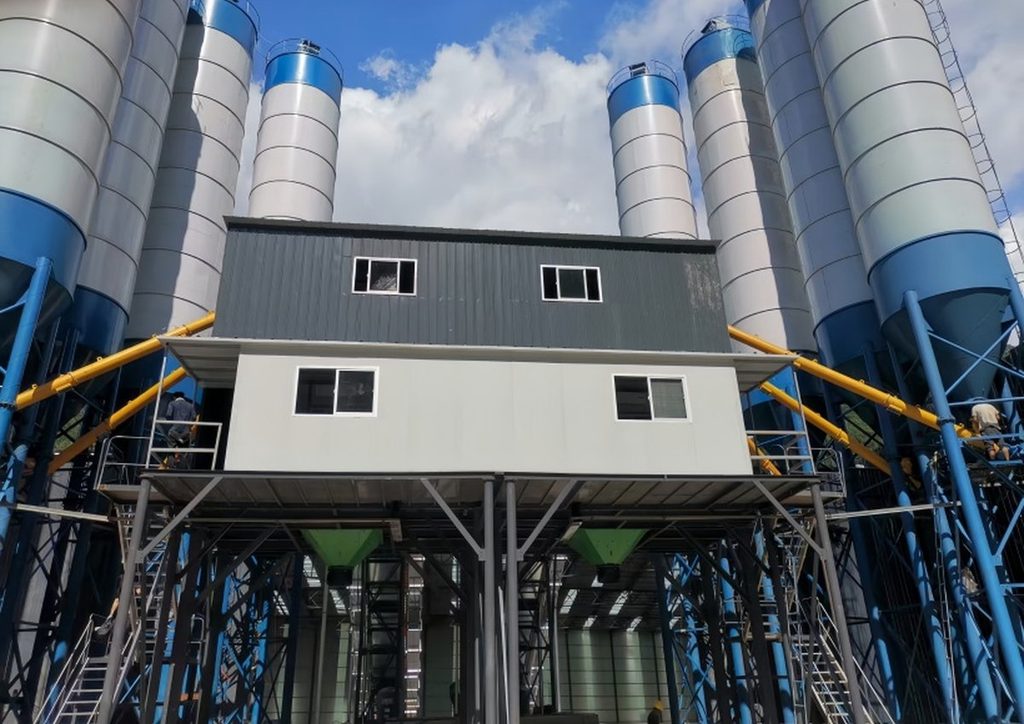
Tongxin HZS90 concrete batching plant with four cement silos and a control room at a ready-mix site.
HZS90 Concrete Batching Plant at a Glance
Before money changes hands, operators usually want three numbers: rated output, batch size and dosing accuracy. The HZS90 delivers 90 m³/h theoretical productivity, a 1.5 m³ discharge per batch on a 60-second cycle, and ±1% accuracy on cement, water and admixtures. Everything else — silo count, belt width, automation level — is configuration, and configuration is where the price moves.
- Parameter Specification
- Theoretical productivity 90 m³/h
- Discharge capacity 1.5 m³ per batch
- Mixing cycle ≤ 60 s
- Mixer model JS1500 twin-shaft forced mixer, 2 × 30 kW
- Batching machine PLD2400 aggregate batcher
- Batching accuracy Aggregate ±2%; cement/water/additives ±1%
- Total installed power ≈ 185 kW
- Discharge height 3.8 m (4.1 m optional)
- Annual capacity ≈ 200,000 m³ at 300 working days
System Breakdown: What Makes Up the HZS90
A batching plant is a set of subsystems that have to work as one machine. The HZS90 follows the classic modular layout — mixer, batcher, silos, conveyors and control — and each subsystem has a configuration choice that affects both performance and the final concrete batching plant price analysis (https://www.txmixing.com/news/Concrete-Batching-Plant-Price-Analysis-How-Model-and-Configuration-Influence-Your-Investment-Decision.html).
Mixing System: JS1500 Twin-Shaft Forced Mixer
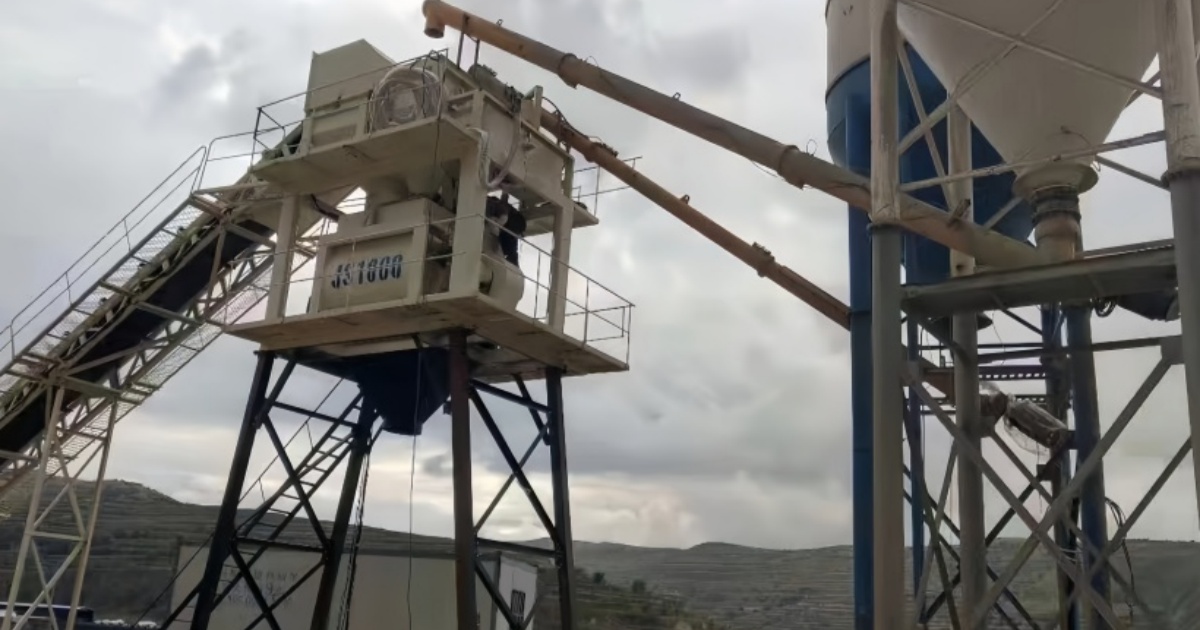
The heart of the HZS90 is the JS1500 forced twin-shaft mixer (https://www.txmixing.com/concrete-mixer/JS1500-Concrete-Mixer.html) with two 30 kW motors driving the shafts at 35 rpm. Twin-shaft design gives fast, homogeneous dispersion of aggregate, cement and water — the practical result is a uniform batch every 60 seconds with fewer rejected loads. The 1.5 m³ discharge matches the PLD1600-class weighing system upstream and the truck mixer downstream, so the plant does not spend time waiting on its own components.
Batching System: PLD2400 Aggregate Batcher
Aggregates are weighed by the PLD2400 aggregate batcher (https://www.txmixing.com/batching-machine/PLD2400-batching-machine.html), available with three or four storage bins depending on how many aggregate sizes your mix design needs. Belt feeding runs at about 1.6 m/s, and the weighing tolerance sits at ±2% for aggregate, ±1% for cement, water and admixtures — numbers that hold up against ASTM C94/C94M mixing practice when the load cells are calibrated on a fixed schedule.
Powder Storage and Conveying
Cement, fly ash and mineral powder are stored in bolted cement silos (https://www.txmixing.com/cement-silo/Flaky-cement-silo.html) — typically two or three 100-ton units for an HZS90 station — and transferred by screw conveyors (https://www.txmixing.com/screw-conveyor/LSY-screw-conveyor.html) sized to keep up with the mixer. A 219 mm screw rated around 40 t/h is the common choice here. Silos and screws are where a lot of cheap quotes quietly save money: thinner silo wall plating or undersized screws that bottleneck the plant at peak output.
Control System and Power Supply
The HZS90 runs on a computerized control system with manual/automatic switching, storage for up to 999 mix formulas, automatic fault detection and optional remote data transmission for centralized monitoring. Total installed power works out to roughly 185 kW depending on the conveyor and silo configuration, which translates to a recommended transformer of 250–315 kVA — size it on the calculated load, not on the brochure number.
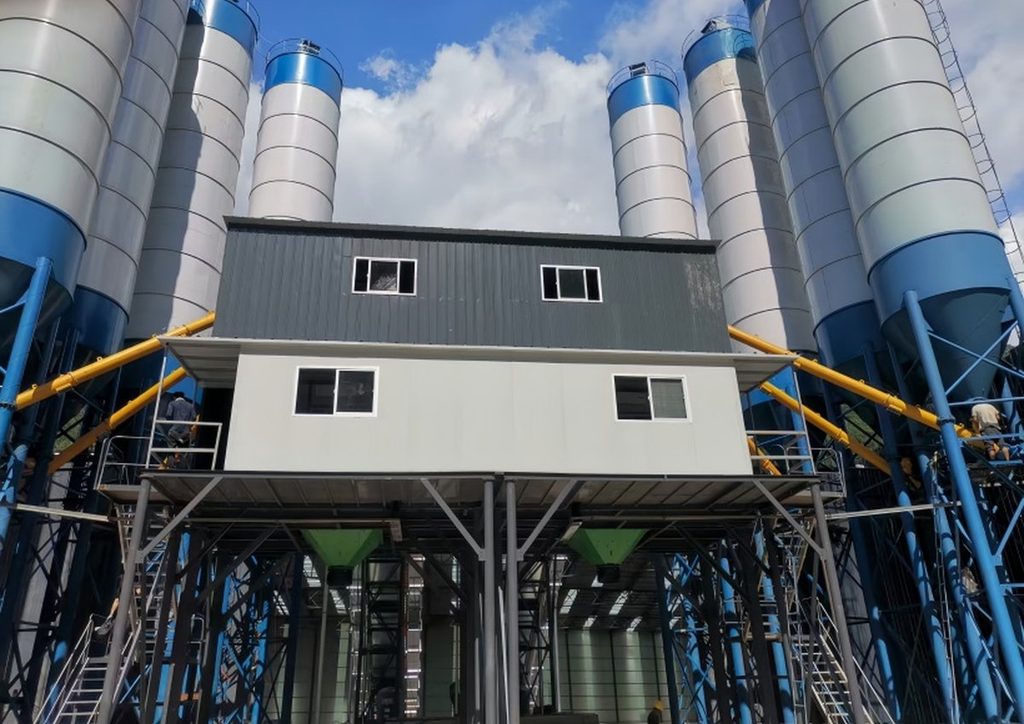
The HZS90 control room and cement storage silos keep weighing and discharging on a continuous cycle.
Theoretical vs. Actual Output: What to Expect On-Site
The brochure says 90 m³/h; a working site rarely sees that number for a full shift. In practice, operators report 70–80 m³/h of continuous production, because truck waiting time, power stability, raw-material feeding speed and short maintenance breaks all eat into the cycle. Treat the rated figure as the ceiling and plan logistics around 75–80% of it — the same rule that applies to every batching plant, whatever the label on the tower.
HZS90 Concrete Batching Plant Price: What Really Drives the Cost
There is no single list price for an HZS90, and any manufacturer that gives you one number without asking about your site is simplifying. A base-spec station — JS1500 mixer, PLD2400 batcher, one silo, standard PLC — typically lands in the $55,000–$70,000 range from a Chinese factory. A fully configured plant with two or three 100-ton silos, pulse dust collection, sand & gravel separator, higher-grade automation and a year of commissioning support pushes the total toward $75,000–$95,000. Freight, customs and site civil works are separate line items and often exceed the difference between two competing quotes.
So when you compare HZS90 concrete batching plant price quotes from different suppliers, you are really comparing configurations. The table below shows the decisions that move the number most.
- Price factor What changes Impact direction
- Steel thickness and bracing Main-frame plate 6 mm vs. 8–10 mm, galvanized vs. painted Heavier steel adds cost, extends service life in humid sites
- Weighing sensor brand HBM or Mettler-Toledo load cells vs. domestic sensors Premium sensors raise accuracy and repeatability
- PLC and control components Siemens/AB PLC vs. domestic controllers Global brands cost more, simplify parts sourcing abroad
- Silo quantity and capacity One vs. two vs. three 100-ton silos Each silo adds a meaningful chunk to the quote
- Environmental accessories Pulse dust collector, sand & gravel separator Required on many regulated sites, adds 5–10%
- Automation level Manual/auto switch vs. full remote monitoring Intelligent systems add cost but cut operating staff
- After-sales scope Documentation only vs. on-site commissioning and spares Commissioning support is often worth more than the hardware discount
The Cheap-Quote Trap
The lowest HZS90 concrete batching plant price is not always the cheapest plant to own. A quote that saves $8,000 up front by using thinner silo plating, non-brand sensors and a stripped control system can easily cost $30,000 in downtime and rework over three years. Ask for the full configuration list in writing — silo wall thickness, sensor brand and accuracy class, PLC make, wear-part specification and the exact scope of after-sales support — before you compare numbers.
Real-World Case: HZS90 on a Provincial Highway Upgrade
[IMG3]
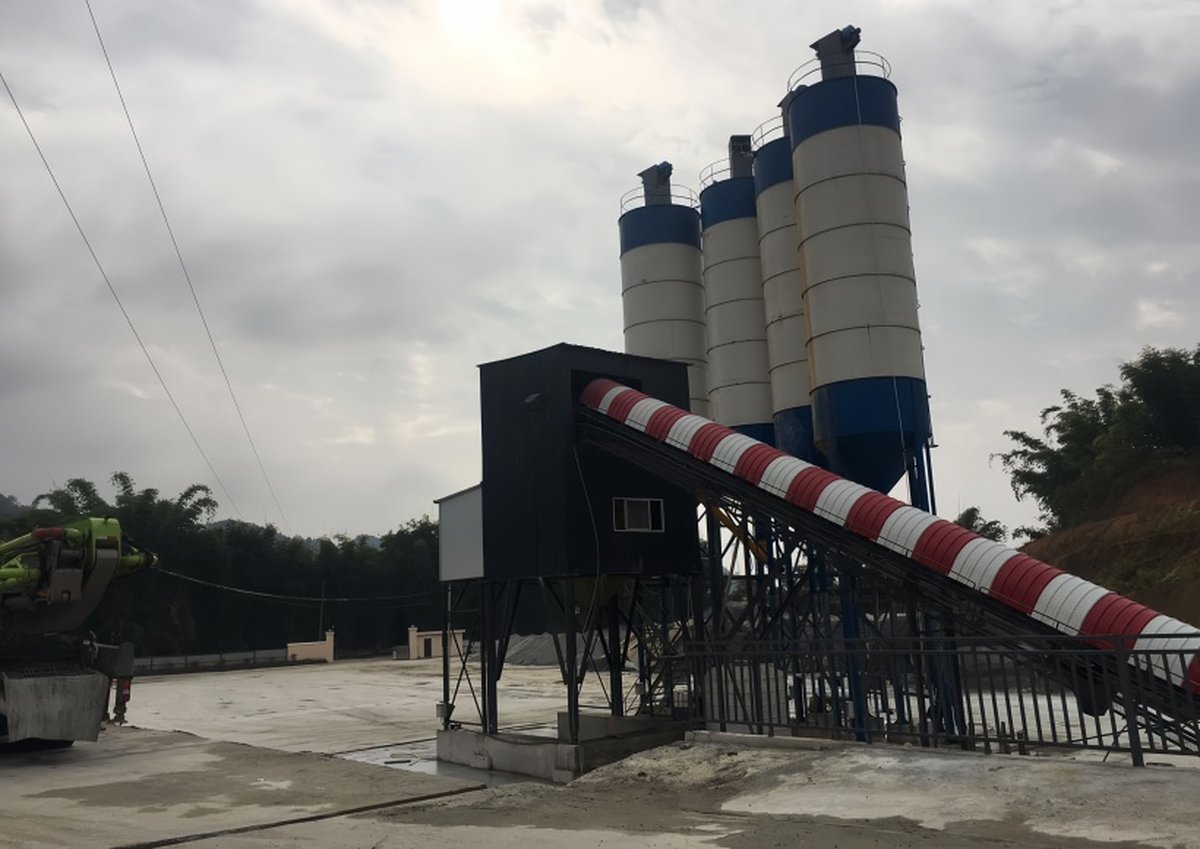
Aggregate conveyor line of the HZS90 plant during the Southeast Asia highway project.
One reference we keep going back to is a provincial highway upgrade project in Southeast Asia that took delivery of a Tongxin HZS90 in 2025 — at a negotiated HZS90 concrete batching plant price that included two weeks of on-site commissioning. During those two weeks we pulled 120 consecutive batches from the PLC log:
- Practical output ran 76–82 m³/h across the shift, peaking at 640 m³ in a single 8-hour day
- Cement weighing stayed within ±0.5% of the ±1% rating; water metering drifted under 0.4 L per batch
- Mixer liner wear after 40,000 batches was within the manufacturer’s wear allowance
- Downtime averaged about 3 days a month, split between scheduled maintenance and grid power dips
The operator cut energy cost per cubic meter by roughly 20% after we helped reschedule most of the mixing load into low-tariff night hours. None of that shows up in a brochure, but it is exactly the kind of detail that separates a plant that runs from one that merely exists on paper.
HZS90 vs. HZS60 vs. HZS120: Where It Fits
Choosing between the HZS60, HZS90 and HZS120 is mostly a question of project pace and truck fleet. The table below summarizes the practical differences, and it also shows where the HZS90 concrete batching plant price typically lands relative to each model; for more depth, our HZS60 capacity guide (https://www.txmixing.com/applications/hzs60-concrete-batching-capacity.html) and the HZS120 series articles cover the two neighbors in detail. For a quick reference on industry terminology, the concrete batching plant overview on Wikipedia (https://en.wikipedia.org/wiki/Concrete_plant) explains the standard definitions. For a quick reference on industry terminology, the concrete batching plant overview on Wikipedia (https://en.wikipedia.org/wiki/Concrete_plant) explains the standard definitions.
- Model Theoretical output Practical output Mixer Batcher Typical use
- HZS60 60 m³/h 40–50 m³/h JS1000 PLD1600 Mid-size sites, ready-mix yards
- HZS90 90 m³/h 70–80 m³/h JS1500 PLD2400 Highway, precast, commercial supply
- HZS120 120 m³/h 80–90 m³/h JS2000 PLD3200 Large infrastructure, metro projects
HZS90 Concrete Batching Plant Price FAQ
What does “theoretical productivity 90 m³/h” mean? Can I get 90 m³/h all day on-site?
A: 90 m³/h theoretical productivity is calculated under ideal lab test conditions. On real construction sites, factors including truck waiting time, power stability, raw-material feeding speed and maintenance breaks reduce actual output. Most users achieve 70-80 m³/h practical continuous production.
What mixer is fitted for Tongxin Machinery HZS90 batching plant?
A: It adopts JS1500 forced twin-shaft mixer with dual 2 × 30 kW motors. This mixing host is widely used for HZS90 grade plants and delivers stable mixing quality for multiple concrete grades.
What are the main factors affecting HZS90 concrete batching plant price?
A: Key variables include structural steel thickness, brand of weighing sensors and control components, silo quantity, environmental accessories, automation upgrade, and included after-sales service. Cheaper offers may omit important wear-resistant components or technical support.
Can the HZS90 plant be relocated to multiple job sites?
A: Yes. Its modular combined structure is designed for repeated disassembly, transport and reassembly. You will still need proper foundation for each new location, and inspect all wear-parts before restarting production.
What daily maintenance work should operators perform?
A: Check mixer liner and blade wear, clean residual concrete inside mixing drum, inspect belt tension, verify weighing system zero-point calibration, and check lubrication points. Follow manufacturer-provided operation manual for detailed maintenance schedule.
About the Author
This guide was prepared by the engineering team at Tongxin Machinery (https://www.txmixing.com/) — a Chinese manufacturer of concrete batching plants with two decades of production experience and installations across more than 60 countries. Our company background (https://www.txmixing.com/news/Tongxin-Machinery-Building-a-first-class-concrete-equipment-manufacturer-with-advanced-technology.html) and the HZS90 product page (https://www.txmixing.com/concrete-batching-plant/HZS90-Concrete-Batching-Plant.html) go deeper into the machinery and the team behind it.
Related Reading
- HZS90 Concrete Batching Plant: Complete Composition and Configuration Guide (https://www.txmixing.com/uncategorized/hzs90-concrete-batching-plant-composition-configuration.html)
- HZS90 Concrete Batching Plant: An Efficient, Intelligent Engineering Solution (https://www.txmixing.com/applications/hzs90-concrete-batching-plant-an-efficient-intelligent-and-modern-engineering-solution.html)
- HZS90 Power System Configuration Guide (https://www.txmixing.com/applications/hzs90-concrete-batching-plant-power-system-configuration-guide-tongxin-machinery-provides-professional-solutions.html)
- HZS60 Concrete Batching Capacity: Output, Specs & Investment Guide (https://www.txmixing.com/applications/hzs60-concrete-batching-capacity.html)
- Concrete Batching Plant Price Analysis: How Model and Configuration Influence Investment (https://www.txmixing.com/news/Concrete-Batching-Plant-Price-Analysis-How-Model-and-Configuration-Influence-Your-Investment-Decision.html)
Whatever HZS90 concrete batching plant price you eventually negotiate, the plant only pays for itself when it matches your production rhythm, your aggregate supply and your maintenance discipline.
Ask for the configuration sheet in writing, check the silo and conveyor sizing against your peak demand, and budget for commissioning support — the cheapest quote is rarely the cheapest plant to own.
For a detailed quotation and a configuration matched to your project, contact the Tongxin Machinery (https://www.txmixing.com/) sales team with your site conditions and annual concrete demand. The ready-mix concrete produced by the HZS90 follows the mix design principles covered in the ready-mix concrete overview (https://en.wikipedia.org/wiki/Ready-mix_concrete). Contact us for the latest HZS90 concrete batching plant price, delivery schedule and site layout drawing.