








A precast plant in Southern California was bleeding $4,200 a week on rejected architectural pavers – pigment streaking, aggregate segregation, surface voids that QC flagged before they ever reached the curing racks. The plant manager blamed the cement supplier. He blamed the admixture dosage. He even blamed humidity swings in the yard. Nobody thought to look at the mixer.
Turns out, the twin shaft unit they’d spec’d for “maximum throughput” was running paddle tip speeds that literally sheared pigment particles out of suspension in a 60-second batch cycle. The intensive mixing action that makes twin-shaft machines so fast was the same force destroying the color dispersion their product demanded. Six weeks after swapping to a planetary mixer, rejection rate dropped from 7.2% to 0.8%.
That’s the twin shaft vs planetary mixer decision in a nutshell: it’s not about which machine is “better.” It’s about which failure mode you can afford to live with.
What’s Actually Happening Inside the Mixer?
Let’s get something straight before we talk features. Both twin shaft and planetary mixers produce high-quality homogeneous concrete. Both can hit the compressive strength spec on a 4,000-psi mix design. The question isn’t whether they mix – it’s how they mix, and what that motion does to your specific materials, your cycle times, and your maintenance budget.
Twin Shaft: The Aggressive Workhorse
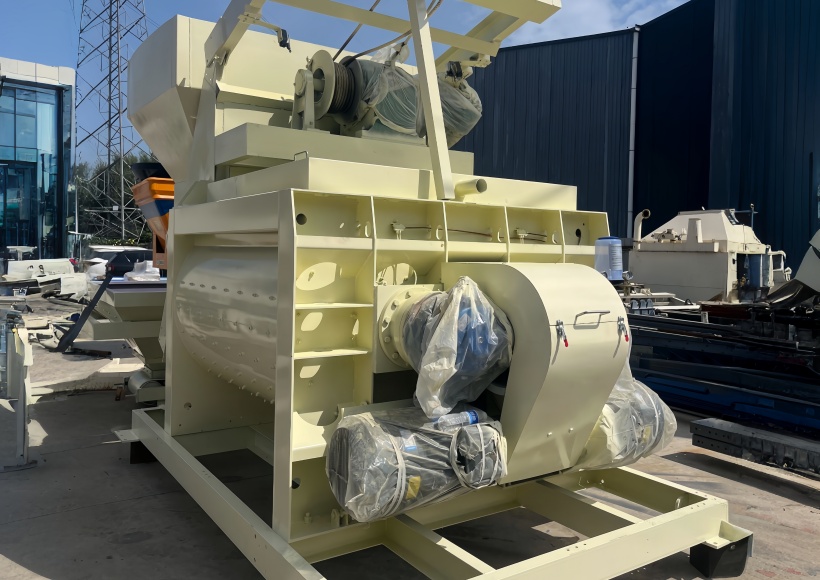
A Twin Shaft Concrete Mixer runs two horizontal shafts with opposed-spiral paddle arrangements that counter-rotate. Material gets caught in a violent cross-flow between the shafts – what engineers call the intensive mixing zone. Aggregate particles collide at high velocity, cement paste coats every surface, and the batch reaches homogeneity fast. We’re talking 30 seconds of actual mixing time for a standard 1-yd batch, compared to 45-60 seconds in a planetary or pan mixer of equivalent capacity.
But that aggression comes at an operational cost. The paddle tip clearance on a twin shaft unit – typically 3-5mm from the trough floor – means wear plates take a beating. On abrasive mixes (high river-gravel content, slag cement blends, manufactured sand), I’ve seen wear plate life drop below 8,000 cycles. That’s a maintenance event every six weeks on a plant running 200 batches per day. If your operation doesn’t have a scheduled wear-parts replacement protocol, you’ll find out the hard way when a paddle gouges the trough floor and you’re staring at a $14,000 repair instead of a $2,800 liner swap.
Planetary: The Precise Sweeper
A planetary concrete mixer takes a fundamentally different approach. A central star wheel drives satellite paddles that rotate on their own axes while revolving around the mixing pan – epicyclic motion, like a planetary gearset. The paddles sweep the entire pan floor with minimal dead zones, ensuring materials are uniformly distributed. Tip speeds are lower than twin shaft, but the coverage pattern is more complete. For a 1-yd batch, you’re looking at 45-55 seconds of mixing time – slower, but the homogeneity coefficient (the statistical measure of material distribution uniformity) typically runs 0.98 or better, versus 0.95-0.97 for a twin shaft on the same mix design.
That difference doesn’t sound like much until you’re producing colored concrete. Pigment dispersion is unforgiving. A 2% variance in pigment distribution shows up as visible streaking on a finished paver. Twin shaft mixers can hit 0.98 homogeneity, but you have to extend the cycle time to compensate – which kills the throughput advantage that justified buying one in the first place.
Wear Parts, Seals, and the Real Cost of Ownership
Here’s where most procurement teams get it wrong. They compare the sticker price of the mixer and maybe glance at the motor kW rating. They don’t model wear parts consumption, shaft seal maintenance intervals, or the labor cost of accessing the mixing chamber for inspection on a stationary unit.
Shaft Seals: The Silent Budget Killer
On a twin shaft mixer, the shaft seals sit at the junction where each horizontal shaft enters the mixing trough. These are typically multi-lip seal assemblies or mechanical face seals with a grease purge system. They’re under constant assault from cement paste, fine aggregate, and – if your plant is anywhere near the coast – chloride-laden air. A failed seal lets abrasive material migrate into the bearing housing – then you’re replacing a $4,500 bearing assembly and losing two days of concrete production., not a $180 seal kit.
On a twin shaft unit, accessing the seal area means draining the trough and pulling the end cover – a 4-6 hour job. On a planetary, the vertical shaft places the bearing above the pan. Seal inspection takes 45 minutes. I’ve seen planetary units from Tongxin Inji deliver 18-month seal longevity in precast plants running single-shift operations. The same plant’s twin shaft unit needed seal service every 7-9 months on a similar duty cycle.
Discharge: Speed vs Cleanliness
Twin shaft mixers use a bottom-hinged discharge gate – a pneumatically or hydraulically actuated door that swings open along the trough floor. Discharge time for a 2-yd batch: 8-12 seconds. Fast. But that gate is a wear surface. The seal edge degrades, and you start getting material weepage between batches. Not a big deal for ready-mix concrete headed to a pump truck on a large-scale project. A very big deal for colored architectural precast where cross-batch contamination means a color shift your customer catches on the jobsite.
Planetary mixers typically discharge through a center bottom gate or a side chute. Slower – 15-25 seconds for equivalent batch size – but cleaner. The pan geometry means less residual material after discharge. For multiple color runs per shift, that 10 seconds is irrelevant compared to 20 minutes cleaning a twin shaft trough between changes.
Choosing the Right Mixer: Which Type Fits Your Operation
I’ve spec’d both types of concrete mixers used in batching plants across the Western US, and the decision tree is narrower than most equipment dealers will tell you. The right type of mixer depends less on brand loyalty and more on what you’re actually producing, how many batches per day you’re running, and what your QC rejection criteria look like. The mix design complexity matters more than the size of your batch plant.
When Twin Shaft Wins?
Choose a Twin Shaft Concrete Mixer when your plant is running high-volume, standard-mix ready-mix concrete. If you’re feeding a pump truck on a commercial pour, doing 200+ batches per day, and your mix designs are standard 3,000-5,000 psi concrete with minimal admixture complexity, the twin shaft’s cycle time advantage compounds. Over a 10-hour shift, saving 15 seconds per batch on a 200-batch day buys you 50 minutes of additional capacity. That’s 15-20 extra cubic yards per day – real money when you maximize output on a tight-margin operation.
Twin shaft also handles harsh, low-slump mixes better. If you’re producing roller-compacted concrete or dry-cast products, the intensive mixing action is exactly what you need to fully hydrate a low-water mix. Drum mixers can’t touch this performance level, and pan mixers lack the shear force for stiff mixes. For contractors on various construction projects, the mixing efficiency at high volume is hard to beat.
When Planetary Wins?
Choose a planetary concrete mixer when your operation is precast-focused – especially architectural precast, colored concrete, pavers, and intricate components where surface finish and homogeneity directly affect rejection rates. If your QC team is rejecting product for aesthetic reasons – streaking, segregation, voids – the mixing action is almost certainly part of the problem. Planetary mixers also win on plants with frequent mix-design changes, because the pan geometry and lower tip speeds mean less residual material and faster cleanout between batches. The compact footprint helps in tight precast layouts.
For UHPC (ultra-high-performance concrete) and fiber-reinforced mixes, planetary is the only realistic choice. The fiber distribution in a twin shaft mixer is uneven enough that you’ll see clumping and balling – and UHPC at $1,200+ per cubic yard is not where you want to discover that. Planetary’s gentle, thorough motion synchronizes fiber dispersion without the aggressive shear that causes fiber balls. The same applies to grout and specialty blends.
For SCC (self-compacting concrete) with viscosity-modifying admixtures, planetary’s lower shear input preserves mix stability and extends working time. Twin shaft can produce SCC that meets flow requirements, but the high-shear environment breaks down viscosity modifiers prematurely – costing you 15-20 minutes of slump retention on high-performance concrete.
The Specification Trap Nobody Warns You About
Here’s something equipment brochures won’t tell you. The rated capacity of a mixer – that “1.5 cubic yard” or “2 cubic yard” number on the spec sheet – is the aggregate volume, not the batched concrete volume. Most manufacturers calculate capacity based on dry aggregate loading, not on the final wet mix volume after water and cement are added. A twin shaft mixer rated for 2 yd of aggregate typically produces 1.3-1.5 yd of finished concrete per batch. Planetary mixers are slightly more forgiving – usually 75-80% of rated capacity as finished product.
If you’re sizing a concrete batching plant based on spec-sheet numbers without accounting for the fill factor, you’ll undersize the mixer by 20-25%. I’ve seen this happen on two separate precast plant projects. Both ended up adding a second mixer line 14 months after commissioning – at 3x the cost of buying the right size the first time. Select your mixer based on required finished concrete output, not on the aggregate capacity number the salesman puts in bold on the quote.
Motor Power and Drive Efficiency
Don’t fixate on motor kW. A twin shaft mixer and a planetary mixer with identical rated capacity will have very different power draw profiles. Twin shaft units peak high during the initial charging phase – when dry aggregate hits the paddles – and then settle. Planetary mixers have a flatter, more consistent power curve because the epicyclic motion doesn’t create the same shock loading. If your plant’s electrical system is already running near capacity, the twin shaft’s peak demand might require a larger service entrance or a soft-start system that adds $8,000-$15,000 to your electrical integration.
Also consider conveyor integration. Twin shaft mixers typically sit lower in the plant structure, which can simplify your charging conveyor layout. Planetary mixers have a taller vertical profile, which may require adjustments to your aggregate feed conveyor angle or batching plant platform height. These aren’t dealbreakers, but they’re line items that show up in your civil works budget, not your equipment budget – and they’re easy to miss during the specification phase. These key differences ripple through your entire plant layout – from electrical service to conveyor angles to maintenance access.
Tambayoyi da ake yawan yi
1. What’s the typical wear parts replacement interval for a twin shaft mixer?
On standard ready-mix concrete with river gravel aggregate, expect 12,000-15,000 cycles per set of wear plates. Abrasive mixes (slag cement, manufactured sand) can cut that to 6,000-8,000 cycles. Budget $2,500-$4,000 per replacement, including labor and downtime.
2. Can a planetary mixer handle high-volume ready-mix production?
Yes, but you’re paying for precision you don’t need. A 2-yd planetary mixer typically runs 55-60 second cycle times versus 30-35 seconds for a comparable twin shaft. At 150+ batches per day, that gap costs you 30-40 minutes of lost capacity per shift.
3. How do shaft seal failures typically present on a twin shaft mixer?
Early stage: grease weepage at the seal housing, visible as a gray paste around the shaft entry point. Mid-stage: slurry dripping during batch cycles. Late stage: bearing temperature spike and audible grinding. By late stage, you’re replacing the bearing assembly, not just seals – budget $4,000-$5,500 and 2 days of downtime.
4. Is a twin shaft or planetary mixer better for SCC production?
Both produce SCC that meets ASTM C1618 flow requirements. Twin shaft is faster and suitable when SCC is a smaller portion of your product mix. For plants where SCC is 60%+ of production volume and uses viscosity-modifying admixtures, planetary’s lower shear input preserves mix stability and extends working time by 15-20 minutes.
5. What’s the realistic service life of each mixer type?
With proper maintenance, both types deliver 15-20 years of service. Planetary mixers tend to age more gracefully due to lower wear rates on the vertical shaft design. Twin shaft units may require a mid-life refurbishment (shaft realignment, bearing replacement, trough relining) around year 8-10, typically costing $25,000-$40,000 depending on capacity.