








Step onto any concrete batching plant or massive infrastructure site in Texas or Ohio, and you will see the same recurring failure. A procurement manager buys a 100-ton steel tower based on a generic desktop volume calculation, only to discover that the site runs out of material halfway through a critical continuous pour.
The underlying issue is simple. Bulk Portland cement does not behave like water. It is a temperamental, friction-driven powder that expands, compacts, and traps air based on how it was loaded, how long it sat in transit, and the atmospheric humidity of your job site. If you rely blindly on a standard volume calculation without factoring in the material’s fluidization state or mechanical dead zones, your operational logistics will face significant disruption.
The Flawed Physics of Basic Volume Versus Real-World Tonnage
Most generic sizing charts make a catastrophic assumption: they treat cement density as a fixed constant. If you look at standard engineering handbooks, they list the bulk density of Portland cement as roughly 1.5 tons per cubic meter (94 pounds per cubic foot). In a sterile laboratory environment, that number holds up. On a live construction site, that assumption fails completely.
When a pneumatic dry-bulk tanker pumps cement into a storage unit via a 4-inch fill pipe, the material undergoes intense aeration. The particles are suspended in a high-velocity stream of compressed air. When it enters the storage chamber, the cement is heavily fluffed or fluidised. In this highly aerated state, its effective bulk density drops significantly—sometimes as low as 1.1 to 1.2 tons per cubic meter.
Conversely, if that same material sits in a storage unit for three weeks under the weight of its own head load, it consolidates. Vibrations from nearby aggregate batchers and heavy diesel trucks pack the powder tightly. The density in the bottom cone can spike to 1.6 tons per cubic meter or more.
Therefore, if you use a standard, static formula to estimate your storage footprint, you will face errors. To avoid these issues on the job site, you need a dynamic cement silo capacity calculator that accounts for these shifting density profiles rather than relying on an idealized mathematical average.
Visualizing the Density Divergence in Bulk Material Storage:
+------------------------------------------+
|  Top Ullage Space (Safety Zone)          | -> Zero Material Weight
+------------------------------------------+
|  Aerated Upper Zone (Fluffed Powder)     | -> Density: ~1.1 to 1.2 t/m³
|  Material expanded by compressed air     |
+------------------------------------------+
|  Consolidated Lower Zone (Packed)        | -> Density: ~1.5 to 1.6 t/m³
|  Compacted by self-weight & vibration    |
+------------------------------------------+
|  Discharge Cone (Active Flow Area)       | -> Prone to Arching/Rat-holing
+------------------------------------------+
Demystifying the Geometric Math: Cylinder Plus Cone
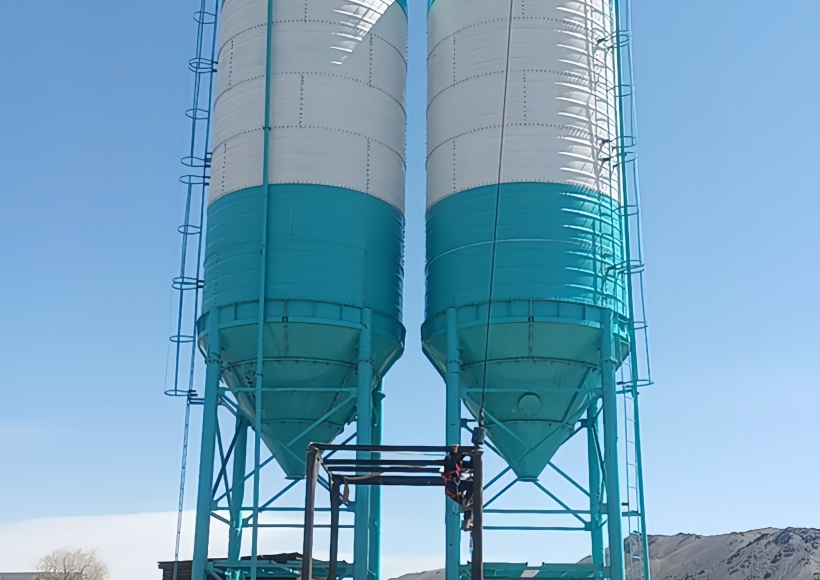
To understand what you are actually buying when looking at a steel or aluminium cement silo for sale, you have to break the structure down into its two primary geometric components: the main upper cylinder and the lower discharge cone.
The Cylindrical Body Volume
The upper section holds the bulk of your inventory. The theoretical volume of this cylindrical section is calculated by multiplying the cross-sectional area by the height of the cylinder sheet metal.
Formula: Volume of Cylinder = 3.14159 * r² * h_cylinder
Where r is the internal radius (half of the internal diameter) and h_cylinder is the straight wall height, measuring from the weld line of the bottom cone up to the top eave line.
The Conical Bottom Volume
The bottom hopper section is where the math gets missed by inexperienced field buyers. The cone allows the material to channel toward the discharge gate via gravity, but its volume is significantly lower than a cylinder of the same height.
Formula: Volume of Cone = (1 / 3) * 3.14159 * r² * h_cone
Where h_cone is the vertical depth from the wide joint where it meets the cylinder down to the throat of the discharge flange.
The Crucial Ullage Correction Factor
Summing these two volumes gives you the gross geometric capacity. However, you can never fill a storage unit completely to the top weld seam. Doing so will blind your dust collection cartridges, plug your pressure relief valves, and cause a catastrophic structural rupture during a high-pressure pneumatic blowout from a delivery truck.
You must subtract an ullage allowance—typically the top 0.5 to 1 meter of the cylinder—to account for the natural angle of repose. When cement is blown into the center, it forms a conical peak with an angle of roughly 36 to 45 degrees. It does not lay flat like water. If you want a dependable site configuration, using an advanced engineered system like the one provided by Tongxin Jentera ensures these industrial design constraints are integrated directly into the manufacturing blueprint before steel hits the rolling machines.
Industrial Sourcing and Manufacturing Realities
When navigating the international market for industrial concrete equipment, you will encounter two main structural designs: welded one-piece storage units and bolted segmented designs. Choosing between them involves balancing logistics costs against on-site installation timelines.
| Engineering Attribute | Welded Monolithic Units | Bolted Segmented Units |
| Shipping Logistics | High freight cost; requires specialized wide-load flatbeds or open-top ocean containers. | Exceptional shipping efficiency; panels pack flat into standard 40-foot HQ containers. |
| Structural Integrity | Factory-welded under controlled environments; zero risk of panel seam leakage. | Relies on high-tensile bolts and EPDM gaskets; requires precise torqueing during site setup. |
| Erection Timeline | Rapid deployment; crane lifts it onto foundations, anchor bolts are secured, and it is ready. | High labor component; requires several days of field assembly to seal and bolt panels. |
| Corrosion Risk | Minimal; uniform exterior industrial primer and polyurethane topcoats. | Moderate at connection points if field assembly scratches the protective coating. |
For export markets across Southeast Asia, Africa, or North America, bolted designs dominate due to containerized shipping economics. However, if your plant is within a few hundred miles of the fabrication facility, a factory-welded unit cuts field labor expenses significantly.
Regardless of the structural type, the thickness of the steel plate matters. Cheap, low-tier manufacturers often use thin 4mm mild steel for the upper rings, which can warp under severe wind loads or internal vacuum pressures. Industrial-grade suppliers like Tongxin Jentera utilize a minimum of 5mm to 6mm high-yield structural steel for the lower cylinder rings, with reinforced heavy-gauge plating for the hopper section to handle the intense frictional forces of discharging powder.
Field Failure Modes: The Hidden Killers of Effective Storage Capacity
A major flaw of basic sizing tools is their assumption that all material inside the chamber will flow out smoothly when the butterfly valve opens. In reality, industrial powders frequently encounter flow issues that can reduce your effective storage capacity by half.
1. Rat-Holing (Funnel Flow)
If the material is damp or the discharge cone angle is too shallow (less than 60 degrees for Portland cement), the powder directly above the discharge gate drops out first. This creates a narrow vertical channel straight through the center of the unit. The material on the periphery remains compacted against the steel walls, completely stagnant. You might have 30 tons of material left in the unit, but because it is stuck to the sides, your batcher runs dry.
2. Arching and Bridging
When compacted powder forms a dense, self-supporting arch directly over the outlet flange, material flow stops entirely. This typically occurs when moisture infiltrates the bottom flange due to improper sealing or lack of inline air dryers on your aeration system.
To combat these real-world disruptions, your equipment specification sheet must include mechanical flow aids:
- Aeration Pads / Fluidization Nozzles: These inject low-pressure compressed air along the inner walls of the cone to lower the coefficient of friction and keep the material moving.
- Pneumatic Bin Vibrators: High-frequency, low-amplitude impactors that shatter internal bridges without causing structural fatigue to the steel plate.
- Level Indicators: High and low-level rotary paddle switches or continuous radar level transmitters. Relying on a crew member hammering the side of a steel sheet to guess the material level is an unsafe and inaccurate practice.
Before signing off on a machinery purchase order, check your calculations using a professional-grade cement silo capacity calculator. This ensures your project planning accounts for the appropriate material characteristics, structural safety margins, and density variations.
Common Flow Failures Reducing Effective Capacity:
      [Rat-Holing]                 [Bridging / Arching]
   +-----------------+              +-----------------+
   |                 |              |                 |
   |  |   |   |   |  |              |  Material Stuck |
   |  |Stagnant|  |  |              |  In Upper Zone  |
   |  |Material|  |  |              |                 |
   |  \   | |   /  |              |   /---------\   |
   |   \  | |  /   |              |  /   Arch    \  |
   +----+--| |--+--+              +----+---| |---+--+
           V                               X
     (Narrow Funnel)                (No Flow Output)
Procurement Strategy: How to Read a Factory Specification Sheet
When reviewing a commercial proposal for a bulk storage asset, do not look only at the headline price or the generic tonnage rating. Look for specific engineering data points:
- Net Volume in Cubic Meters: This is the only fixed metric. Tonnage is variable, but internal volume does not change. If a vendor quotes a “100-ton storage unit,” ask them whether that assumes a loose density of 1.2 or a compacted density of 1.5. A true 100-ton capacity at a loose density requires an internal volume of at least 83 cubic meters.
- Cone Angle: Ensure the bottom discharge hopper features a minimum 60-degree slope. Anything less will cause flow issues with fine powders like cement or fly ash.
- Filtration Surface Area: A pneumatic truck blows material in at high cubic feet per minute rates. The air needs to escape through the top dust collector. For a standard 80 to 100-ton setup, ensure your top-mounted pulse-jet baghouse provides at least 24 square meters of filtration fabric area to prevent over-pressurization.
By double-checking your dimensions with a reliable cement silo capacity calculator, you can verify vendor claims and select an asset that aligns with your site’s operational demands.
Soalan Lazim
Q1: How do I calculate the storage capacity needed for a concrete plant project?
Look, if your dispatcher runs blind based on desktop spreadsheets, you are bound to screw up a live pour. Forget generic daily yardage targets. Figure out your hourly burn rate on your heaviest structural mix—say, a 4000 PSI pump mix packing 564 pounds of cement per yard. If your plant is knocking out 120 yards an hour, you are eating 34 tons of powder every 60 minutes. If your closest terminal is a two-hour round trip for a bulk tanker, a standard “two-day safety stock” calculation is complete fiction. You need enough buffer to survive three missed truck slots back-to-back during a continuous pour, meaning your minimum onsite storage should equal 150% of your peak daily consumption.
Q2: Why does my storage unit show a different level on the radar sensor after a delivery?
You are seeing phantom inventory, and it drives yard managers crazy. When a bulk trailer Hooks up its blower and dumps 25 tons of powder into the silo, that material gets heavily fluffed by compressed air. The particles expand like a shaken bag of flour, dropping the local density down to nearly 1.1. Your top-mounted guided wave radar reads the high peak of this aerated fluff column and flags the silo as full. Give it four hours. The air settles out through the roof vents, the powder packs down under its own weight, and the column drops by three feet without a single ounce leaving the gate. Trust the tonnage weight cells on the legs, not the radar cone level right after a blower disconnects.
Q3: Can I use the same storage unit for both Portland cement and fly ash?
Mechanically, yes, the steel does not care. Logistically and legally? It is a total nightmare unless you want your concrete test cylinders failing at 28 days. Fly ash is a completely different animal—it is much lighter, averaging around 55 to 65 pounds per cubic foot compared to cement at 94 pounds. If you run the math through a basic cement silo capacity calculator, a tower built to hold 100 tons of Portland cement will physically max out at about 65 tons of fly ash because the ash takes up way more physical space. More importantly, cross-contamination is a massive liability. If your butterfly valve leaks or your screw conveyor cross-feeds ash into a structural concrete ticket, your mix designs are shot and your insurance company will walk away.
Q4: What are the risks of operating a bulk storage unit without a pressure safety valve?
You are looking at a catastrophic silo pop. When a driver hooks up his line, he wants to dump his load fast so he can get back on the highway. If he cranks his blower up to 25 or 30 PSI and your top dust collector cartridges are already blinded with crusted powder from morning humidity, that air has nowhere to go. Without an operational, spring-loaded pressure relief valve (PRV) to dump that pressure instantly, you are essentially sitting next to a massive steel pipe bomb. The internal pressure will tear the roof seams clean off the top shell, or worse, turn your multi-ton dust housing into a missile. If your PRV is frozen shut with rust, you are begging for a structural disaster.
Q5: How often should I inspect the interior of my bulk powder storage system?
Forget the standard textbook advice that says “inspect once a year during winter shutdown.” That is a lazy rule of thumb that ignores real-world weather. If your plant is running out in high-humidity zones like Houston or the Florida coast, moisture is your absolute worst enemy. Condensation crawls up the inside of those steel plates every single night. You need to drop a light down the top hatch every three months to check for sidewall crusting and heavy build-up in the discharge cone. If you let that crust build up, it turns into hardened concrete chunks that break off, jam your fluidization lines, and destroy your aggregate batcher screw gates right in the middle of a production run.