








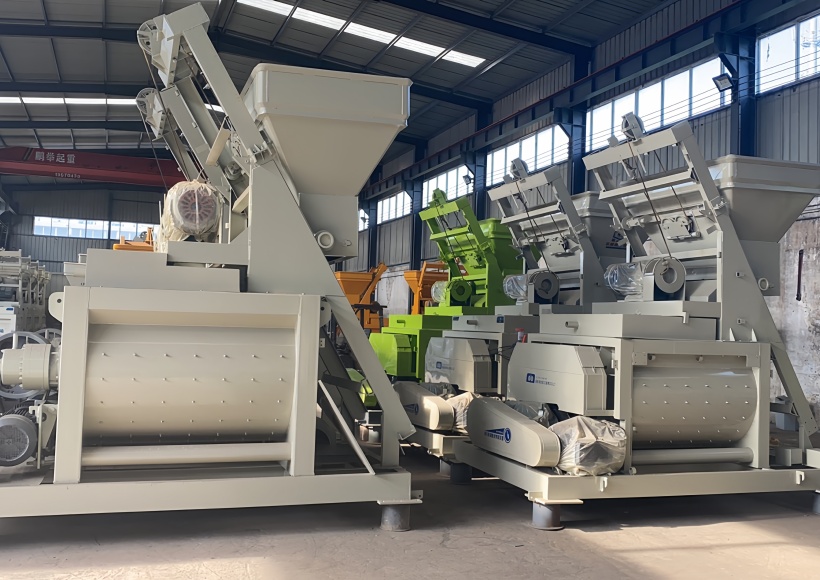
Last spring I stood in a precast yard in Langfang watching a fresh batch of C50 bridge girder concrete come out of a single shaft mixer the plant manager had just swapped in to cut capex. The first truck sampled fine. The second truck, same mix design, same water-cement ratio, came back with a 6% spread on the 28-day cube breaks – enough to put the whole pour on hold and burn two days of standby on a 90-ton gantry crane. That variance is the entire reason the single shaft vs twin shaft mixer conversation exists, and most spec sheets will not tell you why.
If you are reading this trying to write a purchase requisition for a concrete batch plant, let me save you a weekend. The real choice is not about nameplate capacity. It is about cycle time, shear profile, and how forgiving the machine is when your aggregate gradation drifts, which it will.
The Real Decision: Cycle Time and Shear, Not Nameplate
Most procurement teams open the comparison by looking at rated output in cubic meters per hour. That number is a sales fiction based on a free-flowing, low-slump, well-graded aggregate at ideal moisture. On site, your aggregate will arrive at 5% moisture on a rainy week, your sand will have a fines spike, and your cement will be 60°C off the silo. The mixer that holds its mixing time under those conditions is the one you want.
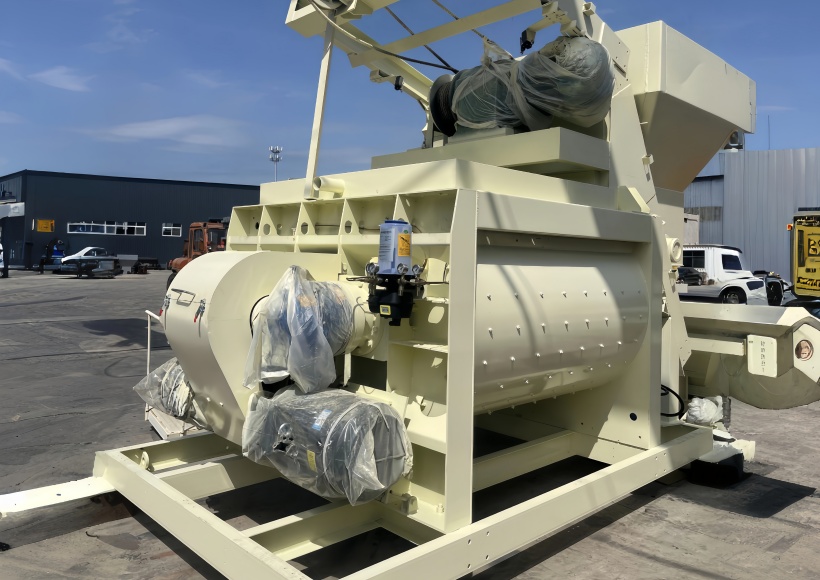
A single shaft mixer uses one horizontal shaft with mixing paddles arranged in a helical pattern inside a stationary mixer tank. The mixing action is convective – material is folded and pushed along the axis. A twin shaft mixer uses two horizontal shafts, counter-rotating, with paddles or blades that cross paths in the middle of the mixing zone. The difference is not subtle: one fluidizes and transports, the other fluidizes, transports, and shears at the intersection.
That shear zone is where high-viscosity materials, fibre-reinforced mixes, and self-compacting concrete get their homogenization. Without it, you are relying on dwell time, and dwell time kills production rates. This is not a mixer technology debate – it is a production efficiency debate. If your mix design sits in the mixer for 90 seconds to hit uniformity, you have already lost a third of your theoretical throughput.
Single Shaft Mixers: Where They Earn Their Keep?
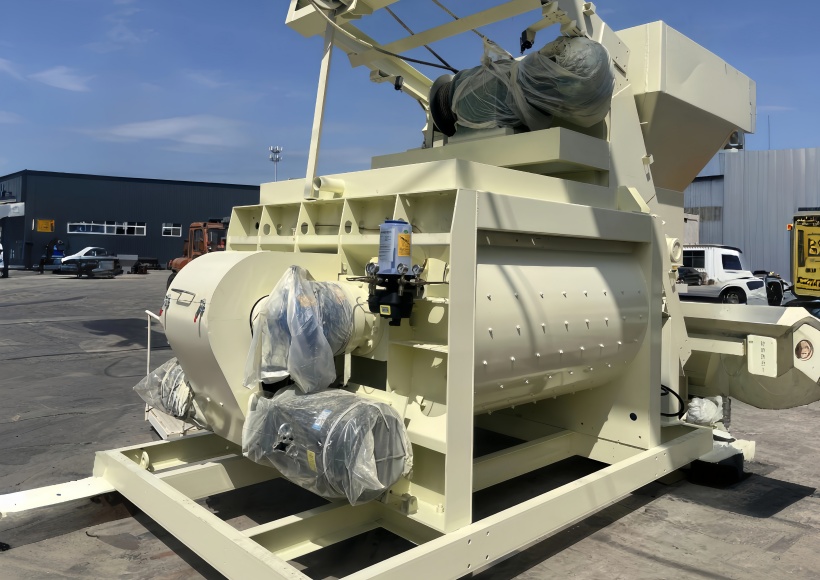
A single shaft concrete mixer is the right call when your mix design is conventional, your batch size is moderate, and your production needs do not require sub-60-second cycles. These shaft mixers are widely used in small to medium concrete batch plant operations, in precast shops turning out blocks, pipes, and pavers, and in regional ready mix concrete yards where the mixer trucks turn around in 20-minute windows, not 7-minute ones.
The honest selling points: lower initial capital, fewer wear parts, a single motor and bearing set to maintain, and a mixer tank you can weld up with a small crew when the paddles finally chew through the liner. The units ship modular, often LCL-consolidated in 20-foot containers for buyers without a gantry on site – and the field maintenance is forgiving enough that a competent mechanic can keep one running for 15 years. These mixers serve the part of the market where consistency beats throughput, and where smaller capacity is a feature, not a bug.
Where single shaft falls down: high-slump, low-water mixes with viscous admixtures; long fibre reinforcement (the paddles will ball it); and any mix where the specification demands a coefficient of variation on strength below 5%. If your client is a DOT, a nuclear facility, or a dam authority, do not. Just do not. The mixing process simply does not generate the shear to distribute fibre or viscous admixtures uniformly across the batch, and the mixture will segregate at discharge. A single shaft mixer will produce good product quality on conventional mortar and standard precast – it will not produce high-performance concrete at spec.
Twin Shaft Mixers: When You Pay for the Counter-Rotation?
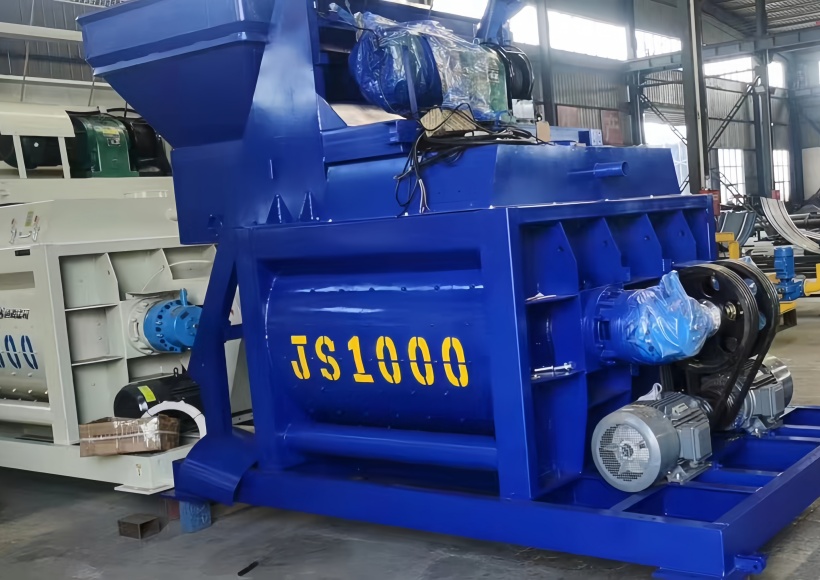
A twin shaft concrete mixer is the right call when your production capacity target is 90+ cubic meters per hour, your mix designs include SCC, RCC, UHPC, or fibre-modified blends, and your client will reject the load if the cube variance exceeds 3%. The counter-rotating shafts create a shear zone at the centre of the mixer tank where the two paddle trains cross – that intersection is doing the real homogenization work, not the convective transport along the axis.
The payoff: mixing time drops to 30 seconds for a 3 m³ batch, the mixture exits the mixer at a uniformity a single shaft would need 90+ seconds to approach, and you can run challenging aggregates – chip with high flakiness, manufactured sand with fines spikes, recycled concrete aggregate – without segregating the pour. You can produce high-quality concrete at production rates that change the economics of the plant. If you want the spec details on the twin shaft concrete mixer range, the Twin Shaft Concrete Mixer page lays out rated capacities, paddle configurations, and seal options in detail – and yes, I am biased, I have run these units in the field, but the spec sheet is the spec sheet.
The cost: a twin shaft mixer commands 1.7 to 2.2× the initial investment of a comparable single shaft unit, has two seal assemblies (and the seal is the failure-prone wear part on any shaft concrete mixer), two bearing sets, and a gear arrangement that demands proper alignment at install. Like all serious twin shaft mixer units, these ship fully assembled in 40-foot containers – which means you need a crane and a foundation designed for the dynamic load. Skip the foundation calc and you will be replacing bearings inside 18 months. I have seen the bill. It is not a conversation you want to have with finance.
Key Differences: A Side-by-Side Field View
Mixing efficiency.
Single shaft gives reliable mixing results on conventional concrete at 60-90 seconds per batch. Twin shaft hits the same uniformity at 30 seconds. For a concrete batch plant running 100 batches a day, that is the difference between 60 m³/h and 120 m³/h on the same floor footprint. Faster processing wins even when the connected load is higher.
Uniformity.
Single shaft mixes by convection; the mixture exits with a 4-7% coefficient of variation on cement content. Twin shaft mixes by convection plus shear at the counter-rotating paddle intersection; the COV drops to 1.5-3%. If you are producing high-performance concrete or self-compacting concrete, that delta is your specification margin.
Wear and maintenance.
Single shaft has one paddle train, one seal, one bearing. Manufacturer’s maintenance is straightforward, parts cost is low, and a single mechanic can handle it. Twin shaft doubles the wear items and adds a synchronized gear drive – the maintenance tasks are not harder, but they are more frequent and demand a real alignment protocol. The mixing of concrete at high shear chews liners faster on twin shaft; budget for it.
Mix flexibility.
Single shaft suits standard concrete, mortar, and moderate-viscosity precast mixes – and any site where essential equipment needs to form concrete at steady, smaller capacity rates. Twin shaft handles fibre, SCC, RCC, UHPC, high-viscosity materials, and difficult aggregates without segregating. If your plant runs various materials across the week, twin shaft is the only honest answer.
Energy consumption.
Twin shaft draws more instantaneous current but finishes the batch faster. Per cubic meter of concrete produced, twin shaft is typically 8-15% more energy efficient – faster processing saves money even when the connected load is higher.
Choosing the Right Mixer for Your Project
Selecting the right shaft concrete mixer comes down to four questions, in order:
What is the strength specification?
Anything above C50, or anything with a COV requirement below 5%, twin shaft. No negotiation.
What is the target production capacity?
Below 60 m³/h with moderate batch size, single shaft earns its keep. Above 90 m³/h, twin shaft. Between 60 and 90, you are trading initial investment against cycle time – go twin shaft if you expect to grow.
What is the mix design?
Fibre, SCC, viscous admixtures, manufactured sand with high fines – twin shaft. Conventional ready mixed concrete and standard precast – single shaft.
What does the foundation and shipping look like?
Single shaft ships modular in 20-foot containers and tolerates a lighter foundation. Twin shaft needs a 40-foot container, a crane, and a dynamic-load foundation. If your site cannot support the install, no amount of cycle-time math saves money you cannot deploy.
If you are still sizing the call, talk to the engineering desk at Tongxin Jentera – the wrong mixer is the one that does not match your production efficiency target, not the one with the lower sticker. The Twin Shaft Concrete Mixer spec page is the right second stop once you have your production numbers nailed down. Planetary mixer and pan mixer configurations sit elsewhere in the line and suit different essential-equipment niches, but for high-throughput shaft concrete production, the counter-rotating twin shaft is what actually carries the load.
Soalan Lazim
1. What is the typical mixing time for a twin shaft mixer vs a single shaft mixer?
A twin shaft mixer hits target uniformity in 30 seconds for a 3 m³ batch. A single shaft mixer needs 60-90 seconds for the same batch size and conventional mix design. For high-viscosity or fibre mixes, single shaft may not reach the target COV at all.
2. Can a single shaft mixer produce self-compacting concrete (SCC)?
Not reliably. SCC needs the shear zone the counter-rotating twin shaft paddles create. Single shaft can produce SCC on small batches with long dwell times, but the COV sits above 5% and you will fail the spec on a DOT pour.
3. How much more does a twin shaft mixer cost than a single shaft mixer?
Typically 1.7 to 2.2× the initial investment for the same rated capacity. The capex gap is recovered in 18-36 months on a plant running 80+ m³/h through faster batch cycles and the ability to price into high-spec concrete.
4. What is the failure-prone wear part on a shaft concrete mixer?
The shaft seal. A single shaft has one; a twin shaft has two. A failed seal lets cement paste into the bearing, and a failed bearing takes the shaft out of alignment. Budget for seal replacement at 8,000-12,000 hours of operation.
5. Does a twin shaft mixer need a special foundation?
Yes. The counter-rotating shafts create a dynamic load a single shaft does not. Plan for an engineered concrete pad with anchor bolts designed for the dynamic load envelope, not a static load calc. Skip this and you will be replacing bearings inside 18 months.