









If you have ever stood next to a generator when a fully loaded 2-cubic-meter twin-shaft mixer tries to start up, you know the sound. It is a deep, mechanical groan followed by the violent shudder of the alternator trying not to tear itself apart, right before the main breaker trips.
Most procurement teams calculate concrete batching plant power consumption by simply adding up the nameplate kilowatt (kW) ratings on the electrical cabinet and applying a generic diversity factor. That is exactly how you end up with a fried alternator on a remote job site in the middle of a critical continuous pour.
Calculating the energy footprint of modern concrete batching plants is not about average running loads; it is entirely about surviving the peak transients. Whether you are running a massive stationary plant or compact mobile plants, understanding the harsh realities of inrush currents, step load acceptance, and real-world mechanical friction is the only way to keep your production of concrete online.
Breaking Down the Actual Load: It’s Not Just the Mixer
When sizing your power supply, you cannot treat all specific equipment equally. A batching plant is an aggressive, asymmetrical electrical load.
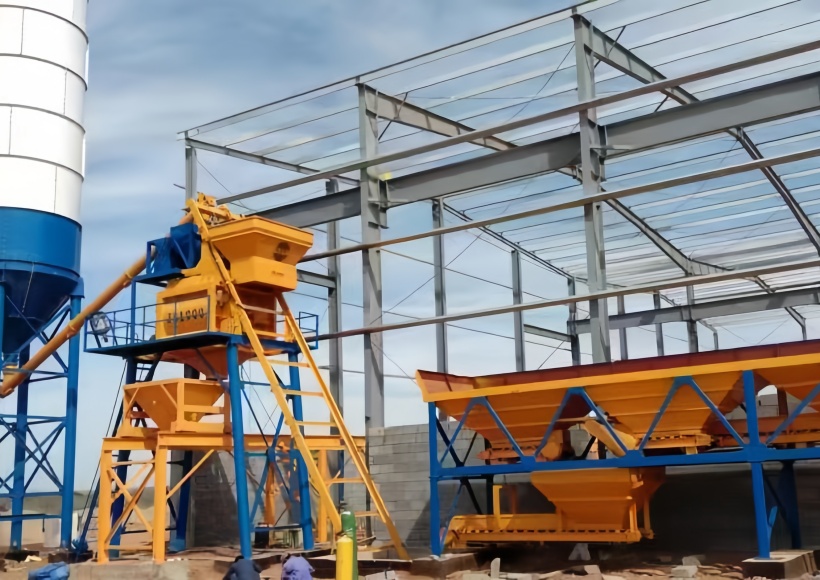
The Twin-Shaft Concrete Mixer (The Grid Killer)
The concrete mixer is the undisputed heavyweight of energy consumption. But here is the industry secret: running empty, a standard 1.5 cubic meter twin-shaft mixer draws surprisingly little power. The nightmare scenario is the “hot start”—a power failure occurs mid-batch, and you must restart the motors with two tons of wet aggregate, cement, and water sitting stagnant in the drum. If your plant requires approximately 2×30 kW for the mixer, that 60 kW running load can easily spike to 180 kW or more in apparent power (kVA) during a heavy start if you are not using Variable Frequency Drives (VFDs) or soft starters.
Material Storage & Conveyor Systems
Conveyor systems and bucket elevators for aggregate handling represent steady, continuous loads, but they are highly susceptible to environmental factors. A cold morning can turn gearbox grease to sludge. Wet aggregate increases the material weight by up to 10%, forcing the aggregate feeders and inclined belts to draw significantly higher amps just to move the same volume.
Cement Silos, Screw Conveyors, and Pneumatics
Pumping cement and admixture relies heavily on screw conveyors and air compressors. Compressors have notorious starting spikes. If your programmable logic controllers (PLCs) happen to trigger the compressor to recharge the air lines at the exact millisecond the concrete mixer powers up, your generator’s voltage will sag hard enough to drop the contactors in the control panel, causing a total plant shutdown.
The Brutal Math Behind concrete batching plant power consumption
Let us stop talking in vague terms and look at how a veteran operator calculates the per cubic meter energy requirements. You cannot just measure kilowatts (kW); you must calculate apparent power (kVA). Generators are rated in kVA, not just kW, because they have to handle the reactive power (kVAR) demanded by large induction motors.
The formula is simple: kVA = kW / Power Factor.
Most industrial motors in concrete mixing plants run at a power factor of around 0.8 to 0.85. This means a 100 kW load actually requires a 125 kVA generator just to run continuously, before factoring in any starting spikes.
If your stationary plant has a total connected load of 150 kW, you do not buy a 150 kVA generator. You do not even buy a 200 kVA generator. You analyze the starting sequence. If the automation level of your plant allows for staggered starting—meaning the control system starts the mixer first, waits 10 seconds, starts the air compressor, then the conveyors—you might survive with a 250 kVA unit. If you manually bang everything on at once, expect to need 400 kVA just to overcome the inrush current.
Top-tier manufacturers understand this electrical friction. Systems designed by ตงซิน แมชชีนเนอรี่ integrate advanced control systems that automatically stagger motor startups, significantly mitigating the initial electrical punch and allowing concrete producers to run safely on leaner, more cost-effective generators.
Sizing the Generator: Why Procurement Always Gets It Wrong
Choosing the right generator sizing for batching plants is where capital expenditure (CAPEX) usually fights operational expenditures (OPEX) and loses.
Standby vs. Prime Power Ratings
Generators have two ratings on the spec sheet. Standby power is for emergencies (running 1 hour out of 12). Prime power is for continuous, reliable operation. A generator sold cheaply as a “300 kVA” unit is often a 300 kVA Standby / 270 kVA Prime. If you push it to 300 kVA continuously for an 8-hour shift of uniform concrete production, it will overheat, the winding insulation will degrade, and you will blow the engine. Always size based on the Prime rating.
The 30% Voltage Dip Limit
When a large electric motor starts, it pulls 5 to 7 times its full load amperage (FLA). This massive current draw creates a magnetic sink that pulls down the voltage of the generator. If the voltage drops by more than 30%, the magnetic contactors in your plant’s electrical cabinet will chatter, release, and spark, welding themselves shut or shutting down the plant. Sizing the generator properly means ensuring the alternator has enough copper mass to absorb that step load without dropping below the 30% voltage threshold.
The Hidden Variables: Mix Design and Environmental Factors
Your concrete batching plant power consumption is never static. It is a living, breathing metric that reacts to what you are feeding the machine.
Mix Design Viscosity
High-strength concrete with low water-to-cement ratios (low slump) is incredibly stiff. Producing this type of high-quality concrete puts immense mechanical strain on planetary mixers and twin-shaft concrete mixers. The mixer motors will draw current near their absolute thermal limits for the entire batching time. Conversely, a highly fluid flowable fill mix acts almost like a lubricant, drastically reducing the running kW demand. Choosing the right concrete mix design isn’t just about structural integrity; it dictates your fuel burn rate per cubic meter.
Automation and Operational Discipline
An idiot-proof control system is worth its weight in diesel. Advanced automation prevents operators from overloading the aggregate weigh hopper or stopping the mixer while full. Industry-leading setups, such as those engineered by ตงซิน แมชชีนเนอรี่, use smart PLCs to monitor the real-time amperage of the mixer. If the current spikes too high due to a stiff mix, the automated batching system can momentarily pause the aggregate feed, preventing a mechanical jam and avoiding an electrical overload that would otherwise stall the power supply.
The Final Verdict on Reducing Operating Costs
Optimizing energy consumption in the construction industry is not about buying smaller cables or cheaper motors. It is about total cost of ownership. It is about understanding that a plant with VFDs on the main mixer might have higher initial installation costs, but the reduction in inrush current means you can lease a generator that is 30% smaller, saving thousands of dollars in diesel fuel and transport costs over a six-month highway project.
It is about respecting the heavy-duty nature of concrete production. Size the cables right to prevent voltage drop over long runs on-site. Clean the cement filters to reduce backpressure on the pneumatics. And never, ever size your power generation based purely on what the spreadsheet says.
คำถามที่พบบ่อย (FAQs)
1. Why does my concrete plant’s main breaker trip only during the first batch of the day?
Cold temperatures overnight cause the lubricating grease in the mixer gearboxes and conveyor bearings to thicken, dramatically increasing mechanical friction. This leads to a longer and higher inrush current duration during the first start, which can easily exceed the thermal trip curve of your circuit breaker. Installing block heaters or running a dry cycle first can prevent this downtime.
2. Can I use a standby diesel generator as the primary power source for mobile concrete batching?
You can, but it is a risky move that will void the warranty. Standby generators are engineered for limited run times during utility failures. For continuous mobile plants operating off-grid, you must use a generator rated for “Prime Power” to handle the sustained thermal loads and step-load cycling of concrete mixing plants without catastrophic engine failure.
3. Does upgrading to a Variable Frequency Drive (VFD) for the mixer reduce power consumption?
VFDs do not significantly reduce the continuous running power required to mix a cubic yard of concrete (the mechanical work remains the same). However, they drastically eliminate the massive starting current spikes (inrush). This prevents peak-demand utility charges and allows you to use a significantly smaller, more fuel-efficient generator, which indirectly leads to massive cost savings.
4. How does the choice of aggregate impact my kWh per cubic meter?
Dense, sharp-edged crushed rock requires significantly more mechanical torque to fold and mix than smooth river gravel. Additionally, if the aggregate is wet, it weighs more. Your inclined conveyor motors must work harder to pull that extra dead weight up to the waiting hoppers, increasing overall energy consumption and driving up operating costs.
5. What is the standard rule of thumb for sizing a generator for a batch plant?
While you should always run exact calculations based on motor data and starting methods (Star-Delta vs Direct-On-Line), a safe industry rule of thumb is to take the total connected load in kW of all electrical components, convert it to kVA (divide by 0.8), and multiply by 1.5 to 2.0 to handle the aggressive starting spikes of the mixer and air compressor simultaneously.