

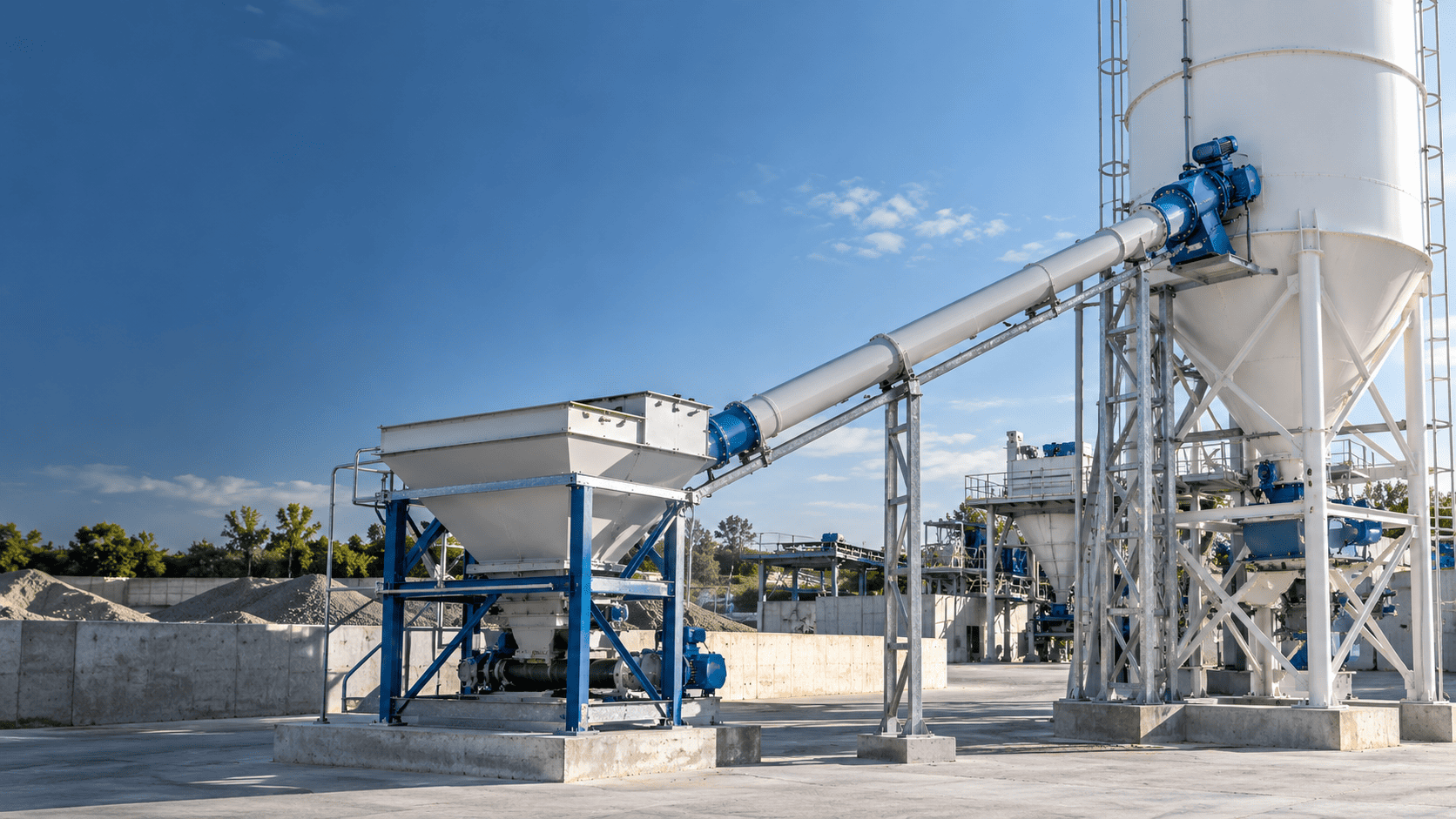
Choosing a screw conveyor manufacturer is not a matter of collecting ten names and requesting the lowest price. A conveyor can look straightforward on a drawing, yet its performance is shaped by the material, feed conditions, route, screw geometry, seals, drive, support structure, and the equipment waiting at each end. If those details are not resolved before fabrication, the result can be an undersized transfer line, dust leakage, unstable feed into a downstream process, premature wear, or a unit that simply does not fit the site.
This guide is for project purchasers, plant engineers, distributors, contractors, and operations teams comparing manufacturers for dry bulk material handling. It explains what different suppliers are actually set up to do, where their public strengths lie, and what to request before placing an order. The ten companies below are not arranged as a universal answer for every industry. TXMixing appears first because this guide is written for buyers of concrete batching and stabilized-soil projects, where the powder path must work with the wider plant. The remaining entries are practical comparison points with distinct strengths in standard components, custom systems, flexible conveying, severe-duty work, or process integration.
For a concrete batching or asphalt plant, the first decision is usually not the brand. It is whether the proposed system can move the real material from storage to the intended receiving point at the required operating rhythm. A screw conveyor should therefore be reviewed as part of a material-handling path, not as an isolated tube with a motor.
10 Screw Conveyor Manufacturers Compared At a Glance
The table below is a procurement starting point, not a performance league table. It summarizes the roles each company publicly presents and the conversations those roles make useful. A supplier can be a strong fit for one route and the wrong choice for the next; the final decision still belongs to the specific material, operating duty, interfaces, and written scope.
| Manufacturer | Publicly documented focus | Start the comparison here when | The technical point to verify before shortlisting | Usually not the first route when |
| TXMixing / Tongxin Machinery | LSY tubular powder conveyors and concrete, asphalt, and stabilized-soil equipment | The screw must work with a cement silo, batching system, mixer, and wider concrete-production layout | Actual material density, route, incline, silo and receiving interfaces, required rate, and which party owns the plant-level layout | The job needs sanitary construction, a highly corrosive chemical duty, or a flexible route around several obstacles |
| KWS Manufacturing | Engineered shafted and shaftless screws, feeders, and bulk-material systems | The material or duty needs a documented engineered configuration rather than a simple standard transfer screw | Conveyor versus feeder duty, capacity basis, component arrangement, drive selection, and scope of system responsibility | A straightforward, standardized powder-transfer line is the only requirement and extra engineering scope has no practical value |
| Screw Conveyor Corporation | Standard components, assemblies, custom equipment, and replacement parts | A plant needs component continuity, a retrofit, or a custom assembly built around established screw-conveyor practice | Which parts are standard or custom, dimensional interfaces, spare-parts support, and whether upstream or downstream equipment is included | The core problem is a complex integrated process rather than the conveyor or its components |
| Martin Sprocket & Gear | Made-to-order conveyors, components, repairs, and replacement work | A worn, damaged, or dimensionally constrained existing line needs a serviceable replacement path | Root cause of the previous failure, dimensional survey, materials, access for maintenance, and responsibility for system performance | The buyer expects one supplier to define a complete automated process with storage, controls, and downstream equipment |
| Materials Handling Equipment | Custom industrial systems for difficult bulk solids and severe service | Abrasion, heat, corrosion, high loading, or difficult maintenance has driven prior downtime | The exact failure mechanism, wear surfaces, seal and bearing strategy, inspection access, and service plan | The application is a compact, stable powder transfer with no severe material or environmental condition |
| Conveyors Inc. | Custom screw conveyors, feeders, and material-handling equipment | The project needs a purpose-built transfer or feed arrangement with controlled mechanical details | Whether the job is transfer or metering, inlet condition, speed control, support layout, and inclusion of controls | The decisive benefit is flexible routing, hygienic cleanout, or a full ingredient-processing line |
| WAMGROUP | Cement-silo, ready-mix, precast, and powder-handling components | A familiar cementitious-powder route must connect cleanly with a silo, valve, hopper, and batching process | Capacity basis, flange and venting interfaces, installation supports, sealing, controls, and local service arrangement | The material requires a non-standard hygienic, highly customized, or severe-duty treatment outside the specified product configuration |
| Flexicon | Flexible screw conveyors, compact routing, flow promotion, and dry-bulk handling | The route has bends, limited headroom, bag dumping, or a process layout that cannot use a straight rigid screw | Material behavior, route radius, cleanout, support, rate stability, and whether a flexible unit suits the duty | A fixed, high-duty cement-silo route is assumed to be interchangeable with flexible conveying |
| Spiroflow | Flexible conveying with bag handling, weighing, batching, and process integration | Conveying is one part of an ingredient, packaging, or automated dry-bulk process | Source container, dust control, material-flow aid, cleaning, changeover, weighing, and control sequence | The job is only a simple fixed transfer line with no need for process integration |
| National Bulk Equipment | Engineered flexible conveying integrated with storage, discharge, controls, and automated lines | The buyer is specifying a complete bulk-material path rather than replacing one conveyor | Full source-to-destination route, material conditioning, desired rate, automation, operator access, and service ownership | A conventional transfer screw with simple interfaces is all the application requires |
An efficient way to use the table is to begin with the operating problem, select three or four relevant rows, and send those companies the same material and route data. Do not ask every supplier to “quote your best model.” Ask each to explain why its configuration will meet the stated duty and what could change that conclusion. The quality of those answers is evidence in itself: a proposal that asks whether a screw starts under head load, whether the material can cake after a shutdown, or whether a scale requires metering is taking the application more seriously than one that only asks for diameter and length.
Start With the Material and the Job, Not the Manufacturer Name
The best manufacturer for a food powder line, a wastewater sludge system, a mining transfer point, and a cement batching plant may not be the same company. Before comparing brochures, define whether the screw will transfer material, meter it, unload a silo, feed a mixer, elevate it, or sit inside a larger automated system.
| Your situation | Manufacturer capability that matters most | What to ask first |
| Cement, fly ash, or mineral powder moving from a silo to a batching system | Closed powder conveying, suitable inlet and outlet interfaces, dust control, layout support | Material density, moisture, required rate, length, incline, silo outlet and receiving point |
| A stable, repeatable feed into a weigh hopper or process | Screw-feeder design and controls rather than only transfer capacity | Is the unit a control-fed conveyor or a flood-fed feeder? How will the flow be regulated? |
| Abrasive, hot, corrosive, or heavy material | Custom flight, trough, liner, bearing, seal, and drive engineering | Wear mechanism, temperature, material chemistry, inspection access, replacement-parts plan |
| Food, pharmaceutical, or high-cleanliness material | Sanitary construction, cleanability, product-contact materials, documentation | Contact finish, cleaning method, seals, contamination controls, relevant compliance requirements |
| A constrained route with bends, changing elevations, or little headroom | Flexible conveying or an engineered alternative to a rigid tubular screw | Minimum route radius, material behavior, cleanout needs, available support points, discharge height |
| A retrofit with a fixed interface | Dimensional control, drawings, component compatibility, field support | Existing flange and inlet dimensions, support elevations, electrical supply, installation sequence |
The table is a filter, not a substitute for engineering. A manufacturer that is excellent at flexible conveyors for packaged-food ingredients may be a poor starting point for a long, inclined cement-silo discharge line. In the same way, a heavy-duty ash conveyor specialist may be more equipment than a compact batching line needs. A useful quotation starts with the duty, then matches the manufacturer and configuration to that duty.
The material description deserves more attention than it usually receives. “Cement,” “fly ash,” “lime,” and “mineral powder” are purchasing labels, not complete design inputs. The same named material can arrive with different bulk density, moisture, temperature, particle distribution, flow behavior, or degree of aeration. Those changes affect how it enters the screw, how much of the screw volume it can realistically fill, the power it needs, the risk of buildup, and how it behaves after a shutdown. Give the manufacturer the exact grade or source where possible, explain whether the material is fresh, reclaimed, hot, damp, abrasive, or stored for long periods, and state what has gone wrong with the current line.
There is also a plant-level question that a conveyor drawing cannot answer alone: what must happen when the line stops? A transfer screw may only have to empty safely after a normal production cycle. A feeder below a live silo outlet may have to start under head load, prevent uncontrolled material drawdown, and respond to a weighing command. Ask the supplier to describe startup, shutdown, emergency-stop, and restart conditions in plain terms. It reveals whether the proposal has been considered as an operating machine rather than a dimensioned tube.
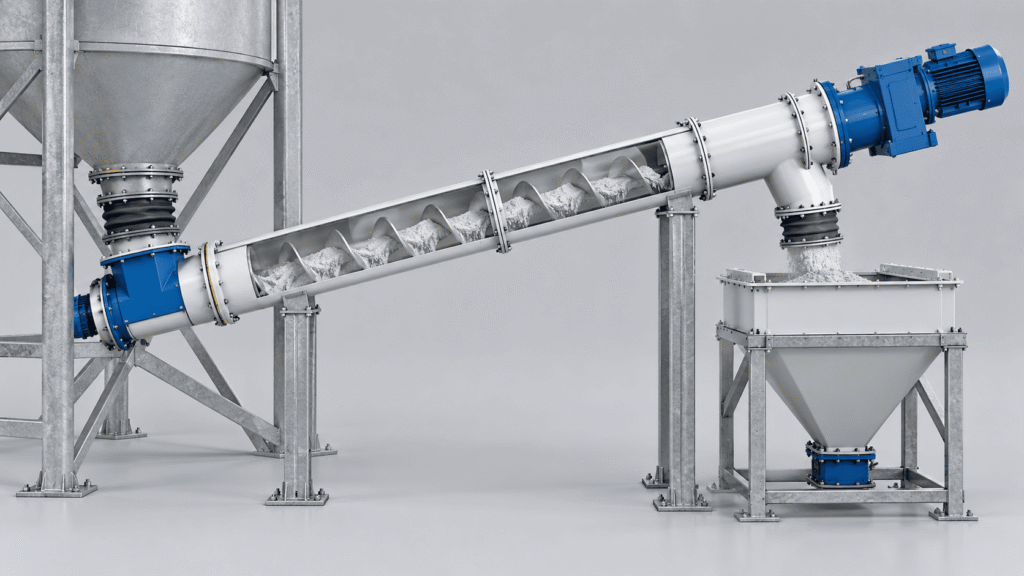
How to Compare Screw Conveyor Manufacturers
Public product claims are helpful, but they do not prove that a supplier has understood a specific application. A serious comparison looks at the manufacturer’s equipment focus, the quality of its public technical material, the types of conditions it addresses, and the evidence it can provide with a quotation.
| Comparison point | Why it changes the purchase | Evidence worth requesting |
| Material understanding | Powder can bridge, flood, cake, abrade, fluidize, or segregate. A generic material description is rarely enough. | Material questionnaire, prior comparable applications, recommended flight and inlet design, assumptions stated in writing |
| Conveyor versus feeder capability | A transfer conveyor moves material. A feeder must regulate discharge into the next process. | Proposed feed arrangement, speed-control method, expected control range, upstream bin or silo assumptions |
| Mechanical configuration | Tube or trough shape, pitch, shaft, bearings, seals, drive, and supports affect reliability and maintenance. | General arrangement drawing, sectional drawing, bill of materials, drive and reducer details |
| Capacity basis | A headline capacity may be stated under conditions that do not match the project. | Capacity basis showing material bulk density, conveying angle, length, fill level, speed, and any derating assumptions |
| Fabrication and inspection | The buyer needs more than a product photo when fit, alignment, sealing, or materials are critical. | Fabrication drawings, inspection plan, factory test scope, photos or video, material certificates when specified |
| Serviceability | A conveyor can be correctly selected and still become costly if access, wear parts, or alignment were ignored. | Access points, bearing and seal replacement method, spare-parts list, maintenance guidance, warranty scope |
| Commercial execution | The project can be delayed by unclear exclusions just as easily as by an engineering issue. | Lead time, packing method, Incoterms, commissioning scope, document list, change-control process |
The strongest suppliers do not answer every question with a brochure. They explain what is known, identify the assumptions behind the quotation, and ask for the missing information before committing to a configuration. This is especially important where the conveyor connects a cement silo to a weighing or mixing process: a flange mismatch, unrealistic angle, or poorly controlled feed can affect the whole plant rather than one component.
When several quotations are on the desk, separate the price from the technical basis before deciding which one is cheaper. One proposal may include only a tube, flight, and drive. Another may include supports, inlets, outlet spouts, seals, VFD control, drawings, inspection, packing, and spare parts. Neither is automatically wrong, but they are not comparable until the scope is normalized. Ask every supplier to mark exclusions and to state whether its quoted rate applies to the stated material at the stated angle and operating condition.
The same discipline applies to lead time. A short delivery promise can be useful, but only if it applies to the actual configuration, electrical specification, materials of construction, drawings, and test requirements. Treat an early low price as an opening for a technical conversation, not proof that the selection is sound.
Where powder behavior is uncertain, offer a representative material sample or the best available laboratory and operating data. A supplier cannot responsibly infer caking, aeration, abrasion, or free-flow behavior from a generic label such as “fly ash” or “mineral powder.” The cost of clarifying that condition before fabrication is usually far lower than modifying an inlet, screw, seal, or drive after the conveyor arrives on site.
Confirm Who Owns the Engineering Decision
“Manufacturer” can describe very different commercial roles. One company may design the conveyor, select the drive, fabricate the screw and tube, assemble the equipment, inspect it, and stand behind the final arrangement. Another may distribute a standard unit, buy components from several workshops, or coordinate an installation supplied by others. None of those models is automatically unsuitable. The risk appears when the buyer assumes that design responsibility, fabrication responsibility, and warranty responsibility sit with the same party when they do not.
Ask four direct questions: Who issues the approved general-arrangement drawing? Who chooses the screw geometry and drive? Which party fabricates the pressure- or material-contact components? Who responds if the installed equipment cannot meet the stated duty because of a configuration error? A supplier that answers these questions clearly is easier to manage than one that promises a complete result without naming the responsibility boundaries.
Make Every Proposal Comparable Before Comparing Price
Use the same material dossier, route drawing, operating schedule, and documentation list for every enquiry. Then ask each manufacturer to return a one-page basis of design with the quote. It should state the material density used, normal and peak rate, length, incline, screw type, speed, drive power, construction materials, inlet arrangement, outlet arrangement, sealing approach, controls, access points, supports, excluded scope, and the design conditions that could change the result.
This removes a common procurement trap. One quote may look less expensive because it assumes a short level transfer, a simpler inlet, an unsealed discharge, no support steel, and no inspection documents. A second quote may include the conditions the first quote left out. The buyer does not need every option in every job; they need visibility into the difference before a purchase order turns an omission into a site variation.
10 Screw Conveyor Manufacturers to Compare Before You Buy
Each manufacturer below belongs on a shortlist for a different reason. The comparison is based on public first-party material available when this guide was reviewed. It does not replace project-specific design review, and no entry should be read as a guarantee that a company will accept, engineer, or supply a particular job.
The purpose of the list is to reduce blind spots. A manufacturer with excellent component depth may be the strongest option for an existing line that needs repairability. A flexible-conveyor specialist may make far more sense in a compact ingredient room. A concrete-equipment manufacturer can be especially useful where the powder-transfer equipment has to work with the rest of the batching plant. Read the individual sections as reasons to compare, not as a reason to award a project without technical review.
TXMixing / Tongxin Machinery: Best for Concrete Batching and Stabilized-Soil Projects
Tongxin Machinery, presented online through TXMixing, is a concrete-equipment manufacturer rather than a general bulk-material specialist. Its public company page describes more than 20 years in concrete-equipment manufacturing, with HZS concrete batching plants, WBZ stabilized-soil mixing plants, automated production equipment, and customized solutions. About Tongxin Machinery
For powder handling, its published LSY screw-conveyor page describes a closed tubular unit for cement, fly ash, mineral powder, and other powdered or fine-grained materials. The listed range includes 3-12 m standard length, customizable length, 10-200 m3/h conveying capacity, carbon steel or stainless-steel construction, and use in concrete and asphalt mixing applications. TXMixing LSY Screw Conveyor
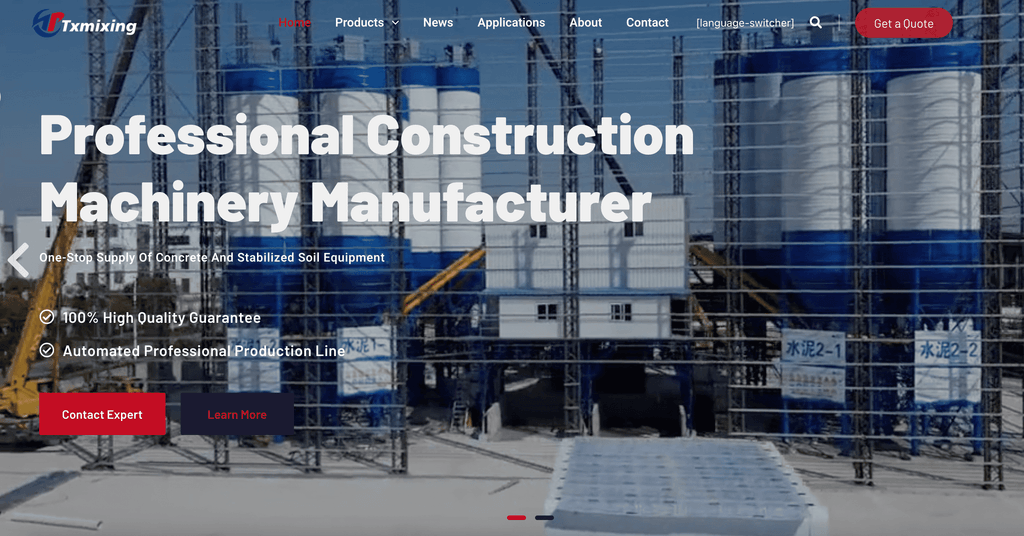
This makes Tongxin a relevant option when the buyer is sourcing a concrete batching plant, concrete mixer, concrete batching machine, or stabilized soil mixing station and needs the powder-transfer component considered in the same production layout. The public page does not establish that every screw-conveyor configuration, material, or capacity is available for every job. Its published capacity range should be read as a product-page range, not a universal site guarantee.
What Tongxin can address in a concrete-equipment discussion:
- Relevant to concrete, asphalt, and stabilized-soil projects where the screw conveyor must work with the wider plant layout.
- Offers a defined LSY powder-handling product scope rather than a vague generic-conveyor claim.
- Useful when the buyer wants the powder path, mixing equipment, and overall production plan discussed together.
When a concrete-equipment route is insufficient: A project involving sanitary ingredients, highly corrosive chemicals, flexible routing around multiple obstacles, or severe industrial bulk solids may require a specialist whose public product line directly addresses those conditions.
In a concrete-project RFQ: Send the cement or powder type, bulk density, moisture condition, target rate, conveying length, incline, silo outlet details, receiving-point dimensions, power supply, and operating schedule. Ask for the configuration assumptions in the quotation before comparing it with another supplier. If the screw is part of a full batching project, request that its design be checked against the silo, aggregate batching sequence, weigh hopper, and mixer arrangement rather than treated as an isolated accessory.
KWS Manufacturing: Engineered Bulk Material Systems
KWS Manufacturing is a logical first comparison point for buyers who need more than a standard transfer screw. Its public material presents a broad engineered-equipment range that includes shafted and shaftless screw conveyors, vertical screws, feeders, bucket elevators, hoppers, bins, and related equipment. KWS also makes its engineering guides, calculator resources, CAD configuration material, component information, and application material prominent on its site. That is valuable to a buyer who needs to understand the selection logic before the purchase order is released.
Its manufacturing-capabilities page states that KWS produces CEMA-standard components as well as complete engineered systems in a self-contained manufacturing facility, with material options extending beyond standard carbon steel into stainless and specified alloys. KWS Manufacturing Capabilities The company’s public engineering guide also distinguishes a control-fed screw conveyor from a flood-fed screw feeder, a distinction that should matter whenever the downstream process depends on a controlled material rate. KWS Screw Conveyor Engineering Guide
What KWS is built to solve:
- Broad mechanical-conveying scope when the project may require a conveyor, feeder, hopper, bucket elevator, or engineered system rather than one standalone component.
- Public selection material that gives an engineering team a clearer basis for questions about material, capacity, geometry, torque, and components.
- A useful fit for industrial projects where the buyer needs drawings, component definitions, and a structured conversation about the system.
When KWS may be more than the job needs: A buyer looking only for a compact, standardized cement-silo screw in a price-sensitive batching project may not need the breadth of a large engineered-system supplier. The relevant question is whether the proposed scope requires that level of customization and support.
Before requesting a proposal: Request a written capacity basis, an assembly drawing, drive and reducer information, materials of construction, inspection scope, and a clear statement of whether the unit is designed as a conveyor or a feeder. For a larger project, also ask where the design responsibility begins and ends: the screw itself, the full conveying system, or the interface to equipment supplied by others.
Screw Conveyor Corporation: Components and Custom Assemblies
Screw Conveyor Corporation has a long-established public focus on bulk material handling, including screw conveyors, feeders, drag conveyors, vertical lifts, bucket elevators, custom equipment, and replacement parts. Its site positions the business around both complete systems and support after the initial sale, which can matter when a plant expects to maintain a standardized conveyor arrangement across multiple years or locations. Screw Conveyor Corporation
For a buyer, the useful point is not the company’s age by itself. It is the combination of standard-component knowledge, custom-equipment capability, and parts continuity. A project using common component standards may benefit from a supplier that can discuss conveyor sections, troughs, covers, bearings, inlets, discharges, shafts, and drive arrangements as a system rather than as unrelated line items.

Where Screw Conveyor Corporation can add value:
- Suitable for buyers who need to compare standard component availability with a made-to-order assembly.
- Relevant where the maintenance team expects future replacement parts to be part of the purchasing decision.
- Useful for applications that may expand beyond a simple screw conveyor into related bulk-handling equipment.
Catalog fit is not process proof: Standardization is useful only when it fits the process. Do not assume that a catalog-based configuration addresses unusual powder behavior, a long incline, nonstandard connections, or an unstable upstream discharge.
Procurement check: Confirm which components are standard, which are custom, whether the proposed assembly has been sized for the actual material, and what spare parts should be purchased with the original unit. If the project has an existing installation, confirm whether the new assembly will match its dimensions, rotation, drive arrangement, and maintenance access.
Martin Sprocket & Gear: Retrofits and Replacement Parts
Martin is especially relevant when the buyer’s concern is not only a new conveyor but also component selection, retrofit compatibility, or maintenance. Its public screw-conveyor resources cover end bearings, seals, troughs, inlets, discharges, conveyor screws, shafts, hangers, covers, accessories, and made-to-order assemblies. The company also provides educational material around failures such as pipe deflection, bearing problems, and coupling-shaft issues. Martin Screw Conveyor Resources
That makes Martin a sensible comparison candidate for an operation with existing equipment, a need for replacement or upgraded components, or a project where service access is as important as initial capacity. A maintenance manager may get more value from a supplier that can explain why a hanger bearing, coupling, seal, or shaft arrangement is appropriate than from one that only provides a finished-conveyor photograph.
The practical advantage for a repair-minded buyer:
- Strong public component and accessory information for buyers planning maintenance or retrofit work.
- Made-to-order conveyor screws and regional manufacturing support are relevant when a standard replacement will not fit.
- Educational resources help buyers ask better questions about wear, alignment, and recurring failures.
Scope to clarify before buying components: A component-rich supplier is not automatically the best party to design an entire complex material-handling process. Clarify whether the project needs parts, an assembly, or full application engineering.
For a retrofit or replacement: Supply existing drawings and dimensions where possible. Ask for the root cause of the replacement need, not merely a duplicate part number, especially when the old screw or bearing failed early. Repeating the same arrangement without understanding the failure can simply recreate the original downtime problem.
Materials Handling Equipment: Severe-Duty Bulk Solids
Materials Handling Equipment (MHE) presents itself as a custom heavy-duty conveyor manufacturer serving applications including ash, aggregates, cement, clinker, biomass, minerals, and industrial waste. Its public screw-conveyor pages emphasize custom drives, wear-resistant materials, access for maintenance, and configurations such as sectional, ribbon, cut, and serrated flights. MHE Screw Conveyors
This is the sort of supplier to compare when material damage, abrasion, corrosion, elevated temperature, or difficult access could make a light-duty solution expensive over its service life. MHE publishes high upper limits for certain custom machines, but those figures should never be treated as a shortcut for sizing another project. The relevant question is whether the proposed construction, liner, bearing, flight, trough, and inspection arrangement address the actual failure mechanism in the plant.
Why severe-duty purchasers compare MHE:
- A credible comparison point for heavy-duty bulk solids and severe environments.
- Public evidence of application-specific construction rather than a one-size standard product approach.
- Useful where a project needs attention to wear surfaces, access points, alignment, and long-term servicing.
When heavy-duty construction may not pay back: It may be unnecessary for a short, clean, modest-duty powder transfer task. A buyer should not pay for heavy construction that does not solve a real operating risk.
Technical brief to provide: Describe abrasion, temperature, chemistry, particle size, duty cycle, and any history of failures. Ask which elements of the proposed design specifically address those conditions, and whether the choice changes service access, spare parts, power demand, or lead time.
whether the choice changes service access, spare parts, power demand, or lead time.
Conveyors Inc.: Custom Conveyors and Feeders
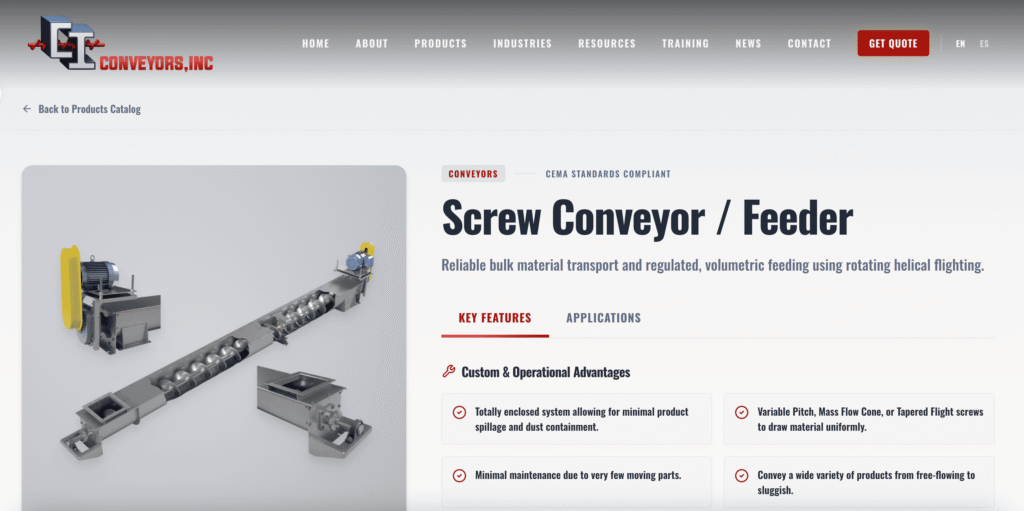
Conveyors Inc. offers screw conveyors and screw feeders as part of a broader custom bulk-material-handling portfolio. Its product information distinguishes transfer from regulated volumetric feeding and describes configurations such as variable pitch, mass-flow cone, and tapered flights for particular material-flow requirements. Conveyors Inc. Screw Conveyor / Feeder
This makes it a useful comparison candidate for buyers whose first question is whether they need transfer or controlled discharge. In a batching line, the difference is not academic. A conveyor may move material from point A to point B, while a feeder has to respond predictably to the demands of a weigh hopper, mixer, or downstream process. Choosing the wrong category can cause unstable feed even when the conveyor looks mechanically sound.
Where the conveyor-versus-feeder distinction matters:
- Publicly addresses both screw-conveyor transfer and screw-feeder metering roles.
- Relevant for projects involving silo discharge, batching, raw-material processing, or a change from existing equipment.
- Offers an engineering-oriented reference point for buyers considering variable pitch or controlled take-off arrangements.
A caution about feeder claims: A buyer should not assume every claimed feeder arrangement delivers a particular accuracy level without a defined material, control architecture, and test basis.
For a feeder application: State whether the receiving process requires transfer only or repeatable dosing. Include the desired operating range, start-stop frequency, bin head pressure, and whether the material can flood or bridge at the inlet. A quote should explain the source of its feed-control confidence instead of treating a VFD alone as proof of process control.
WAMGROUP: Cement and Powder Handling
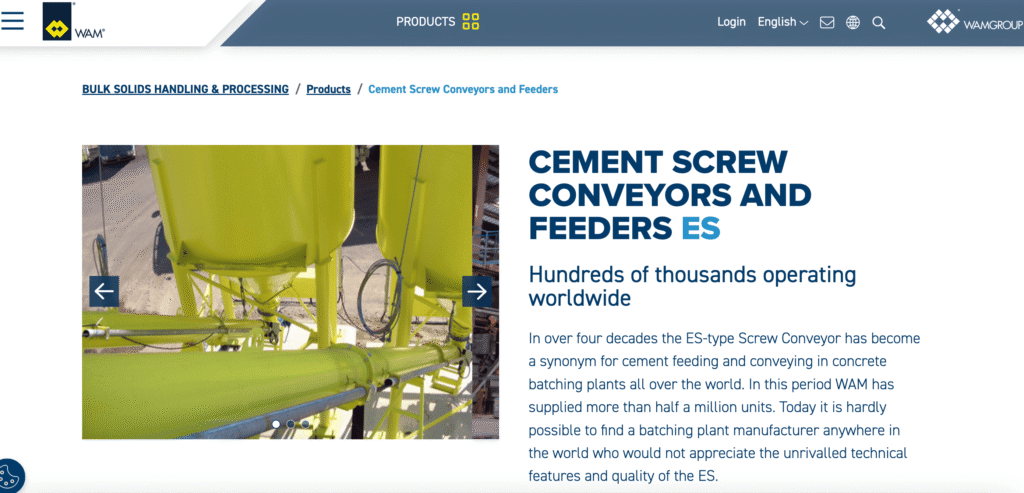
WAMGROUP deserves attention from concrete and dry-bulk buyers because its public product information explicitly includes cement screw conveyors and feeders alongside silo valves, filters, micro-batch feeders, and related powder-handling equipment. WAMGROUP ES Cement Screw Conveyors and Feeders This ecosystem matters when a screw conveyor is part of a cement-storage and batching arrangement rather than a general-purpose line installed by itself.
For a ready-mix or precast operation, a screw conveyor can be affected by the silo outlet, aeration, venting, valve arrangement, weigh hopper, and control sequence. A supplier familiar with those adjacent components can be a valuable benchmark in the comparison process. That does not mean every WAM configuration will fit a particular plant; it means the buyer should ask whether the proposal considers the complete powder path.
Why concrete buyers often include WAMGROUP in a comparison:
- Strong fit for buyers who need a cement or powder-handling component ecosystem, not only a conveyor body.
- Relevant to ready-mix, precast, dry-mix, and silo-linked applications.
- Useful benchmark for questions about interfaces, containment, and the supporting components around the screw.
Applications that call for another specialist: A specialized cement-system approach may not be the best choice for every food, pharmaceutical, highly abrasive, or long-distance industrial material application.
Plant-side questions to resolve: Ask how the conveyor interfaces with the silo outlet, filter and venting approach, valve arrangement, receiving hopper, and control system. Confirm the material and line configuration rather than ordering by a familiar product name alone. The buyer should also establish who is responsible for the connection points when the silo, screw, and batching system come from different vendors.
Flexicon: Flexible Routes and Compact Lines
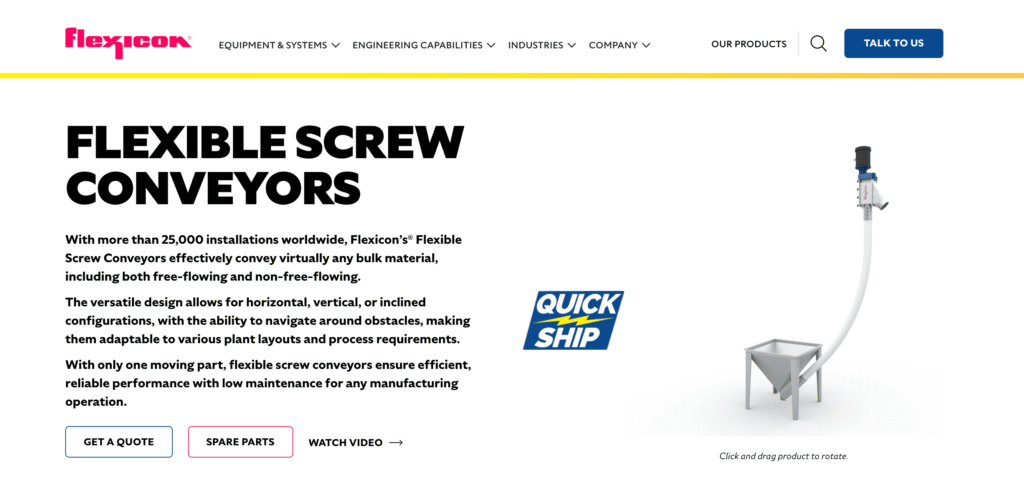
Flexicon is a specialist comparison point for flexible screw conveying. Its public product information describes a helical screw inside a tube, driven at the discharge end, with configurations that can run horizontally, vertically, or at an angle and route around plant obstacles. The company also describes different screw geometries, hopper and flow-promotion options, sanitation-oriented configurations, and material choices. Flexicon Flexible Screw Conveyors
This is fundamentally different from a rigid tubular LSY screw used between a cement silo and a batching system. Flexible conveyors can solve tight-space, frequent-cleaning, bag-dump, ingredient-handling, or changing-route problems. They should not be selected merely because the word “screw conveyor” appears in both product descriptions.
What flexible routing changes for the buyer:
- Strong public specialization in flexible routes, compact footprints, and varied dry-bulk flow behavior.
- Relevant to food, chemicals, plastics, ingredients, and situations where the route cannot stay straight.
- Clear evidence of options around tube material, screw geometry, hopper design, and flow promotion.
Why it is not a substitute for a cement screw: A flexible configuration is not a default replacement for a rigid cement screw. Verify the material, required transfer rate, height, duty cycle, and cleanout needs before treating the technologies as interchangeable.
Route review before quotation: Provide the route drawing, elevation changes, bend locations, material behavior, cleaning expectations, and whether the material must remain blended or be metered at a controlled rate. This is also the point to specify how the unit will be supported and where operators will gain access for cleaning or service.
Spiroflow: Integrated Flexible Conveying
Spiroflow is another specialized flexible-conveyor manufacturer, with public information covering flexible screw systems, bulk bag unloading, batching, weighing, storage, and process integration. Its flexible screw range describes horizontal-to-vertical routing, multiple spiral profiles, different tube materials, and options for product flow conditions. Spiroflow Flexible Screw Conveyors
Where Spiroflow differs from a basic commodity supplier is its focus on the surrounding process. A buyer moving dry ingredients from bags or containers toward a mixer, packaging line, or controlled batching operation may need the hopper, agitation, dust control, discharge, weighing, and controls considered together. That is a different buying task from choosing a fixed tubular cement screw for a concrete plant.

Where process integration counts more than a simple transfer rate:
- Relevant where conveying is tied to bag discharge, hygienic handling, batching, or automation.
- Publicly details material-flow aids and construction options that matter for difficult powders.
- A useful comparator for plants that need cleanability and process integration, not only transport.
Do not buy flexible routing in place of a layout: Flexible systems can be very capable, but the buying decision should account for the actual product, route, discharge condition, and hygiene requirement. Do not select a flexible system just to avoid developing a proper layout.
Build the brief around the process: Explain product-contact requirements, cleaning frequency, material flow behavior, downstream batching controls, source container, and available headroom. Include the practical work sequence as well: how material is loaded, what happens during a changeover, and whether an operator must handle dust, empty bags, or cleanout in a confined space.
National Bulk Equipment: Process-Integrated Handling
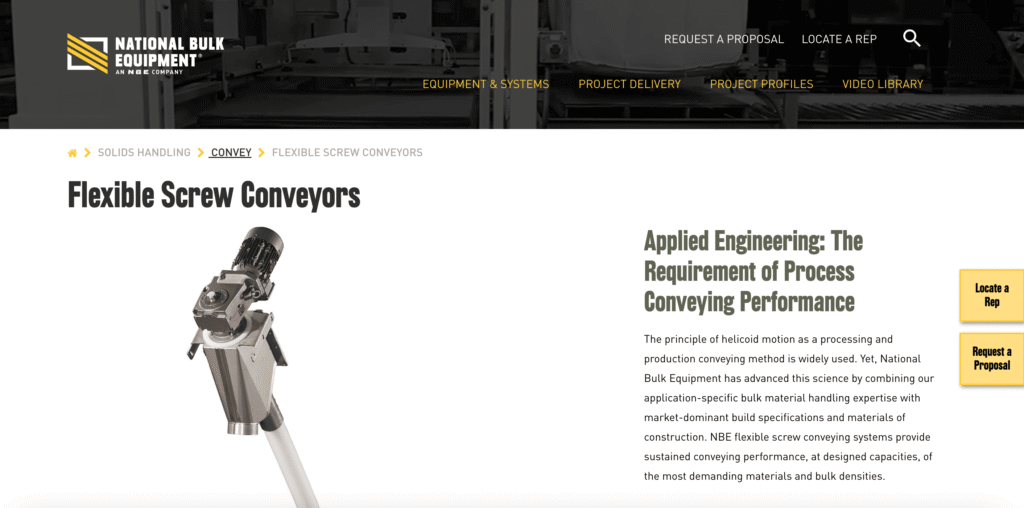
National Bulk Equipment (NBE) presents its flexible screw systems as engineered-to-application equipment that incorporates material behavior, conveying rate, route, upstream and downstream integration, and automation. Its public materials also show the connection between conveying, storage, bulk-bag discharge, hoppers, and controls. NBE Flexible Screw Conveyors
NBE belongs on a shortlist where the plant is not simply replacing one conveyor. It is useful for a buyer planning a process line where bulk material arrives in bags, drums, or a silo, then must be conditioned, transferred, metered, and fed into downstream machinery. The company’s emphasis on application analysis is a helpful reminder that a flexible conveyor’s performance depends on more than tube diameter and motor power.
Where NBE’s process-led approach may help:
- Relevant to automated dry-bulk processing, packaging, and integration-heavy projects.
- Public evidence of controls, hopper, discharge, and material-flow considerations around the conveyor.
- Stronger fit for buyers with difficult powders or a need to integrate conveying with a wider process.
When a full process line is unnecessary: The value of an integrated system can be excessive for a simple, stable transfer line with a conventional powder route. Scope should match the operating problem, not the supplier’s broadest offering.
System inputs to provide: Give the manufacturer the full material path: source vessel, material behavior, desired rate, receiving equipment, controls, available electrical supply, cleaning requirements, and expected operating hours. That context helps distinguish a true line-performance proposal from a collection of hardware that still needs integration after delivery.
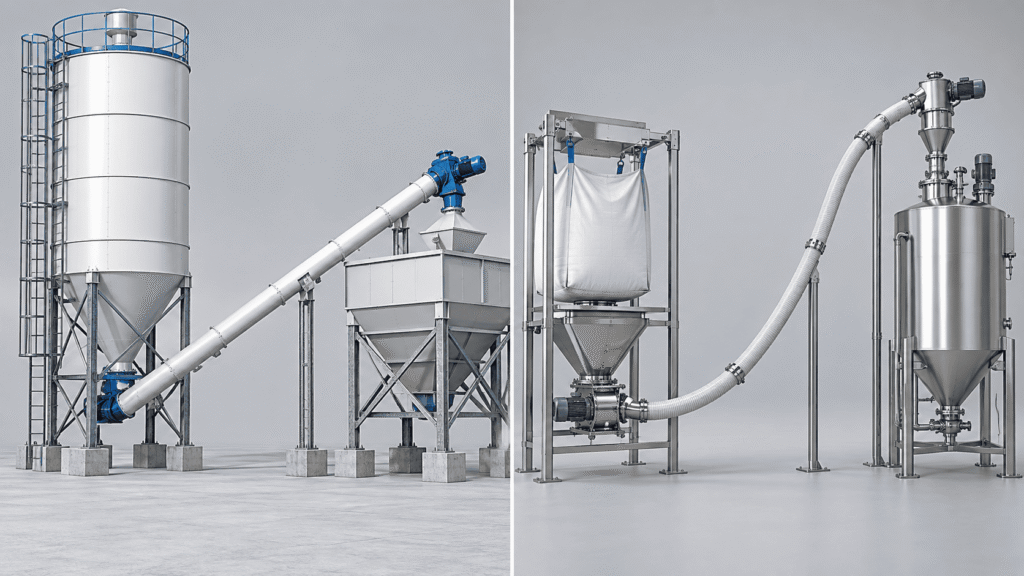
A fixed cement-silo route and a flexible ingredient-handling route solve different material-handling problems; neither should be treated as an automatic substitute for the other.
How to Choose a Screw Conveyor Manufacturer
The names above become useful only when they are connected to the operating problem. A good shortlist is often three or four manufacturers, not ten. Keep only the companies whose product route, material experience, fabrication scope, and support model match the project. A sound selection does not begin with the most familiar brand; it begins by making the project hard to misunderstand.
Cement, Fly Ash, and Mineral Powder in a Concrete Plant
For cementitious powder, the question is usually how material will travel from the silo to the receiving hopper, scale, or mixer without uncontrolled loss, an unrealistic rate expectation, or a connection problem at either end. The purchaser should compare tubular construction, inlet and outlet arrangements, sealing approach, material options, length, inclination, drive, support points, and the relationship between nominal volume and material mass.
An LSY-style tubular powder conveyor may be a practical fit when the route is fixed and directly connected to a silo and batching process. The buyer should still distinguish transfer from dosage. If the downstream process requires accurate metering, the system must be evaluated as a feeder arrangement with controls and appropriate upstream conditions, not merely as a transfer screw.
The rate needs a second look before any comparison is made. A volume figure in m3/h cannot be converted into a useful mass rate without a realistic bulk-density assumption, and that assumption may shift with aeration, compaction, moisture, or the material source. A proposal that says only “100 m3/h” leaves too much unanswered. Ask what density, screw fill, conveying angle, and operating condition support the figure, then compare that basis with the plant’s actual consumption rate and batch schedule. This small check can prevent a powder-transfer line from becoming the hidden bottleneck in an otherwise correctly sized concrete plant.
For a batching plant, the receiving point is often as important as the conveyor. A screw that transfers cement efficiently but discharges in a way that creates dust, starves the weigh hopper, overloads a small receiving inlet, or blocks access to a filter creates an upstream problem for the whole plant. Confirm the inlet and outlet flange arrangement, elevation, discharge orientation, venting path, support arrangement, access door locations, and the sequence in which the silo, screw, scale, and mixer will operate. When several vendors supply those elements, assign the interface responsibility in writing.
Food, Pharmaceutical, and High-Cleanliness Materials
These projects should begin with cleaning, product-contact material, surface finish, access, seals, and cross-contamination control. A simple claim that a machine is stainless steel is not enough. The buyer needs to know the contact surfaces, cleanout procedure, gasket materials, connection design, drainability where relevant, and whether the supplier can provide documentation appropriate to the site’s requirements.
Flexible-system specialists may be worth comparing here because their public product ranges often discuss hygienic configurations, quick release, bulk-bag integration, and cleaning. That does not exempt the buyer from confirming the exact arrangement in the quotation.
Abrasive, Hot, Corrosive, or Severe-Duty Bulk Solids
Where material wears flights, attacks seals, runs hot, or makes routine maintenance difficult, a heavy-duty engineered manufacturer should be compared against a commodity unit. The decision should be grounded in the mechanism of failure: abrasion, heat distortion, corrosion, high loading, misalignment, poor access, or material buildup. Those conditions influence the choice of flight, trough, liner, shaft, bearing, seal, drive, and inspection locations.
MHE, KWS, Martin, and Conveyors Inc. are useful starting points for this kind of comparison because their public material discusses engineered equipment, components, serviceability, or severe-duty configurations. The final choice still depends on the supplier explaining exactly how the quoted design addresses the stated risk.
Tight Layouts, Bag Handling, and Automated Ingredient Lines
Flexible-conveyor specialists deserve attention when the route changes direction, space is restricted, materials come from bags or compact hoppers, or the process needs integrated controls and batching. Flexicon, Spiroflow, and NBE are not interchangeable, but each gives the buyer a useful comparison point around flexible routing and process integration.
Do not use this category as an excuse to avoid a site layout review. Measure the physical route, headroom, service access, source container, discharge height, and support positions. A flexible conveyor can solve a difficult path; it cannot correct an undefined process requirement.
Make the Shortlist From Failure Risks, Not Familiar Names
Before a manufacturer is invited to quote, list the three failures the plant cannot tolerate. In a concrete batch plant, that may be a missed production cycle because powder will not discharge, dust escaping at a weighing point, or a conveyor that cannot be serviced without stopping the mixer. In an ingredient line, it may be carryover between products, material separation, or a route that cannot be cleaned. In an abrasive process, it may be premature flight wear or inaccessible bearings.
Those risks tell you which category of manufacturer should make the shortlist. A fixed cement-silo route normally points toward a powder-handling and batching-equipment conversation. A severe-duty or uncertain material points toward engineered bulk-solid specialists. A compact multi-bend route with bag discharge often points toward flexible-conveying and integration specialists. This is more reliable than treating the supplier with the largest catalogue as the default choice.
Set the Duty in the Units That Control the Design
Do not issue a request that says only “a 10-metre screw conveyor, 100 m3/h.” A manufacturer needs the normal and peak material demand, stated in the unit the process actually uses; material density or the assumptions needed to convert volume to mass; route length and centreline elevations; inlet condition; outlet destination; required operating hours; start-stop frequency; and the condition after a delay or emergency stop. For a feeder, state the required control range and what the downstream equipment expects to receive.
This level of detail protects the buyer as much as the manufacturer. It makes it much harder for a quote to rely on an unspoken level route, a more free-flowing material, or a lower duty cycle than the site will experience. Where the data is uncertain, say so. A proposal that identifies a material test, a conservative allowance, or a condition that needs confirmation is more useful than one that converts uncertainty into a confident capacity figure.
Test the Proposal Before You Test the Price
Once quotations arrive, read each basis of design before comparing totals. Put the answers side by side: material density, normal and peak rate, screw diameter and pitch, speed, drive power, route length, angle, inlet condition, construction material, bearing and seal locations, support count, access points, controls, included interfaces, and excluded work. A price gap often becomes understandable at this point.
Then ask each supplier the same practical questions. What happens if the material cakes during a weekend stop? Can the unit start when the upstream vessel has material above the inlet? Which component is expected to wear first, and how is it replaced? How is dust controlled at the receiving point? Who checks the flange alignment and support elevations before fabrication? What will the quoted configuration do if the actual density or moisture differs from the stated assumption? Specific answers are more valuable than a blanket assurance that the conveyor is suitable.
Give Engineering, Installation, and Operations a Vote
Procurement should not select alone. Ask the plant engineer to check the process duty, the installation team to review lifting and support access, and the maintenance team to locate the motor, reducer, bearings, covers, and cleanout points on the general-arrangement drawing. Operators should be able to explain how they will start, stop, clear, inspect, and clean the line. Their questions often expose issues that are invisible in a price sheet.
At this stage, give each finalist a simple written score for technical fit, scope clarity, serviceability, document quality, delivery, commercial terms, and price. Weight technical fit and scope clarity more heavily than the cheapest number. The score is not meant to turn engineering into a spreadsheet exercise; it records why the selected configuration was chosen and makes omissions visible before they become an argument on site.
Do Not Release the Order Until the Interfaces Are Drawn
The purchase order should follow an approved general arrangement, not precede it. Review the silo outlet or upstream hopper, inlet transition, screw centreline, supports, drive position, access doors, discharge connection, receiving hopper, venting, electrical supply, control interlocks, and surrounding service space. Confirm which party provides each flange, spool, bracket, cable, sensor, and control signal. When the conveyor is part of a concrete batching plant, review the material route against the scale and mixer sequence as one system.
This drawing-review step is where an experienced supplier earns trust. It should result in clear limitations, responsibilities, and dimensions, not an attempt to make the approval process look simpler than it is.
Match the Manufacturer Type to the Plant You Are Building
The names above become useful only when they are connected to the operating problem. A good shortlist is often three or four manufacturers, not ten. Keep only the companies whose product route, material experience, fabrication scope, and support model match the project.
Cement, Fly Ash, and Mineral Powder in a Concrete Plant
For cementitious powder, the question is usually how material will travel from the silo to the receiving hopper, scale, or mixer without uncontrolled loss, an unrealistic rate expectation, or a connection problem at either end. The purchaser should compare tubular construction, inlet and outlet arrangements, sealing approach, material options, length, inclination, drive, support points, and the relationship between nominal volume and material mass.
An LSY-style tubular powder conveyor may be a practical fit when the route is fixed and directly connected to a silo and batching process. The buyer should still distinguish transfer from dosage. If the downstream process requires accurate metering, the system must be evaluated as a feeder arrangement with controls and appropriate upstream conditions, not merely as a transfer screw.
The rate needs a second look before any comparison is made. A volume figure in m3/h cannot be converted into a useful mass rate without a realistic bulk-density assumption, and that assumption may shift with aeration, compaction, moisture, or the material source. A proposal that says only “100 m3/h” leaves too much unanswered. Ask what density, screw fill, conveying angle, and operating condition support the figure, then compare that basis with the plant’s actual consumption rate and batch schedule. This small check can prevent a powder-transfer line from becoming the hidden bottleneck in an otherwise correctly sized concrete plant.
For a batching plant, the receiving point is often as important as the conveyor. A screw that transfers cement efficiently but discharges in a way that creates dust, starves the weigh hopper, overloads a small receiving inlet, or blocks access to a filter creates an upstream problem for the whole plant. Confirm the inlet and outlet flange arrangement, elevation, discharge orientation, venting path, support arrangement, access door locations, and the sequence in which the silo, screw, scale, and mixer will operate. When several vendors supply those elements, assign the interface responsibility in writing.
Food, Pharmaceutical, and High-Cleanliness Materials
These projects should begin with cleaning, product-contact material, surface finish, access, seals, and cross-contamination control. A simple claim that a machine is stainless steel is not enough. The buyer needs to know the contact surfaces, cleanout procedure, gasket materials, connection design, drainability where relevant, and whether the supplier can provide documentation appropriate to the site’s requirements.
Flexible-system specialists may be worth comparing here because their public product ranges often discuss hygienic configurations, quick release, bulk-bag integration, and cleaning. That does not exempt the buyer from confirming the exact arrangement in the quotation.
Abrasive, Hot, Corrosive, or Severe-Duty Bulk Solids
Where material wears flights, attacks seals, runs hot, or makes routine maintenance difficult, a heavy-duty engineered manufacturer should be compared against a commodity unit. The decision should be grounded in the mechanism of failure: abrasion, heat distortion, corrosion, high loading, misalignment, poor access, or material buildup. Those conditions influence the choice of flight, trough, liner, shaft, bearing, seal, drive, and inspection locations.
MHE, KWS, Martin, and Conveyors Inc. are useful starting points for this kind of comparison because their public material discusses engineered equipment, components, serviceability, or severe-duty configurations. The final choice still depends on the supplier explaining exactly how the quoted design addresses the stated risk.
Tight Layouts, Bag Handling, and Automated Ingredient Lines
Flexible-conveyor specialists deserve attention when the route changes direction, space is restricted, materials come from bags or compact hoppers, or the process needs integrated controls and batching. Flexicon, Spiroflow, and NBE are not interchangeable, but each gives the buyer a useful comparison point around flexible routing and process integration.
Do not use this category as an excuse to avoid a site layout review. Measure the physical route, headroom, service access, source container, discharge height, and support positions. A flexible conveyor can solve a difficult path; it cannot correct an undefined process requirement.
What to Put in a Screw Conveyor RFQ
The fastest way to improve quotations is to give every shortlisted manufacturer the same useful project information. It prevents one supplier from pricing a short, level line and another from silently assuming a long incline, different density, or different duty cycle. It also makes apples-to-apples comparison possible.
| RFQ input | Why it matters | Example of a useful description |
| Material identity | A product name alone may hide big differences in flow behavior | “Dry cement powder; confirm assumed bulk density and any flow-aid requirement” |
| Material condition | Moisture, temperature, particle shape, lump size, and abrasiveness change the design | “Fine mineral powder, stored indoors, possible caking after extended downtime” |
| Required rate | The supplier needs both normal and peak demand | “Target continuous rate and peak rate; state whether this is t/h, kg/min, or m3/h” |
| Job type | Transfer and metering require different inlet and control logic | “Transfer from silo to weigh hopper” or “controlled feed to a mixing process” |
| Route | Length and inclination affect capacity, drive load, supports, and material fallback | “Centerline distance, elevations, proposed angle, and available support points” |
| Interfaces | A line can fail to install if the connections are guessed | “Silo outlet flange, receiving inlet, outlet orientation, access door requirements” |
| Construction | Material selection must reflect the product and environment | “Carbon steel or stainless steel requirement; corrosion, abrasion, and external-weather exposure” |
| Utilities and controls | Motor and control details need to match the site | “Voltage, frequency, control interface, VFD requirement, emergency-stop and interlock expectations” |
| Documentation | Clarify requirements before production starts | “GA drawing, datasheet, motor/reducer data, inspection record, packing list, operating manual” |
| Service plan | The original order is the easiest time to define spares and access | “Recommended spare seals, bearings, reducer information, service access, warranty scope” |
Before releasing a deposit, ask the supplier to identify the assumptions it used. A credible answer may include a limitation or a request for missing data. That is better than a quick assurance that any standard unit will work. For system-level concrete equipment enquiries, use TXMixing’s contact page only after compiling the material and layout data above; it gives the engineering discussion something concrete to work from.
Attach a simple route sketch and recent photographs whenever they are available. A hand-marked drawing that shows the silo outlet, intended receiving point, elevation change, supports, access restrictions, and nearby equipment can reveal issues that a written length and angle cannot. It also gives every supplier the same starting point, which makes the technical differences between proposals far easier to see.
Before the final order, hold a short drawing-review call or meeting with the people who will install and maintain the conveyor. Ask them to walk the proposed route: where a forklift or crane will approach, where the motor can be isolated, where a cover can be removed, where dust may escape during service, and whether bearings, seals, or a reducer can be replaced without dismantling unrelated equipment. This is not extra paperwork. It is the practical check that turns a technically adequate design into something the plant can live with.
A route sketch, material information, interface dimensions, and drive requirements turn a broad request for price into a proposal that can be technically compared.
A Practical Way to Build Your Shortlist
Begin by removing manufacturers that clearly serve a different problem. A flexible conveyor specialist should not lead a heavy cement-silo transfer comparison unless its design has been assessed for that job. A component supplier may be ideal for a retrofit but not for turnkey layout responsibility. A batching-equipment manufacturer may be the strongest candidate for a concrete project while being the wrong choice for a pharmaceutical powder line.
Then keep three to four manufacturers that match the material and system role. Send them an identical RFQ, review their questions as carefully as their price, and compare the assumptions behind each proposal. The most useful supplier is often the one that makes the operating conditions visible: what material it assumes, how it calculated capacity, what the line will connect to, what is included in the drive and controls, and what must be maintained after commissioning.
For a project that combines a cement silo, powder transfer, and concrete production, the decision should be made at the system level. The conveyor, batching equipment, material storage, and mixer need compatible interfaces and operating logic. A standalone price comparison cannot show that relationship.
Frequently Asked Questions
These answers address the points that most often make a conveyor quotation look simpler than it is. Use them to clarify the equipment role and the comparison basis before treating two offers as equivalent.
Is a screw conveyor manufacturer the same as a screw conveyor supplier?
Not always. A manufacturer may design and fabricate complete equipment or key components. A supplier may distribute standard equipment, represent another brand, integrate systems, or provide replacement parts. Ask who will prepare the drawing, who controls fabrication, who will support changes, and who is responsible for warranty and spare parts.
What is the difference between a screw conveyor and a screw feeder?
A screw conveyor usually transfers bulk material from one point to another under controlled feed conditions. A screw feeder is generally used where material enters the inlet under head pressure or flood-loaded conditions and must be metered at a controlled rate. The correct choice depends on the upstream vessel and the downstream process, not on the appearance of the equipment.
How should I compare capacity quotations from different manufacturers?
Ask each manufacturer to state the material bulk density, route length, incline, screw speed, fill assumption, and whether the figure is volumetric or mass-based. Do not compare a m3/h figure from one quote with a t/h figure from another until the stated material-density assumptions are understood.
Which manufacturer is best for cement screw conveyors?
There is no universal answer. For a concrete batching project, compare the supplier’s published powder-handling scope, connection to the silo and receiving process, ability to support the full plant layout, material and sealing options, drawings, control requirements, and after-sales support. A company familiar with concrete batching may be more relevant than a broader supplier if the interfaces and production sequence are the central risk.
Should I order spare parts with the original conveyor?
For a critical production line, discuss recommended wear and service items before shipment. The right list depends on the configuration, but may include bearings, seals, drive-related items, and components with long procurement lead times. The supplier should explain why each item is recommended for the specific unit rather than attaching a generic spare-parts list.