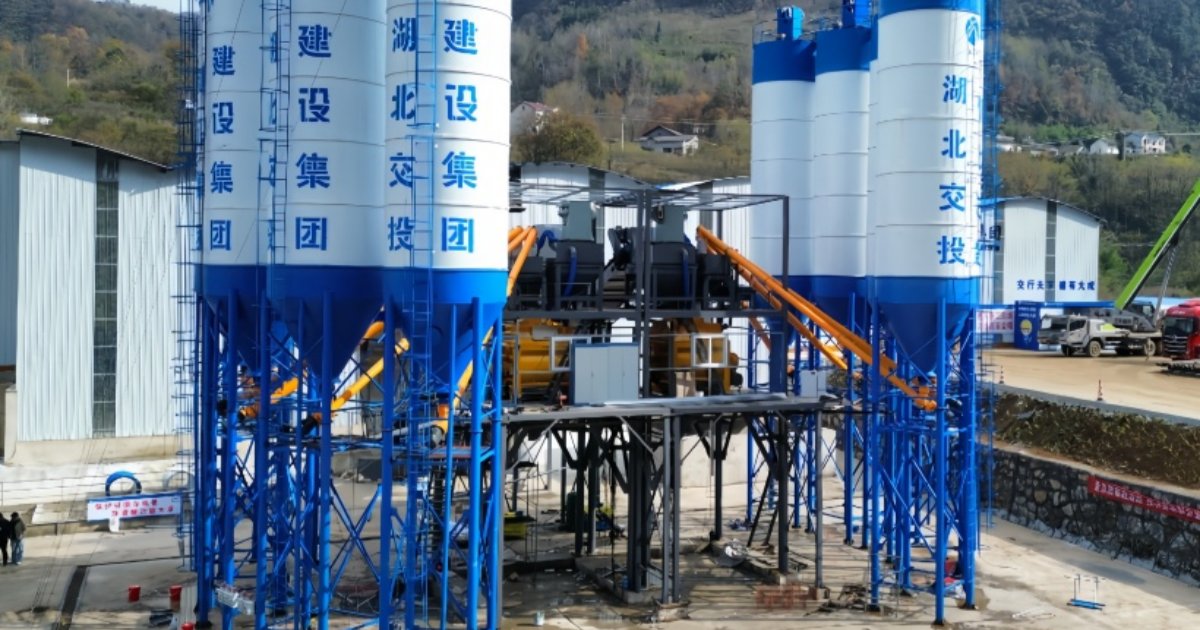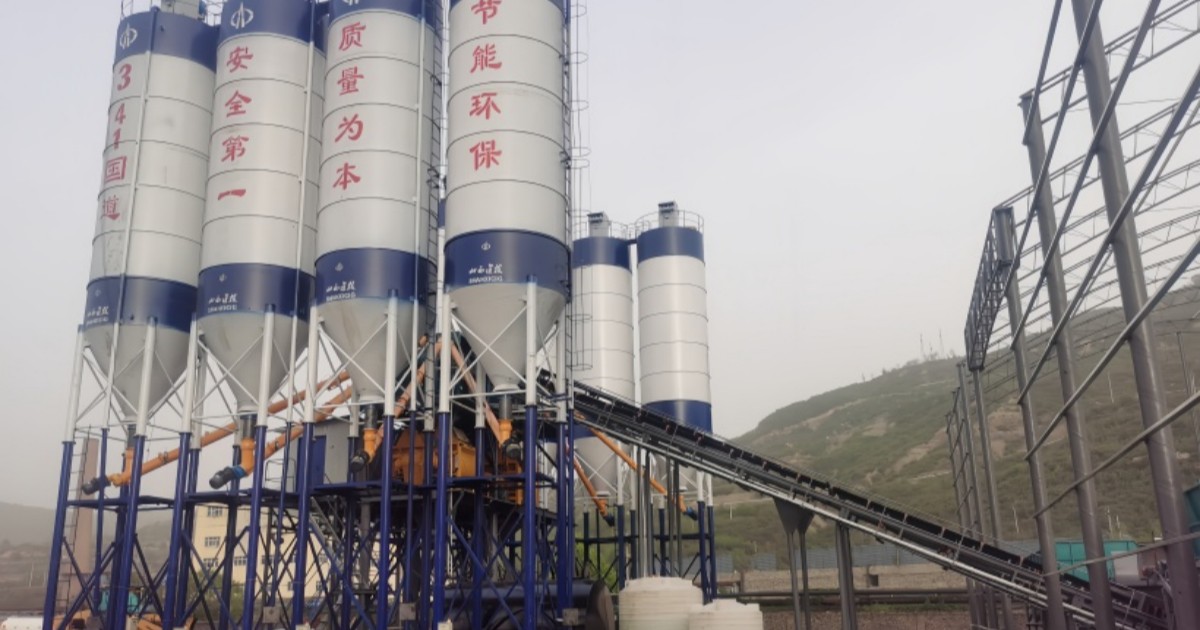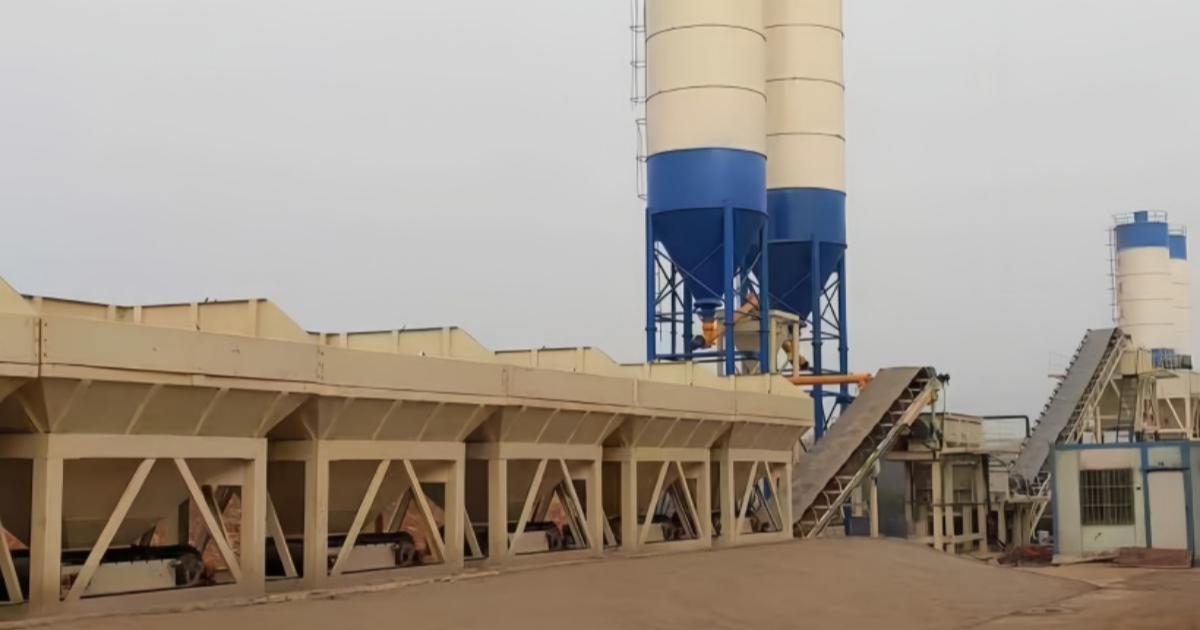

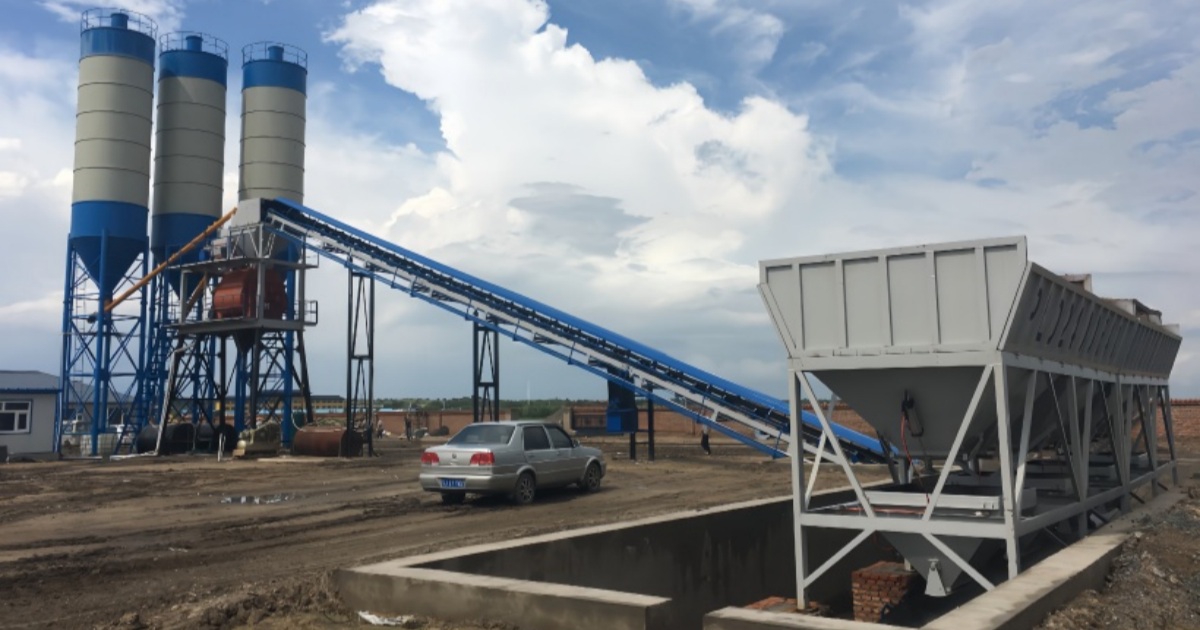
The HZS60 concrete batching plant specifications make it one of the most practical choices for medium-scale ready-mix stations, precast yards, and infrastructure contractors. The plant delivers 60 m³ of concrete per hour with a 1,000 L discharge per batch and a cycle time of 60 seconds or less. Below, we break down every key technical parameter in ten easy-to-compare tables — from the JS1000 mixer and the PLD1600 batching machine to weighing accuracy, power requirements, and environmental performance — so you can evaluate the HZS60 concrete batching plant with confidence.
HZS60 Concrete Batching Plant Specifications at a Glance
The terminology and commercial specification framework used in this guide follows the international standard ISO 19720-1:2017, which defines how concrete mixing plant specifications should be presented and compared. Table 1 summarizes the headline HZS60 concrete batching plant specifications; the following sections detail each subsystem.
HZS60 Concrete Batching Plant Specifications at a Glance
Table 1. HZS60 concrete batching plant specifications (key parameters at a glance)
| Parameter | Specification |
| Theoretical productivity | 60 m³/h |
| Discharge capacity | 1,000 L per batch |
| Mixing cycle time | ≤ 60 s |
| Maximum mixing volume | 1 m³ |
| Annual production capacity | ≈ 150,000 m³ |
| Total weight | 25–30 t (by configuration) |
| Equipment footprint | 45 m (L) × 15 m (W) × 22 m (H) |
| Discharge height | 3.8 m / 4.1 m (optional) |
| Mixer model | JS1000 twin-shaft forced mixer |
| Batching machine model | PLD1600 |
| Batching accuracy | Aggregate ±2%; cement/water/additives ±1% |
| Total installed power | 110 kW |
| Operating voltage | 380 V ±10% |
Three numbers matter most to operators: 60 m³/h theoretical output, a 60-second mixing cycle, and ±1% accuracy on cement and water dosing. Together they define a plant that keeps mixer trucks moving and keeps mix design quality repeatable.
Mixing System: The JS1000 Twin-Shaft Forced Mixer
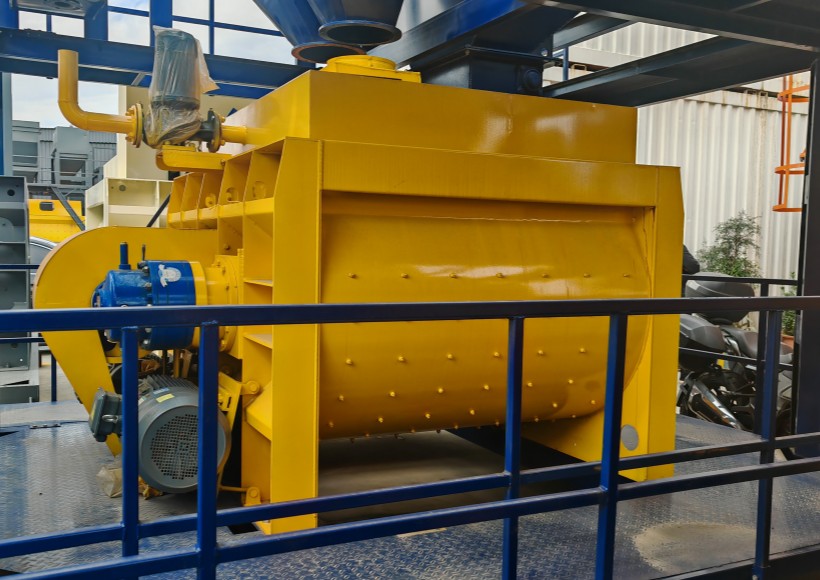
At the heart of the HZS60 is the JS1000 twin-shaft forced mixer, a design that has become the industry standard for batching plants. Its twin shafts drive the mixing blades at 35 rpm, producing a blade linear speed of 1.8 m/s for fast, homogeneous dispersion of aggregates, cement, and water in every cycle. Key mixing parameters are listed in Table 2.
Table 2. Mixing system parameters (JS1000 twin-shaft forced mixer)
| Parameter | Specification |
| Feeding capacity | 1,600 L |
| Mixing motor power | 2 × 18.5 kW |
| Mixing shaft speed | 35 rpm |
| Blade linear speed | 1.8 m/s |
Two 18.5 kW motors share the load, which boosts mixing force while keeping motor wear even. For operators, the practical result is a homogeneous batch every 60 seconds — and fewer rejected loads.
Batching and Weighing System: PLD1600 with ±1% Accuracy
The HZS60 uses a PLD1600 concrete batching machine with four storage bins and a belt feeding system running at 1.6 m/s (Table 3). Aggregate batching accuracy is held to ±2%, while cement, water, and additives are each weighed to ±1% (Table 4).
Table 3. Batching system parameters (PLD1600 concrete batching machine)
| Parameter | Specification |
| Batching capacity | 1,600 L |
| Storage bin capacity | 4 × 12 m³ (optional) |
| Batching accuracy | ±2% |
| Belt conveyor speed | 1.6 m/s |
Table 4. Weighing system parameters (accuracy / ranges / sensors)
| Item | Specification |
| Weighing accuracy | Aggregate ±2%; cement ±1%; water ±1%; additive ±1% |
| Aggregate weighing range | 0–3,000 kg |
| Cement weighing range | 0–1,500 kg |
| Water weighing range | 0–1,500 kg |
| Additive weighing range | 0–50 kg |
| Sensor accuracy class | C3 |
| Sensor protection class | IP68 |
| Sensor operating temperature | -30 °C to +70 °C |
Weighing tolerances follow ready-mixed concrete quality practice: the ±1–2% tolerances in this plant are consistent with the requirements of ASTM C94/C94M, and the batching accuracy is the kind of performance verified by the NRMCA plant certification program. Tight cement and water control is what keeps concrete strength and workability consistent, load after load.
Conveying System: Belt Conveyor and Screw Conveyor
Material flow keeps the whole plant moving. The HZS60 combines an inclined belt conveyor with a screw conveyor to handle aggregates, cement, and powder materials without bottlenecks (Table 5).
Table 5. Conveying system parameters (belt conveyor + screw conveyor)
| Item | Specification |
| Inclined belt width | 800 mm |
| Inclined belt speed | 2.0 m/s |
| Inclined belt capacity | ≥ 120 t/h |
| Inclination angle | 18° |
| Screw conveyor diameter | 219 mm |
| Screw conveyor capacity | 40 t/h |
| Screw conveyor power | 11 kW |
| Screw conveyor length | Customized per site |
An 800 mm belt rated at ≥ 120 t/h keeps pace with the plant’s 60 m³/h output, while the screw conveyor delivers cement and powder at 40 t/h with a length customized to each site’s layout. Cement and fly ash are typically stored in flaky cement silos sized to match daily consumption.
Electrical Control System and Power Requirements
The HZS60 is fitted with a computerized automatic control system that supports manual/automatic switching and a 19-inch display (Table 6). Operators can store up to 999 mix formulas, switch between mix designs instantly, and rely on automatic production statistics and fault diagnosis. Remote data transmission also enables centralized monitoring of plant performance.
Table 6. Electrical control system and electrical parameters
| Item | Specification |
| Control type | Computerized automatic control |
| Operation mode | Manual / automatic switching |
| Display | 19-inch screen |
| Formula storage | Up to 999 mix formulas |
| Production statistics | Automatic recording |
| Fault diagnosis | Automatic detection and alarms |
| Remote monitoring | Remote data transmission supported |
| Total installed power | 110 kW |
| Operating voltage | 380 V ±10% |
| Control voltage | 220 V |
| Ambient temperature | -10 °C to +40 °C |
Planning the transformer? The plant needs roughly 120 kVA of supply capacity on site. For a step-by-step breakdown of power configuration and transformer selection for this model, see our dedicated HZS60 power system and transformer guide.
Environmental Performance: Noise, Dust, and Wastewater
Environmental compliance increasingly decides whether a plant gets its operating permit. The HZS60 is designed to keep noise, dust, and wastewater under control even in sensitive locations (Table 7).
Table 7. Environmental performance parameters
| Item | Specification |
| Mixer noise | ≤ 72 dB(A) |
| Total equipment noise | ≤ 75 dB(A) |
| Dust concentration | ≤ 20 mg/m³ |
| Dust removal efficiency | ≥ 98% (pulse-jet dust cleaning) |
| Wastewater recovery rate | 90% (three-stage sedimentation) |
Soundproofing materials and optimized structural design hold total plant noise within 75 dB(A). A pulse-jet dust collector achieves ≥ 98% removal efficiency and keeps emitted dust at or below 20 mg/m³. A three-stage sedimentation system recovers up to 90% of wastewater for reuse, cutting both water consumption and discharge.
Installation and Operation Requirements
The HZS60 is designed to start earning quickly. Site requirements are modest (Table 8): a foundation bearing capacity of ≥ 15 t/m², a transformer of at least 120 kVA, and water supply of ≥ 20 m³/h. Under typical site conditions, installation and commissioning take 15–20 days.
Table 8. Installation and operation parameters
| Item | Specification |
| Foundation bearing capacity | ≥ 15 t/m² |
| Power supply | Transformer ≥ 120 kVA |
| Water supply | ≥ 20 m³/h |
| Installation period | 15–20 days |
| Staffing | 2–3 persons per shift |
| Energy consumption | ≤ 0.8 kWh/m³ |
| Maintenance | Routine inspection per shift |
Operating costs stay low: just 2–3 people per shift, energy consumption of ≤ 0.8 kWh per cubic meter, and a simple shift-based inspection regime. For day-to-day upkeep, follow our concrete batching plant maintenance guide.
Standard Configuration and Optional Upgrades
The HZS60 ships with a complete standard configuration — production-ready out of the box (Table 9). Optional upgrades let you scale capability as your business grows.
Table 9. Standard configuration and optional upgrades
| Category | Content |
| Standard — Mixing system | JS1000 mixer |
| Standard — Batching system | PLD1600 batching machine |
| Standard — Conveying system | Inclined belt conveyor |
| Standard — Control system | Computerized automatic control |
| Standard — Pneumatic system | Piston air compressor |
| Optional — Dust removal | Pulse dust collector |
| Optional — Wastewater treatment | Sand & gravel separator + wastewater recovery system |
| Optional — Storage bin | Enlarged storage bins |
| Optional — Control upgrade | Intelligent management system |
Each option directly shapes investment and long-term operating costs, so choose carefully. If you are comparing models, our guide to choosing the right concrete batching plant walks through capacity, configuration, and site factors.
Applications: Where the HZS60 Fits Best
The combination of output, precision, and environmental performance makes the HZS60 a natural fit for medium-scale production scenarios.
- Suitable projects: building construction, municipal engineering, highways, railways, bridges, reservoirs, dams, channels, and commercial ready-mix plants
- Suitable concrete: C15–C50 ordinary concrete; waterproof and acid-resistant concrete; stiff concrete for precast components
HZS60 vs. Other HZS Models: Model Comparison
The HZS60 sits between the HZS50 and the HZS75/HZS90 in the Tongxin lineup. Choose the HZS50 if your demand stays below 50 m³/h; step up to the HZS75 or HZS90 when output above 60 m³/h is a firm requirement. Table 10 compares the key parameters across the four models.
Table 10. HZS series model comparison (HZS50 / HZS60 / HZS75 / HZS90)
| Item | HZS50 | HZS60 | HZS75 | HZS90 |
| Theoretical output | 50 m³/h | 60 m³/h | 75 m³/h | 90 m³/h |
| Main mixer | JS1000 | JS1000 | JS1500 | JS1500 |
| Batching machine | — (see product page) | PLD1600 | — (see product page) | PLD2400 |
| Typical use | Small ready-mix / small projects | Medium ready-mix, precast, roads & bridges | Medium-large projects / ready-mix | Large road, bridge & water projects / ready-mix |
Our HZS50 vs HZS60 comparison shows how the JS1000 platform scales across both models, and our HZS90 composition and configuration guide details the larger plant’s layout. Full specifications for each model are on the linked product pages.
HZS60 Concrete Batching Plant Specifications: FAQ Module
This FAQ module contains 10 questions and answers. When publishing, wrap each question-answer pair with the Rank Math FAQ block; the plugin auto-generates the FAQPage schema for rich results in search engines.
1. What are the HZS60 concrete batching plant specifications?
The main HZS60 concrete batching plant specifications are: 60 m³/h theoretical productivity, 1,000 L discharge per batch, ≤ 60 s cycle time, JS1000 twin-shaft mixer, PLD1600 batching machine, ±1% accuracy on cement/water/additives, and 110 kW total installed power (see Table 1).
2. What is the actual output of an HZS60 batching plant?
Theoretical output is 60 m³/h. In practice, actual output depends on trucking, material supply, and mixing time — see our analysis of HZS60 actual output for real-world figures and optimization tips.
3. How much power does an HZS60 concrete batching plant need?
The plant’s total installed power is 110 kW (Table 6). A transformer of at least 120 kVA is recommended, and the operating voltage is 380 V ±10%.
4. How long does it take to install an HZS60?
Under typical site conditions, installation and commissioning take 15–20 days (Table 8). Foundation bearing capacity should be ≥ 15 t/m², with water supply of ≥ 20 m³/h.
5. What concrete grades can the HZS60 produce?
The HZS60 produces C15–C50 ordinary concrete, special concrete such as waterproof and acid-resistant mixes, and stiff concrete for precast components. The 1,000 L discharge per batch and ±1% dosing accuracy keep mix design quality repeatable across grades.
6. Does the HZS60 support remote monitoring and multiple mix formulas?
Yes. The computerized control system stores up to 999 mix formulas, records production data automatically, detects faults automatically, and supports remote data transmission for centralized monitoring of plant performance.
7. What discharge height does the HZS60 offer for mixer trucks?
The standard discharge height is 3.8 m, with an optional 4.1 m version — choose the option that matches your mixer truck heights and aggregate-handling layout.
8. How many people are needed to operate an HZS60 batching plant?
Just 2–3 people per shift. Energy consumption is ≤ 0.8 kWh per cubic meter of concrete, and the maintenance regime is a simple routine inspection every shift.
9. What optional upgrades are available for the HZS60?
Key options include a pulse dust collector, a sand & gravel separator with wastewater recovery system, enlarged storage bins, and an intelligent management system (Table 9). Each option directly affects investment and long-term operating costs.
10. What is the difference between the HZS60 and the HZS90?
The HZS60 (60 m³/h, JS1000, PLD1600) targets medium-scale production, while the HZS90 (90 m³/h, JS1500, PLD2400) is built for larger ready-mix and infrastructure projects (Table 10). See our HZS90 composition and configuration guide for details, or our HZS60 pricing and selection guide to compare investment levels.
Conclusion: A Balanced Choice for Medium-Scale Production
The HZS60 concrete batching plant specifications add up to a balanced, low-risk investment for medium-scale production: enough output to feed continuous pours, precision weighing that protects mix quality, and environmental performance that simplifies permitting.
If you would like a configuration plan matched to your site, contact Tongxin Machinery — our engineers respond within 24 hours.