

Introduction: Choosing the Right Stabilized Soil Mixing Plant
Highway, railway, airport runway, and water conservancy projects all depend on one piece of equipment that rarely gets the attention it deserves: the stabilized soil mixing plant. It produces the subgrade material under every paved surface, and its output quality sets the floor for everything built above it. Choosing the wrong plant does not just cost money — it delays the schedule and drags down material consistency for the whole contract.
Over the past decade, the integrated stabilized soil mixing plant (often called an all-in-one machine) has been replacing traditional split-type equipment on projects around the world. The shift is driven by real site pressures: tighter land, stricter environmental rules, shorter deadlines, and the need to move equipment between multiple project sections.
This guide breaks down the technical differences between the two designs, compares them on six dimensions that affect your budget, walks through two real project cases, and ends with a selection framework you can apply to your own tender. If you already know the basics and only need the comparison numbers, jump to the Six Fundamental Differences table; if the choice still depends on your project profile, work through the How to Choose checklist at the end.
What Is an Integrated Stabilized Soil Mixing Plant?
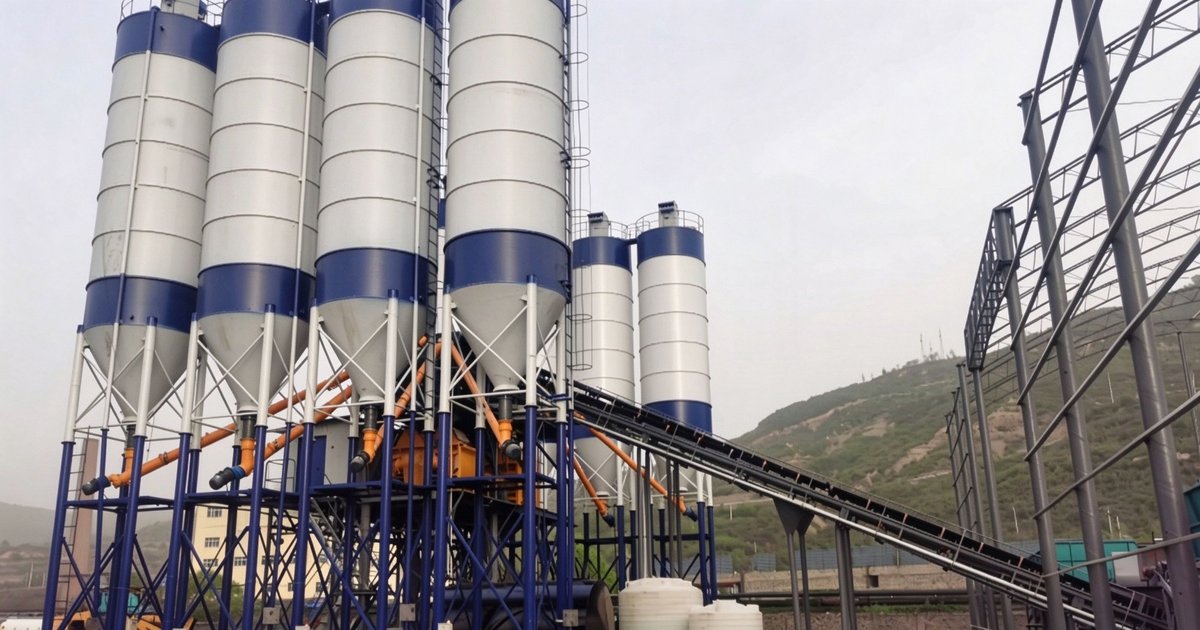
The integrated machine is built around a simple idea: instead of shipping ten separate units that get assembled on site, combine the batching system, belt conveyors, twin-shaft mixer, powder silos, water metering, additive system, and control room into one compact steel structure module. The factory completes the mechanical, electrical, and control connections before dispatch, which removes the most error-prone work from the project site entirely.
That is not a cosmetic change. Because the modules are pre-assembled and tested in the factory, the on-site phase shrinks to foundation preparation, hoisting, and connection. Because the components are arranged in a stacked layout, the whole line fits roughly 40% less floor space than a split layout. And because the structure is fully enclosed, dust stays inside the plant instead of drifting over the neighbours.
Underneath the frame, the integrated machine still uses the same proven components as a full-size line — twin-shaft forced mixer, high-precision scales, PLC control — so compactness does not cost you production quality.The output is essentially cement-treated base, the structural layer defined in open pavement references such as the Wikipedia entry on cement-treated base.
The WBZ integrated range from Tongxin Machinery covers 300, 400, 500, 600, and 800 t/h capacities, so the module can be sized to the daily output target of a single project section rather than forcing an over-specification that idles half the plant.
Each capacity level keeps the same factory-tested assembly logic: the mixer, aggregate batching hoppers, belt conveyor, cement silo, water and additive dosing, and the control room all arrive as one structural package ready for hoisting. The same logic that shortens the on-site phase also shortens the logistics phase — fewer truck loads, fewer lifting operations, and fewer points where a split-type line can be damaged or misaligned in transit.
Traditional Stabilized Soil Mixing Plants: How They Are Built
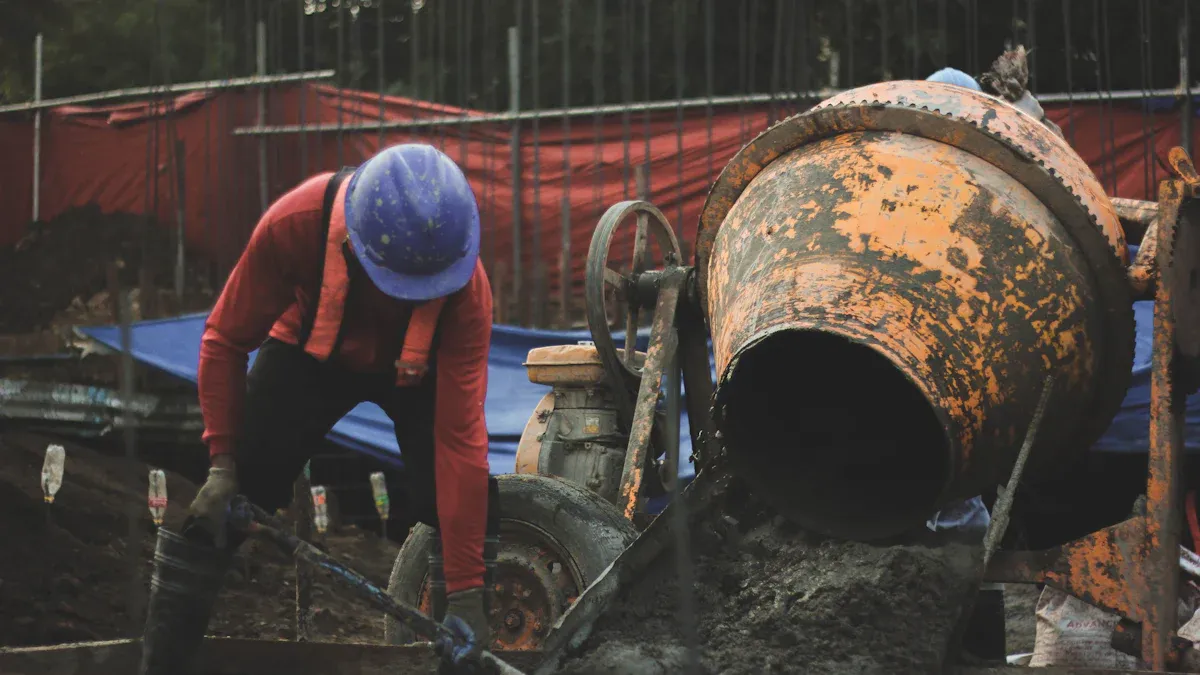
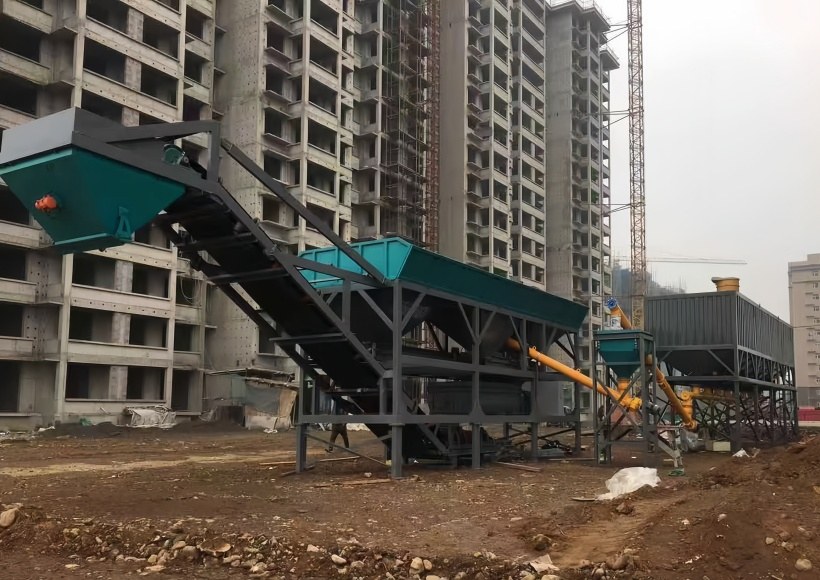
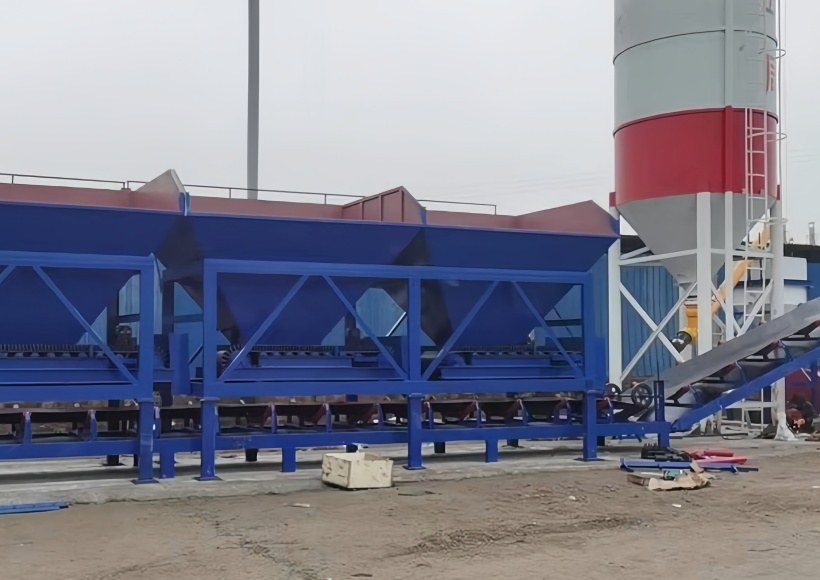
Traditional equipment uses a fully split design. The batching machine, conveyor, mixer, powder silo, and control room are separate structures, connected on site by conveyors and piping. Each component needs its own concrete foundation, and the structures are joined with extensive welding and steel erection.
That design has a long history and works fine on permanent sites where space is cheap and the plant never moves. Its problems start when the project is short, the land is tight, or the environmental inspector shows up. The footprint is not just a comfort issue either — on a constricted site it can push the whole plant layout into double handling of aggregate, longer truck queues, and slower cycle times that quietly eat into daily output:
- Large footprint — typically 800–1,200 m² before truck circulation.
- Foundation works — concrete pouring for each separate structure.
- Long installation — 1–2 weeks on site, sometimes more with welding work.
- Expensive relocation — full disassembly, 10–20 truck loads, weeks of re-erection.
- Semi-automated control — batching accuracy depends on the operator’s attention.
Look at the cost structure of a traditional line honestly and most of the “cheaper” label disappears. The equipment quote is lower, but the project pays again for foundations, for installation labour, for the crane time on every move, and for the longer commissioning window before the plant produces its first ton. On a project with a fixed deadline, those hidden costs are not accounting details — they are schedule risk measured in weeks.
Six Fundamental Differences: Integrated vs Traditional Stabilized Soil Mixing Plant
| Comparison Dimension | Traditional Stabilized Soil Mixing Plant | Integrated Stabilized Soil Mixing Plant |
| Structure & installation | Split-type structure, separate foundations, 2–4 weeks on-site installation with welding | Integrated modules, factory pre-assembled and tested, 1–2 days on-site connection, no welding |
| Mobility & relocation | Full disassembly, 10–20 truck loads, 3–4 weeks re-erection, relocation cost 30–50% of equipment value | Modular relocation, transport reduced 60%+, relocation time cut 70%+, cost down to 10–15% of equipment value |
| Automation level | Semi-automatic, manual operation, batching accuracy affected by human factors | Full PLC automation, remote monitoring, self-diagnosis, formula storage, operator requirement cut 50%+ |
| Investment cost | Lower purchase price, but high hidden costs: foundations, installation fees, relocation and extra labour | Lower total initial investment once foundations, installation and relocation are counted; energy consumption down 20–30%, payback shortened by over 40% |
| Environmental performance | Dust leakage at component joints, harder noise control, extra investment for compliance | Enclosed design with centralized dust removal ≥99.5% efficiency, fewer leak points, meets strict environmental limits |
| Maintenance & upgrades | Dispersed systems, slow troubleshooting, complex upgrades requiring on-site modifications | Modular maintenance, quick fault diagnosis, simple component replacement, downtime reduced 50%+ |
Read the table as a trade-off map rather than a scoreboard. The traditional stabilized soil mixing plant keeps one advantage — the lowest equipment quote on a permanent yard — while the integrated machine wins every dimension that involves time, space, movement, or compliance. The real question is which side of that trade-off your project sits on, and that is exactly what the case studies below illustrate.
Practical Case Studies
Case 1: Highway project across six sections
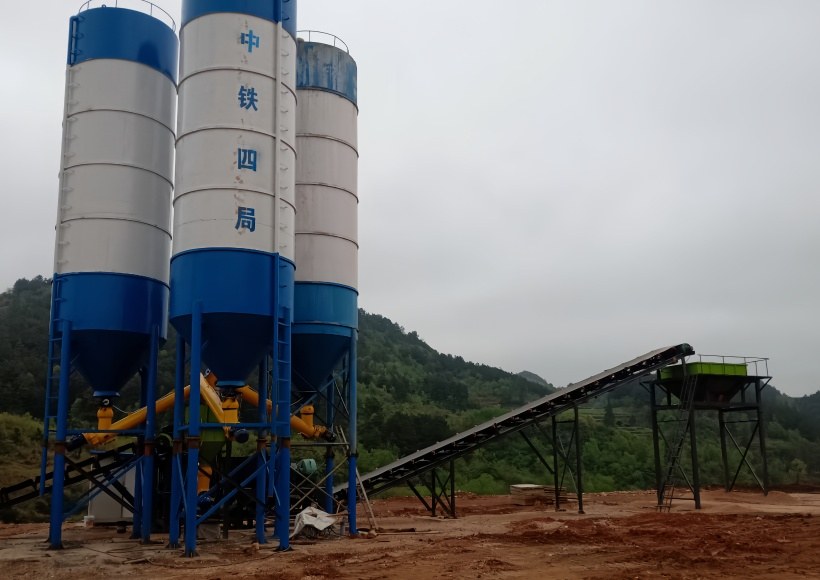
An international contractor ran a 120 km highway project in Africa split into six sections. They used two integrated stabilized soil mixing plants and relocated them four times over the 18-month contract. Each move was measured against what the same contractor had experienced with traditional equipment on earlier projects:
- 84 days of relocation time saved across the four moves
- Approximately $450,000 saved in relocation costs
- Material quality and production stability improved because the plants were not re-welded and re-aligned on every move
The decisive factor was not the purchase price — it was the arithmetic of moving. A comparable WBZ800 unit working on the G70 highway expansion shows the same pattern in practice: the station is relocated between construction sections and keeps producing while the paving team moves forward. Contractors who run multi-section tenders should price the relocation saving per move, not per tonne, before comparing quotes.
Case 2: Urban infrastructure renovation in a downtown site
A major Asian city project had three constraints at once: strict environmental and noise limits, a small downtown worksite, and a hard construction deadline. The integrated plant met the dust and noise requirements out of the box, installed in a space that would not fit a conventional line, and started production within days of delivery.
The project finished on schedule, which the contractor attributed partly to the plant being operational when the paving team was ready. The same cramped-site pressure appears again and again in tenders today — the plant that needs the least land, not the one with the lowest quote, is the one that wins the bid.
How to Choose the Right Stabilized Soil Mixing Plant
Run your project through five checks before you compare price lists:
- Project duration and mobility. Short-term or multi-section projects favour the integrated machine. A permanent yard that will run for ten years can justify a traditional layout.
- Environmental requirements. If the site is near a city, a protected zone, or a residential area, the enclosed integrated design reduces compliance risk.
- Investment budget. Compare lifecycle cost — foundations, installation, relocation, labour, energy — not just the equipment quote.
- Technical capability. The integrated machine’s PLC system needs operators who can work with a touchscreen interface and recipe management. Plan training into the budget.
- After-sales service. Check spare parts availability, response time, and whether the supplier can support installation at your project location.
Two more practical points separate a good decision from an average one. First, verify the grading accuracy story before you commit: the WBZ series achieves precise material proportioning through its metering and mixing arrangement, and you should ask the manufacturer for the tolerance figures that apply to your mix design. Second, build the maintenance plan into the contract, not after delivery — a daily, weekly and monthly checklist for the stabilized soil mixing plant is the cheapest insurance against downtime on a project with a fixed paving window.
For most modern engineering projects — high efficiency, short deadlines, multiple site relocations, or strict environmental requirements — the integrated stabilized soil mixing plant delivers lower comprehensive cost and better schedule reliability.
FAQ: Integrated vs Traditional Stabilized Soil Mixing Plant
When should I choose a traditional stabilized soil mixing plant instead of an integrated one?
Choose traditional equipment when the site is permanent, land is cheap and abundant, and the plant will never move. In that setting the lower purchase price can make sense. Once relocation, foundations, or environmental compliance enter the picture, the integrated machine usually wins on total cost.
How much money does relocation actually save with an integrated plant?
Relocation cost for traditional equipment typically runs 30–50% of equipment value per move, including disassembly, 10–20 truck loads, and weeks of re-erection. An integrated plant brings that down to 10–15% of equipment value and cuts the time by over 70%. On a multi-section highway project with several moves, the savings alone can cover the price difference.
Is the production quality of an integrated plant the same as a traditional line?
Yes. The mixer, scales, and control components are the same models used on full-size lines. The integrated machine’s advantages are in footprint, installation, and mobility — not in lower mixing quality.
What are the environmental requirements for operating one of these plants?
Most sites now require dust control and noise management. The integrated design’s enclosed structure and centralized dust removal system (≥99.5% efficiency) meet typical municipal limits without additional retrofit investment. Confirm your local standard with the manufacturer before ordering.
How long does it take to start production after delivery?
With the foundation prepared, an integrated plant is typically hoisted, connected, and commissioned within 1–2 days. A traditional split line takes 2–4 weeks of on-site construction.
Can the integrated machine handle different stabilized soil mixes?
Cement-stabilized soil, fly ash stabilized soil, and lime-stabilized soil are all standard. Recipes are stored in the PLC and can be switched between batches, so a project running different mix designs for different road layers can produce them on one plant.
What happens if a component fails on an integrated plant?
The modular design means failed components are replaced rather than repaired on site. Standard parts are stocked by the manufacturer, and the control system’s self-diagnosis points the technician to the fault quickly. Downtime is typically halved compared with troubleshooting a dispersed traditional layout.
Do I need specially trained operators?
Basic PLC and touchscreen training is required — typically one to two days. Tongxin Machinery includes operator training with the equipment, covering recipe setting, production monitoring, and routine maintenance.
Conclusion: Selecting Equipment with the Full Project in Mind
The gap between integrated and traditional stabilized soil mixing plants is not about one being “better” in the abstract. It is about matching the equipment to the project: how long it runs, how often it moves, what the site allows, and what the environmental rules demand. Score your own tender against those four questions before you open the price comparison — the answers will point to one layout with very little ambiguity.
For contractors managing short deadlines, multiple sections, urban sites, or strict environmental limits, the integrated stabilized soil mixing plant lowers total cost and removes schedule risk. As a professional manufacturer, Tongxin Machinery offers integrated machines in multiple capacity ranges, plus site layout drawings, installation guidance, and operator training. Send us your project duration, site dimensions, and daily output target — we will recommend the configuration that fits.
WBZ integrated stabilized soil mixing plant product page · Stabilized soil mixing station overview · Stabilized soil mixing plant maintenance checklist