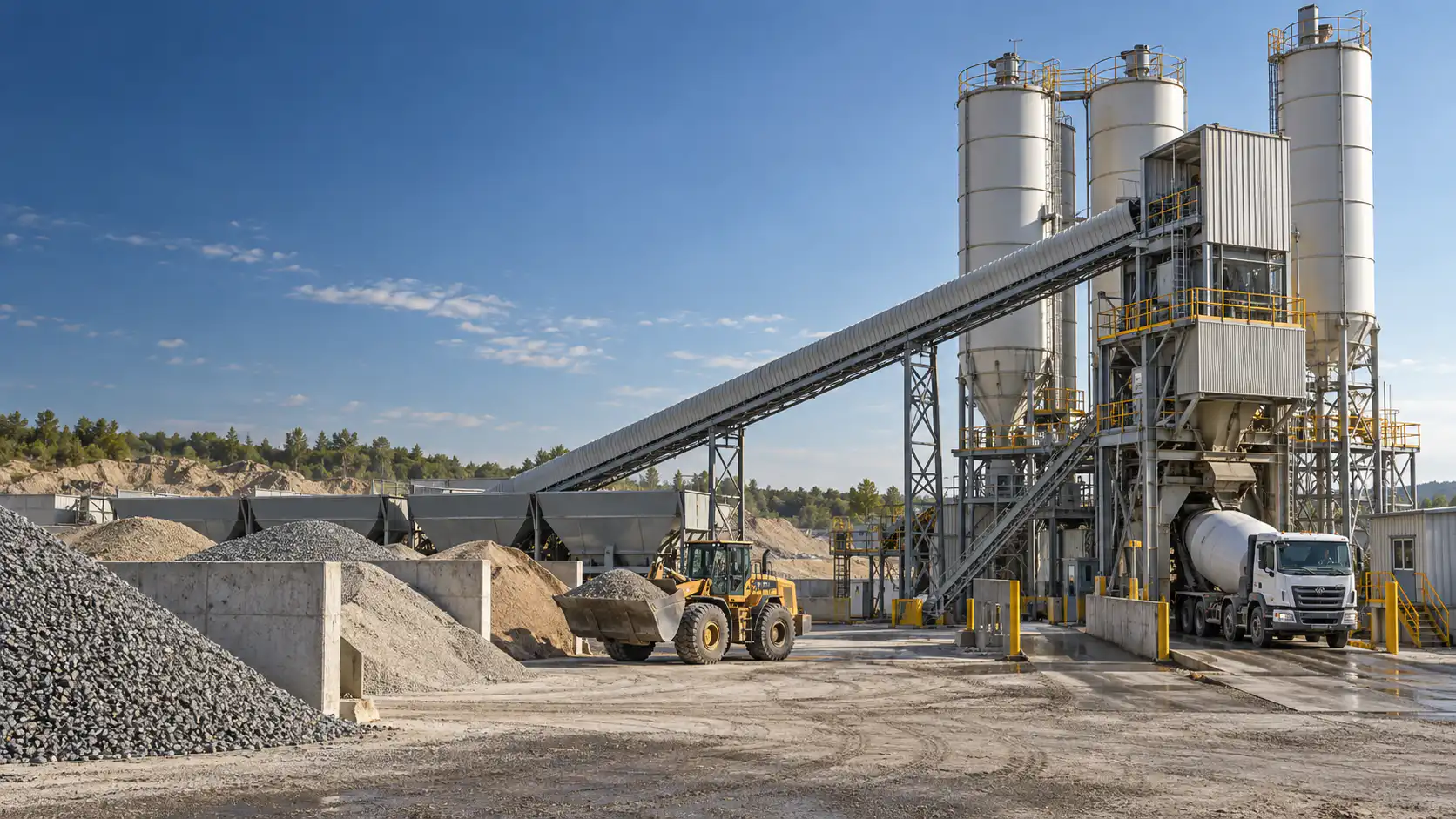

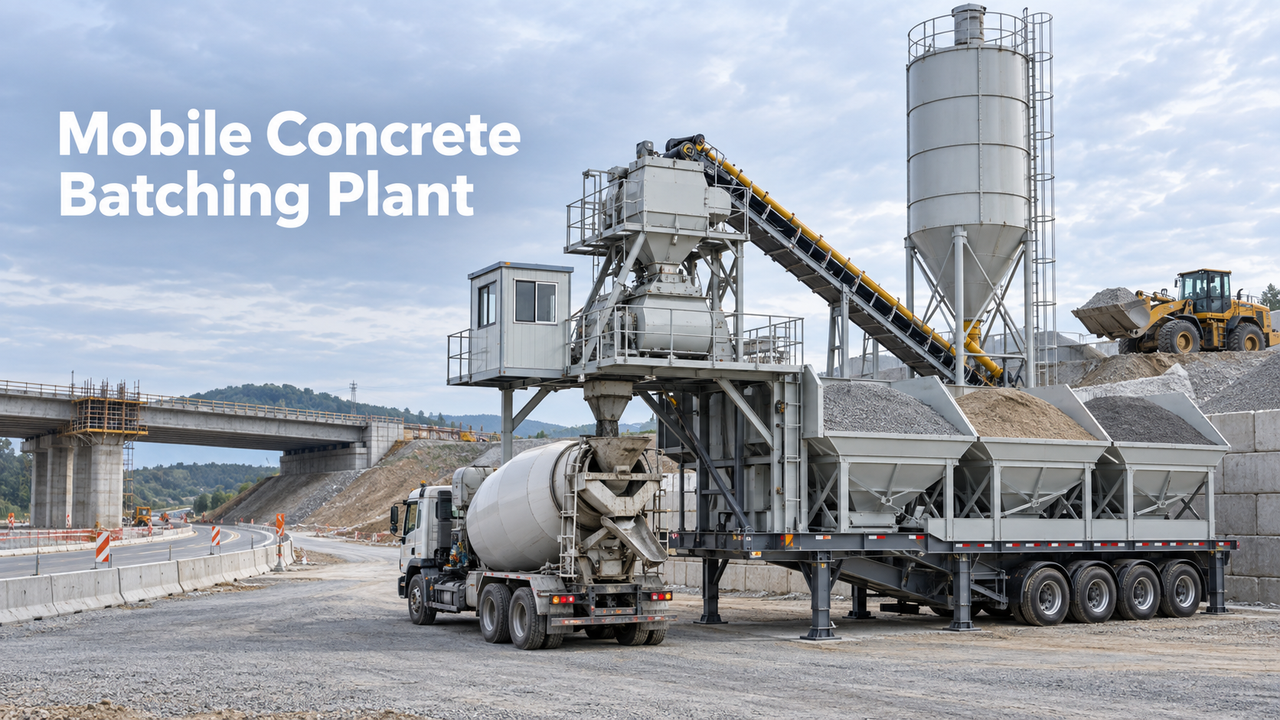
A mobile concrete batching plant brings a controlled concrete-production system to the worksite rather than requiring a permanent yard or complete reliance on delivered ready-mix. It can suit a road project moving along a corridor, a bridge outside a dependable delivery radius, or a contractor sharing one concrete batch plant across several short programs. Reliable operation still depends on prepared ground, access, electrical power, water, aggregate supply, cement handling, washout planning and trained operators.
The decision comes down to a practical question: can relocation solve a defined supply-and-schedule problem more effectively than a stationary plant or delivered concrete? This guide approaches that question as a system decision and shows what needs to be verified before a trailer-mounted configuration is selected.
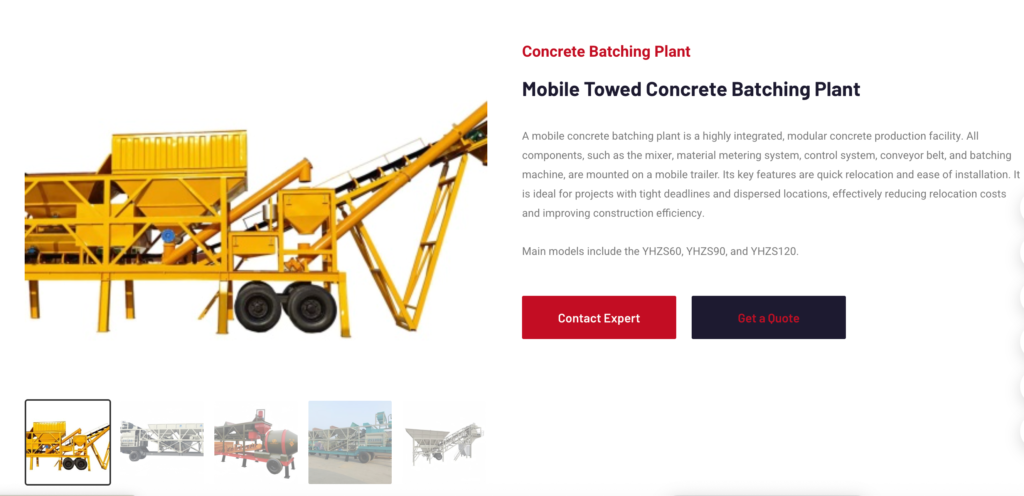
TXMixing publishes mobile towed concrete batching plants in YHZS60, YHZS90 and YHZS120 configurations. Their published specifications give buyers a concrete starting point, but the final model, configuration and site performance must be confirmed against the actual mix design and project conditions.
Quick answer: A trailer-mounted mobile plant is usually the right starting point when a project needs repeatable concrete production at more than one prepared site. It becomes a poor fit when the project has insufficient material storage, no reliable utility plan, limited access for deliveries, or a long enough operating horizon that a stationary layout would work more efficiently. The decisive inputs are peak pour demand, number of relocations, material-replenishment cycle, site footprint and the production process required by the concrete specification.
What Is a Mobile Concrete Batching Plant?
A mobile concrete batching plant is a modular production plant in which the principal batching and mixing functions are arranged for transport and repeat deployment. In TXMixing’s trailer-mounted concept, the main mixer, aggregate batcher, powder, water and admixture metering, belt conveying and control system are integrated around a mobile chassis. At the project site, the system receives raw materials, weighs them to the approved recipe, mixes concrete and discharges it for the planned placing method. Buyers may also call this equipment a mobile concrete plant, mobile batching plant or mobile concrete batch plant; the quote should make the actual transport and mixing arrangement explicit.
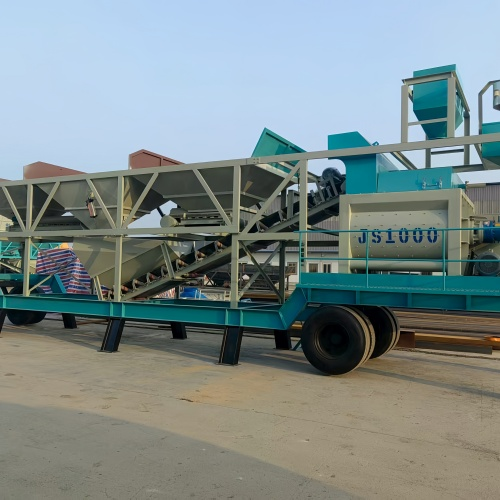
That definition separates a mobile plant from a stand-alone mixer. A mixer combines materials. A batching plant is the coordinated system that stores, measures, transfers and controls those materials before and during mixing. If a project needs several aggregate fractions, repeatable cement and water dosing, admixture control, batch records and a steady output rhythm, it needs more than a mixer on site.
| System element | Its job in a mobile concrete plant | Practical question before purchase |
| Aggregate storage and batching machine | Holds aggregate fractions and delivers measured quantities | How many aggregate sizes are needed, and how will a loader replenish each bin without stopping production? |
| Mixer | Turns the measured ingredients into the required concrete mix | Does the mixer suit the batch size, aggregate size, mix consistency and required output? |
| Cement silo and screw conveyor | Stores and transfers cementitious materials to the weigh system | What storage is required between deliveries, and can tanker access and powder transfer work at the proposed site? |
| Water and admixture system | Adds controlled water and chemical doses | Is the water source reliable, and how will aggregate moisture and admixture storage be managed? |
| Control system | Runs the batching sequence and records the selected recipe | Which recipes, reports, interlocks and language options are required by the project? |
| Trailer chassis and supports | Enables relocation and stabilizes the plant in operation | What is actually transported as one unit, and what still requires separate transport, lifting or assembly? |
Four Labels That Lead to Different Quotes
Buyers often use mobile, portable, compact and foundation-free as synonyms. The terminology is used across concrete plants with very different transport and operating arrangements. Portable concrete plant and portable concrete batch plant are particularly broad labels; Without a defined transport and operating arrangement, two suppliers can quote very different scopes under the same name.
| Configuration | What it is designed to solve | Likely advantage | Limit that must be understood |
| Trailer-mounted mobile plant | Repeat moves between project sites | A high degree of equipment integration and a defined travel configuration | Silo, stockpiles and support equipment may still move separately |
| Portable modular plant | Faster relocation than a conventional fixed installation | Modules can be transported and reassembled | A crane, more assembly work and a larger transport package may be required |
| Foundation-free plant | Reduced conventional reinforced-foundation work | Can reduce civil work where a suitable prepared site is available | It still needs level, compacted ground, drainage and a verified support arrangement |
| Stationary plant | Long-term production at one location | More space for storage, truck flow, multiple silos and a durable operating layout | Civil work, relocation and site commitment are usually greater |
TXMixing’s foundation-free concrete batching plant configuration uses a different approach from the trailer-mounted range. Its published description refers to an H-beam support system placed on hardened, levelled and compacted ground. It can reduce the scope of conventional reinforced foundations where that support area is feasible, while drainage, access, ground conditions and local requirements remain part of the project scope.
Do Not Confuse a Batch Plant With a Volumetric Mixer
The phrase “mobile batch plant” is sometimes used for equipment that follows a very different production sequence. This matters because the operator, mixer, quality-control process and customer expectation can change with the design.
| System | Where ingredients are proportioned | Where final mixing occurs | What a buyer must clarify |
| Central-mix mobile concrete batch plant | At the mobile plant | In the plant mixer before discharge | Mixer type, batch size, mix cycle, discharge method and how the system will be commissioned |
| Dry batch concrete plant | At the plant | Usually downstream, such as in a transit mixer | Who controls final mixing, how travel time is managed and whether the receiving equipment is included |
| Volumetric mixer | In its onboard material compartments and metering system | In its mixer as material is produced | Material calibration, production-rate basis, carry capacity and the suitability of the system for the specified concrete |
In ProAll’s explanation of its volumetric mixer line, “mobile batch plant” describes a valid but different product category. A trailer-mounted central-mix plant should therefore be evaluated as a complete batch-and-mix system. TXMixing’s published YHZS configurations list JS1000, JS1500 and JS2000 mixers together with PLD aggregate batchers. Ask the supplier to state the exact mixing sequence instead of assuming that every mobile plant follows the same process.
For a central-mix concrete plant, the final mixing stage is completed in the plant mixer before discharge. A dry-batch arrangement places that responsibility downstream, so the control plan, receiving equipment and travel-time assumptions must be reviewed differently.
How a Batch Moves From Aggregate to Truck in Concrete Production
Mobility changes the packaging of the plant. It does not change the discipline required to make consistent concrete. Every batch follows a material flow, and a weakness anywhere in that flow can appear as a quality or output problem at the mixer.
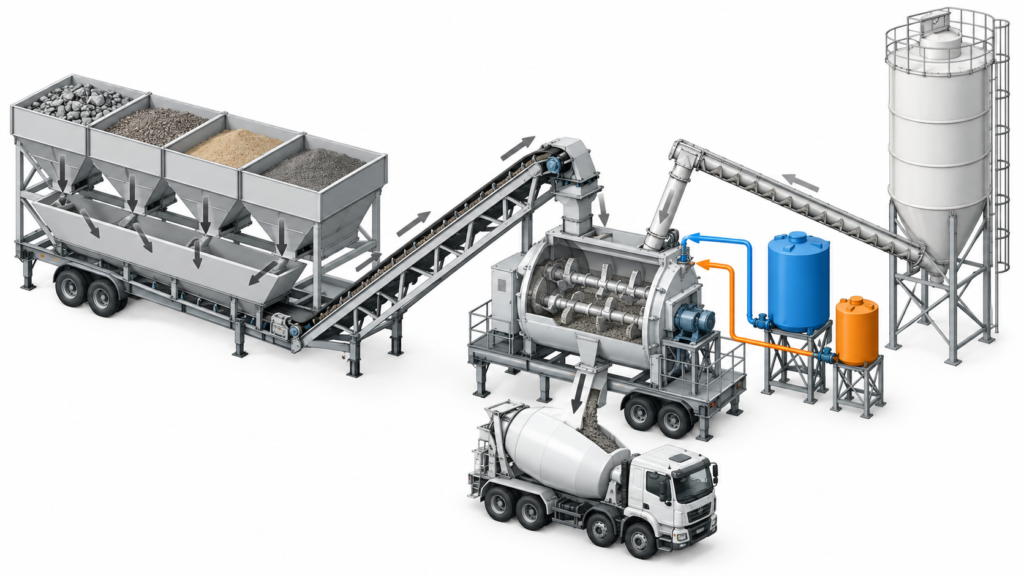
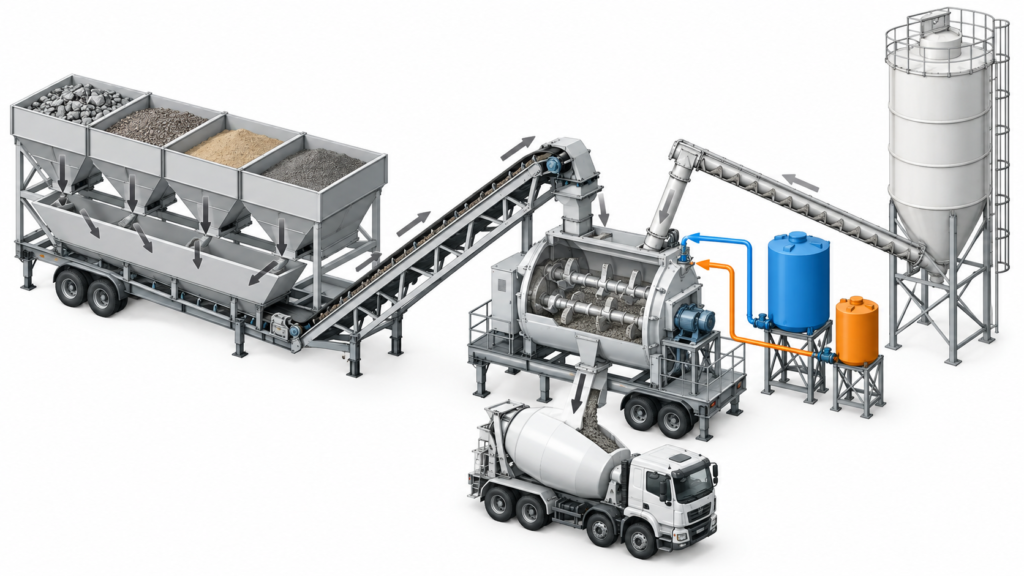
- Aggregate is loaded and stored. A loader places sand and coarse aggregate in the correct bins. The aggregate arrangement must preserve separation between fractions and allow routine replenishment.
- Aggregate is weighed. The batching machine releases each fraction according to the recipe. The PLD concrete batching machine category is the aggregate-measuring part of this sequence, not the complete batching plant.
- Cementitious material is transferred. Cement or another dry powder moves from storage through a controlled transfer path, commonly using a closed LSY screw conveyor. The transfer rate, angle, length and material condition all affect the practical timing of a batch.
- Water and admixtures are dosed. The controller calls for the recipe quantity. Aggregate moisture, water temperature, admixture type and dosing accuracy affect the actual water available in the concrete.
- The mixer produces the batch. The selected mixer combines the ingredients for the required cycle. TXMixing’s published mobile configurations use JS1000, JS1500 or JS2000 mixers; the concrete mixer range lists batch-capacity and aggregate-size information for its JS models.
- Concrete is discharged and placed. The discharge sequence must match the job’s transit mixers, pump, skip, bucket or direct placing method. A plant producing concrete faster than the placement operation can accept it creates a different bottleneck.
- The system is checked between batches. Operators monitor weights, material levels, plant alarms, moisture changes, mixer condition and the quality-control routine defined for the project.
The sequence describes a temporary production facility, with the material and utility dependencies of a permanent operation condensed into a shorter-term setup. The trailer matters, but so do the stockpiles, water, cement transfer, power and receiving operation around it.
Why Nameplate Output Is Not Field Output
Published capacity is normally a useful comparison figure, but it is not a commitment that every project will achieve that number. A plant loses useful output when the batch cycle is delayed, aggregate must be replenished, cement delivery or conveying cannot keep up, the recipe changes frequently, the placing operation is waiting, or the site power and water supply are unstable.
The mixer is often blamed first, but the first question should be whether the entire cycle is balanced. A plant rated at 90 m³/h (about 118 yd³/h) cannot sustain that result if the loader, silo refill, water source or receiving trucks are planned for a lower rhythm. The suitable model is the one whose complete material system can support the peak pour with margin.
What Mobility Actually Changes on Site
A mobile concrete batching plant earns its place when its transport arrangement removes a real project constraint: repeated mobilization, a remote pour location, an unreliable ready-mix delivery radius or the need to reuse one asset across scheduled sites. Its value lies in relocating the central batching and mixing system as a coordinated package while retaining repeatable weighing and recipe control.
| Feature | Practical advantage |
| Integrated chassis for the core batching and mixing system | Reduces the amount of fixed structure that must be recreated after a planned move |
| Modular installation arrangement | Can shorten assembly work compared with reconstructing a conventional fixed plant at every site |
| Measured aggregate, powder, water and admixture dosing | Supports repeatable batching and batch-record routines instead of relying on manual proportioning |
| Reusable equipment across planned projects | Spreads capital use across a sequence of sites instead of leaving a fixed plant stranded after one job |
| Compact temporary layout | May reduce the permanent site commitment required for a temporary production point |
| Foundation-free option on suitable projects | Can reduce conventional reinforced-foundation work where a prepared support area is feasible |
The practical test is whether these benefits remain after the entire material and operating system is included. A trailer that moves easily does not help a project that cannot receive cement, store aggregate, supply water or keep the placing operation moving.
The Main Configurations
A mobile configuration is not one fixed design. The buyer should select the arrangement around project duration, relocation pattern and material strategy rather than treating every short-term job as identical.
When a Trailer-Mounted Plant Earns Its Keep
A trailer-mounted plant is the closest match for a project that will relocate repeatedly and needs a defined transport configuration. Its strength is integration: the core batching and mixing functions are organized so the plant can be moved and recommissioned without recreating a conventional fixed structure each time.
- Strong fit: phased highway work, distributed infrastructure programs, remote construction sites, temporary concrete supply, rental fleets and contractors moving between several known sites.
- What it solves: equipment relocation time and the need to establish a permanent plant at every job.
- What it does not solve: poor access roads, insufficient turning space, missing utility connections, weak operating ground, inadequate aggregate supply or a lack of trained operators.
TXMixing’s trailer-mounted range is published as YHZS60, YHZS90 and YHZS120. The model choice changes more than output. It changes the mixer, aggregate batcher, power requirement, belt width and transport dimensions, which is why a capacity request must include the road route and site layout.
When a Foundation-Free Layout Makes Sense
A foundation-free plant is appropriate when the project expects to stay long enough to need a substantial plant arrangement, but conventional reinforced foundations create unacceptable cost, delay or removal work, and constructing a permanent stationary facility can be uneconomical for temporary or quality-sensitive jobs. It is a site-installation strategy, not merely a mobility feature.
TXMixing lists HZS90, HZS120 and HZS180 configurations for this category. Its page lists reference production figures of approximately 65, 85 and 120 m³/h (about 85, 111 and 157 yd³/h), alongside system dimensions, mixer models and conveyor sizes. Those figures are useful for an initial comparison, but the supplier should confirm the expected output against the final configuration and operating conditions. This can suit a project that needs greater operating permanence than a trailer-based arrangement while still preserving future reuse of the equipment.
- Strong fit: medium-term infrastructure work, rental applications, projects with tight civil-work schedules and locations where restoring the site after removal matters.
- What it solves: avoids reinforced foundation work while also reducing transportation delays and costs tied to hauling fresh concrete from distant supply points.
- Where care is needed: soft ground, standing water, uneven terrain and sites where the support arrangement has not been reviewed. Civil and geotechnical judgment remains essential before the equipment is installed.
When a Fixed Yard Is the Better Call
A stationary concrete batching plant earns its higher site commitment when the project needs persistent production, substantial aggregate storage, multiple silos, predictable truck circulation and a long operating horizon. It is often the better configuration for a ready-mix yard, a long-running commercial supply point or a major project where the plant will not move often enough to recover the logistical value of mobility, though for temporary or phased work, building a permanent stationary setup is not always economical even under strict quality control and may be harder to justify than alternatives for large scale projects.
- Strong fit: high and predictable demand, multiple daily delivery cycles, fixed production sites, large stockpiles and multi-year programs.
- Where care is needed: do not select a stationary plant simply because it has a higher theoretical output. The plant still needs a suitable dispatch layout, material supply plan and operating team.
Projects That Benefit Most
The same mobile plant can be a strong choice on one job and a poor investment on another, including large scale projects. Start with how the work will move, how concrete will be placed and whether the project can support a temporary production system. The table below is a decision aid, not a substitute for a site plan and cost model.
| Project situation | Better starting configuration | Why it can fit | Decision that still needs proof |
| Road or rail project moving through several work zones for infrastructure projects | Trailer-mounted mobile plant | Relocation can follow the work front and reduce dependence on distant dispatch | Route permits, site access, stockpile space and move frequency |
| Remote bridge, hydropower or utility project | Mobile or foundation-free plant | On-site production may reduce dependence on long delivery routes | Power, water, cement supply, spare-parts route and weather resilience |
| Temporary concrete supply operation or rental deployment | Trailer-mounted mobile plant | Equipment utilization can be spread across multiple planned sites, including smaller jobs | Who performs commissioning, calibration, support and transport at each move |
| Fixed ready-mix yard with predictable local demand | Stationary plant | Storage, dispatch flow and a permanent operating routine normally matter more than relocation | Long-term volume, site ownership, permitting and truck circulation |
| Short but high-volume project at one site, especially for large scale infrastructure projects | Foundation-free or stationary plant | A more substantial layout may be justified without repeated moves | Required duration, ground condition, civil work and material storage |
| Small intermittent project with reliable nearby ready-mix | Delivered ready-mix may be stronger | Owning a plant may add more operating burden than it removes | Delivery reliability, short-load charges, pour timing and the total project cost |
For a remote bridge, utility or similar isolated job, an on-site concrete batching plant can reduce exposure to transit distance. It also transfers responsibility for material deliveries, batch control and plant readiness to the project team, which is why the supporting logistics deserve the same attention as the mixer and chassis.
Mobile or Stationary: Decide From the Job
This decision should be made from the project economics and operating constraints, not from a general claim that either format is more efficient; the right batch plant depends on project scale, duration and logistics. Mobile systems trade permanent civil work and fixed-yard scale for relocation ability and more compact logistics. Stationary systems trade mobility for storage, traffic flow and long-term operating stability.
| Decision point | Mobile concrete batching plant |
| Project duration | Best evaluated for temporary, phased or multi-site infrastructure projects, including large scale infrastructure projects that move through several work zones |
| Relocation | A planned part of the equipment concept |
| Material storage | Often constrained by site footprint and transport planning |
| Installation | Can reduce the assembly scope for integrated designs |
| Truck and loader traffic | Needs deliberate planning in a compact work zone |
| Capacity planning | Must account for repeated site setup and replenishment constraints |
| Best buyer question | Is this plant for smaller jobs with reliable nearby ready-mix supply, or for work where on-site production and moves matter more? |
Start With Demand Over the Whole Project
Peak pour demand matters, but it is only one part of the decision. A short job may have a demanding pour day and still be a poor candidate for a large fixed yard if the site will be released soon afterwards. Equally, a modest hourly target may justify a stationary layout when the operation will supply the same market for years and needs reliable storage, truck circulation and repeatable dispatch every day.
Map the highest credible pour window, not just an annual total. Then set it beside the production calendar: how long will the plant remain at one location, how often will it move, and what happens to the equipment between projects? That comparison usually tells the buyer more than a catalogue capacity class.
Treat Installation as a Scope, Not a Date
An integrated mobile arrangement can reduce assembly work, but it does not eliminate preparation. The project still needs an accessible arrival route, a level support area, drainage, lifting arrangements where required, utilities, material storage and a commissioning team. A stationary installation normally needs a more permanent civil and utility plan, but that work can be rational when the plant will operate long enough to benefit from a stable yard.
Ask which installation scope creates less disruption across the full program. For a corridor project with several planned moves, repeated civil work may be the greater burden. For a fixed ready-mix operation, repeated mobilization may be the more expensive choice.
Design Storage and Traffic as One System
Mobile plants are often chosen for a smaller operating envelope, yet the plant itself is only part of the footprint. Aggregate bays, cement deliveries, water storage, loader turning, transit-mixer queuing, washout and maintenance access must all work at the same time. When these flows cross one another, a compact arrangement becomes a bottleneck rather than an advantage.
A stationary yard usually gives the designer more freedom to separate these movements and add storage. That can improve sustained output, but only if the long-term demand and site commitment justify the additional permanent work. Use a scale layout drawing to test the actual vehicle paths before deciding that either configuration fits the site.
Compare Operating Systems, Not Just Equipment Prices
The commercial comparison should include the work surrounding the plant. For mobile equipment, that means each transport, set-up, calibration, temporary utility arrangement and move. For a fixed plant, it means permanent civil work, yard infrastructure, storage, installation and eventual site disposition. Both options also need labor, maintenance, material handling and quality-control costs.
A mobile plant is the better commercial decision when the cost and risk of setting up fixed production repeatedly exceed the cost of designing for relocation. A stationary plant is the better decision when output, storage and fixed-yard efficiency dominate, and the project can recover the cost of a durable site layout over its useful life. The whole-project cost worksheet later in this guide provides a way to make that comparison explicit.
Choosing Between YHZS60, YHZS90 and YHZS120
TXMixing’s mobile product page gives enough configuration detail to move the discussion beyond a generic “small, medium or large” label. Each model needs to be evaluated against the peak demand, material supply plan and transport envelope.
| Model | Published mixer | Published batcher | Listed output | Total power |
| YHZS60 | JS1000 | PLD1600 | 60 m³/h (about 78 yd³/h) | 78 kW |
| YHZS90 | JS1500 | PLD2400 | 90 m³/h (about 118 yd³/h) | 115 kW |
| YHZS120 | JS2000 | PLD3200 | 120 m³/h (about 157 yd³/h) | 140 kW |
YHZS60: The Lower-Logistics Option
The YHZS60 pairs a JS1000 mixer with a PLD1600 aggregate batcher, a 600 mm belt and a listed output of 60 m³/h (about 78 yd³/h). It is the logical starting point when peak demand is moderate, site access is restrictive or the project needs mobile production without the larger power and transport envelope of a higher-capacity configuration.
Its limitation is more than output. The complete support system must still be sized for its working rhythm: aggregate stock, cement resupply, water, discharge arrangement and available production hours. A project with a six-hour peak pour window may find that 60 m³/h on paper leaves too little allowance for interruptions.
YHZS90: When the Pour Window Gets Tighter
The YHZS90 uses a JS1500 mixer, PLD2400 batcher and 800 mm belt, with a listed 90 m³/h output (about 118 yd³/h) and 115 kW total power. It can be a better match where a 60 m³/h class plant would need to run too close to its nominal limit through the critical pour period, but the project still values relocation and a trailer-based configuration.
The buyer should treat the larger configuration as a system decision. Compared with the YHZS60, its published length and height are slightly greater, while the published width remains 2 m; it also needs more available power. Route constraints, equipment access, generator planning and material replenishment need to be checked before assuming that a larger model is the low-risk option.
YHZS120: Only With Strong Site Support
The YHZS120 uses a JS2000 mixer, PLD3200 aggregate batcher, 800 mm belt and a listed 120 m³/h output (about 157 yd³/h). It is appropriate for a project that has a credible high-demand production requirement and the site resources to support it: more power, material deliveries, aggregate handling, discharge capacity and a route that accepts its 16 x 2.6 x 3.8 m published dimensions.
Its key limitation is operational rather than conceptual. A high-capacity mobile plant becomes ineffective if the jobsite cannot keep it supplied or receive its output. Before requesting this model, map the aggregate loader cycle, tanker access, stockpile space, water source, receiving trucks or pumps, and the people responsible for quality checks.
A Conservative Way to Compare the Three
The following matrix is deliberately conservative. It does not claim that a particular model is the universal answer for a given project. It shows the additional operating conditions that should be present before a buyer moves up to a larger configuration.
| Model | Most credible starting use | Conditions that should exist |
| YHZS60 | Moderate peak demand, constrained access or a project prioritizing simpler mobile logistics | A workable 78 kW power plan, material supply capable of maintaining the cycle and a pour schedule that leaves operating margin |
| YHZS90 | Medium-to-high peak demand with a defined relocation plan | Space and access for the 15.5 x 2 x 3.3 m published envelope, 115 kW available power and larger material replenishment capacity |
| YHZS120 | High-demand mobile production with strong supporting logistics | A 140 kW power plan, ample aggregate and cement resupply, sufficient receiving capacity and a route suitable for the 16 x 2.6 x 3.8 m published dimensions |
Specification note: The listed output, power and dimensions above are taken from the TXMixing YHZS product page as checked on September 18, 2026. They are configuration data, not contractual guarantees of site output, transport legality or local electrical suitability.
Build the Plant Around the Project
The selection process should start with the project, then work toward the plant. Choosing by mixer name or nominal output first usually creates a quotation that must be corrected once the site facts emerge.
Start With the Peak Pour
Use the highest credible concrete requirement during the actual pour window, not the average daily volume.
Required average output = peak concrete volume required during the pour / usable production hours
If a project needs 360 m³ (about 471 yd³) in six usable hours, its average requirement is 60 m³/h. That is the start of the evaluation, not the final model choice. The team must then allow for normal delays, recipe changes, material replenishment, test holds and discharge constraints. A model should retain a practical operating margin rather than being selected to run continuously at its headline maximum.
Let the Mix Drive the Equipment
State each aggregate fraction, maximum aggregate size, cementitious materials, admixtures, target concrete classes, expected moisture changes and any special mix requirements. These details affect the aggregate-bin arrangement, weighing system, mixer selection, cement storage and the water-control method.
The published JS500, JS750, JS1000 and JS1500 mixer range illustrates why the mixer should be selected from the material requirement as well as the output target. Batch capacity, feed capacity, mixer power and maximum aggregate size are model-level values, not generic characteristics shared by every configuration.
Map the Material Cycle Before Ordering
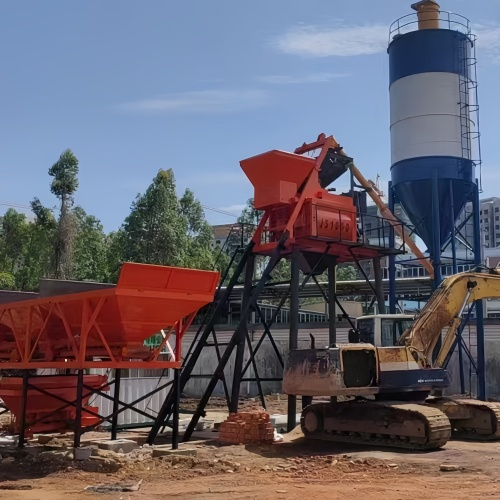
Aggregate, cement and water decide whether the plant can sustain the selected output. Review how much aggregate can be stored, how often it will be replenished, whether a loader can work without crossing the discharge route, how cement tankers access the cement silo, whether the screw conveyor is appropriate for the planned powder transfer path, and any special mix requirements, including precast applications or durability-driven designs. Also account for weather conditions, since stockpile moisture can shift water control and affect mix consistency.
Material planning is especially important on temporary sites. A compact plant layout may save setup space but leave too little room for stockpiles or vehicle circulation. That is not a plant defect; it is a mismatch between production needs and the available site.
Test Utilities at the Actual Site
Compare the quoted connected load with the power genuinely available at the operating site. Do not rely on the generator nameplate without considering starting loads, voltage stability, cable length and other equipment sharing the supply. Water supply should be evaluated for quantity, pressure, storage and the concrete quality-control procedure, including how moisture from aggregate is handled.
Remote sites need a maintenance plan before commissioning. Specify spare parts, lubricants, inspection intervals, support contacts and the route for moving replacement parts to the site. A mobile plant earns its flexibility only if the team can keep it operating between moves.
Compare Whole-Project Cost
Mobile-plant cost includes more than the equipment quote. The project should compare transport, site preparation, assembly, commissioning, power arrangement, water storage, aggregate handling, cement storage, operating labor, relocation, maintenance, consumables and removal or restoration work.
The same is true for a stationary plant. Its higher civil-work commitment may be sensible for a long-term project with stable demand and a durable supply yard. A fair comparison puts all of those costs into the same project model and tests the assumptions against the actual schedule.
A Cost Comparison That Does Not Hide the Important Items
An equipment quote is only one part of the investment. Before deciding that a mobile plant is cheaper, build a project worksheet with the same headings for both options.
| Cost area | Mobile-plant questions | Stationary-plant questions |
| Equipment and configuration | Which trailer modules, mixer, batcher, controls, silos and options are included? | Which fixed modules, storage and automation are included? |
| Civil work | What grading, compacted area, drainage and support preparation are required at each site? | What foundation, drainage, utilities and permanent yard work are required? |
| Mobilization | How many transports, cranes, permits, technicians and days are required for every move? | What is the actual cost and disruption if the plant later needs relocation? |
| Material logistics | Can stockpiles and silo deliveries keep up at every temporary site? | Can the fixed yard receive and store materials efficiently throughout the year? |
| Operating labor | Who operates, maintains, calibrates and moves the plant? | Who operates the fixed facility across the planned production horizon? |
| End-of-project work | What is required to remove the plant, restore the site and move to the next project? | What happens to foundations, yard improvements and fixed utilities after the project? |
The right conclusion may be that purchasing neither plant is appropriate. If local ready-mix supply can satisfy the peak-pour schedule with dependable delivery and the project volume is irregular, delivered concrete may remain the lower-risk operational choice.
Site Setup, Commissioning and RFQ Requirements
A mobile plant can be fast to assemble once the site is ready. It cannot make an unprepared site ready. Treat the following items as preconditions for a realistic delivery and start-up plan.
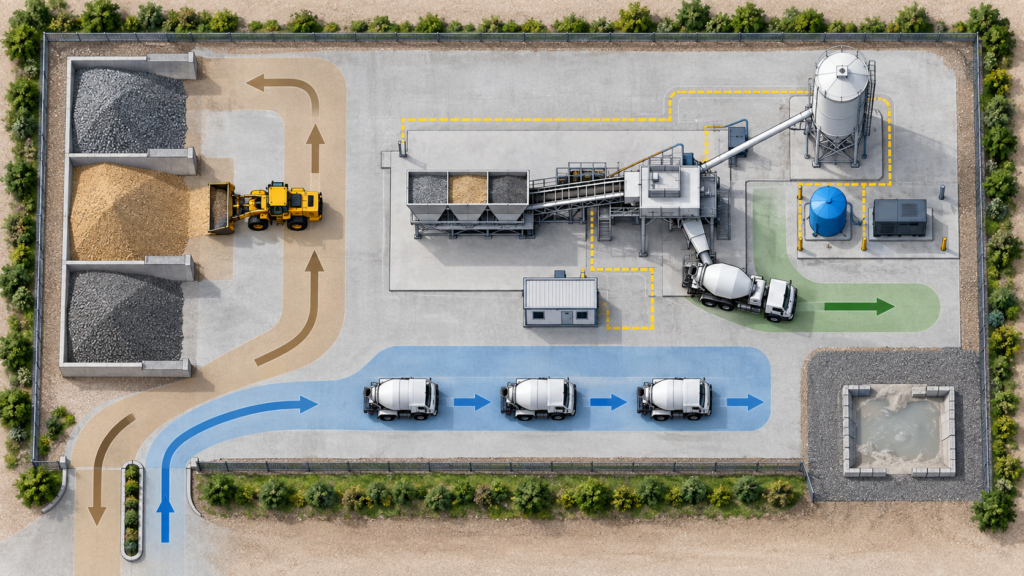
- Transport and arrival plan: Confirm bridge limits, route width, turning radius, height restrictions, permits, escort requirements, off-loading method and the final approach to the site.
- Prepared operating ground: Confirm level, compacted ground; support positions; drainage; wet-weather access; and any required bearing or civil assessment.
- Layout drawing: Use the proposed plant drawing to place the trailer, aggregate bins, stockpiles, cement silo, loader route, tanker position, water storage, generator, discharge point, washout and maintenance access.
- Utilities: Confirm electrical supply, grounding, fuel, water, lighting, emergency isolation and communications needed by the control system.
- Material supply: Confirm aggregate source and stock policy, cement delivery access, admixture handling, dust-control arrangements and the frequency at which each material must be replenished.
- Quality management: Define approved mix designs, scale checks, moisture correction, fresh-concrete tests, batch records and release authority.
- Safe operation: Confirm vehicle separation, guarding, access platforms, lockout procedures, dust and washout controls, operator training and local permit obligations.
A supplier quotation should state more than model and price. Request the plant layout, included and excluded modules, model-specific technical data, utility requirements, transport state, assembly scope, commissioning scope, manuals, spare-parts recommendation and the assumptions used to state production capacity.
Checks Before First Production
A plant that was calibrated at one site should not be assumed to be ready at the next site without a structured recheck. Transport vibration, altered support conditions, reconnected flexible lines and changed aggregate moisture can affect the operating result even when no visible damage is present.
Before the first production batch after installation or relocation, the operating team should confirm the plant is level and supported as specified, inspect structures, fasteners, guards, cables, flexible connections and conveying equipment, verify that weighing systems return to zero, review water and admixture dosing, check mixer and conveyor rotation, and run the agreed trial or calibration procedure. The project quality plan determines the acceptance method and documentation required.
During operation, record material deliveries, aggregate moisture changes, batch deviations, alarms, maintenance actions and any recurring delay in the cycle. Those records are more useful than a generic “high automation” claim because they show which part of the temporary plant system is actually limiting production.
What to Put in an RFQ
| Information to provide | Why it matters |
| Project location, schedule and expected moves | Determines transport, environment and mobilization scope |
| Peak hourly and daily concrete demand | Determines the practical production target, and records show which key parameters of the temporary plant system are actually limiting production |
| Mix designs, aggregate fractions and maximum aggregate size | Determines batching, mixer and storage configuration, including customization options for different project needs |
| Cementitious materials and admixtures | Determines silo, screw conveyor, metering and dust-control requirements |
| Site power, water, fuel and drainage | Determines whether the proposed configuration can operate at the site |
| Access-road dimensions and site layout | Determines trailer feasibility, off-loading and installation approach |
| Required standards and documentation | Determines drawings, electrical documents, test records and compliance requirements |
| Operator and maintenance resources | Determines training, spare-parts and support needs |
Documents That Turn a Quote Into a Decision
A credible proposal lets the buyer trace each important decision back to a document, calculation or agreed site assumption. A public product page is useful for comparing configurations, but it is not the final engineering record for a specific order. Before a purchase order is released, ask the supplier to identify the revision, scope and assumptions behind the selected configuration; clear RFQ information also helps the supplier propose the right customization options for the plant configuration.
| Buyer question | Evidence to request |
| Can the chosen plant meet the planned production program? | Model-specific datasheet stating the selected mixer, aggregate batcher, output basis, connected load and operating assumptions |
| Can the equipment reach and fit the project site? | Transport-state general-arrangement drawing, dimensions, shipping weights, axle/support arrangement and site layout |
| Can installation begin on the planned date? | Site-preparation drawing, support requirements, lifting plan, installation scope matrix and a readiness checklist |
| Can the operation produce controlled concrete? | Scale-calibration procedure, batch-record example, aggregate-moisture procedure, trial-batch plan and the project’s quality-control requirements |
| Can the owner maintain the plant after handover? | Electrical/control drawings, operation and maintenance manual, recommended spares, warranty terms and support contacts; contact the supplier to confirm operator training and after-sales support are covered |
| Does the proposal meet the project and local requirements? | The applicable project specification, authority or permit requirements, and a documented compliance review |
Keep these files with the quotation and note their revision dates. The public TXMixing mobile towed concrete batching plant page is the appropriate place to begin a configuration comparison; the approved datasheet, drawing and order documents must govern the final purchase.
Evidence basis: The configuration references in this guide are drawn from TXMixing’s public mobile-plant, mixer, batching-machine, cement-silo and screw-conveyor pages, checked on September 18, 2026. They support preliminary comparison only. They do not replace model-specific drawings, current datasheets, a site assessment, project quality requirements or the buyer’s local compliance review.
FAQs on Mobile Concrete Batching Plants
How quickly can a mobile concrete batching plant be installed?
TXMixing’s mobile product page states that its integrated configuration can typically be installed and brought into production within one to two days. That figure depends on a prepared site, available utilities, completed transport, correct lifting arrangements and an agreed commissioning scope. It should not be treated as a universal schedule guarantee.
Can a mobile concrete batching plant work as a ready-mix concrete plant?
It can, when the selected configuration, storage, quality controls, dispatch rhythm and site layout support the intended operation. For U.S. work, the governing project specification must be part of that decision. ASTM C94/C94M covers freshly mixed ready-mixed concrete and states that purchaser requirements control where specifications differ. A mixer alone cannot establish a ready-mix operation; the owner still needs a workable material supply, batch-control and quality-management system.
Does a foundation-free plant require no site work?
No. It can reduce conventional reinforced-foundation work, but it still requires an appropriate prepared support area, verified ground conditions, drainage, utilities and a safe operating layout.
What should be compared before choosing YHZS60, YHZS90 or YHZS120?
Compare peak production requirement, realistic operating margin, mix design, power available at the site, route dimensions, aggregate supply, cement storage, discharge method, number of relocations and crew capability. The listed output alone is not enough.
Conclusion
Choose a mobile concrete mixing plant when construction projects will genuinely benefit from moving high quality concrete production from one job site to another and can operate a disciplined temporary concrete plant. For projects that require higher productivity, a plant equipped with a twin shaft mixer can also support consistent mixing under demanding production schedules. Choose a foundation-free configuration when reduced conventional foundation work is valuable but the project still needs a substantial production layout. Choose a stationary plant when long-term output, material storage, and fixed-yard efficiency matter more than relocation.
These two types of movable and fixed production strategies can serve different needs across the construction industry, from temporary infrastructure work to long-term commercial production. The right configuration also depends on local operating conditions and project requirements, whether the plant is being deployed in Florida or another market.
For a project-specific proposal, begin with the TXMixing mobile towed concrete batching plant range, then provide the supplier with the peak demand, mix design, site layout, utility information, material plan, and transport route. That is how a model number becomes a workable production system.