








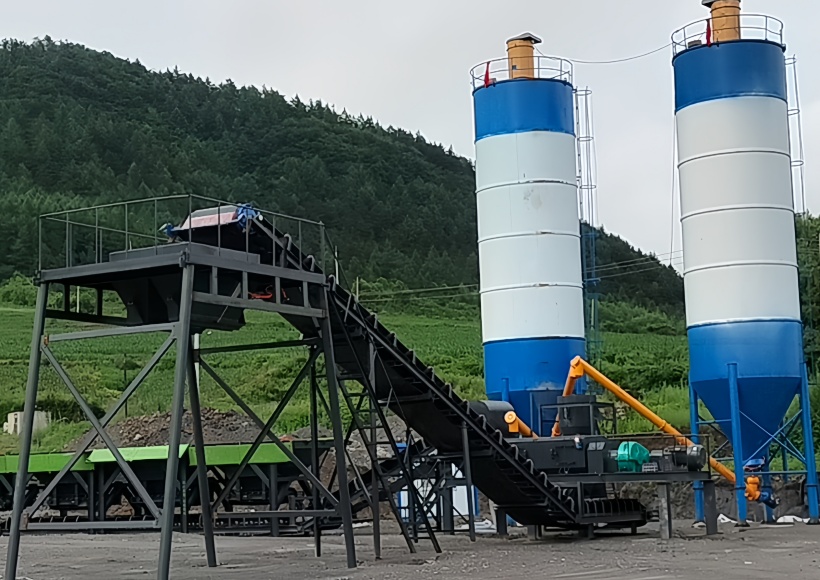
Let’s get one thing straight immediately. Most manuals detailing how to calibrate a batch plant are written by people who have never stood ankle-deep in mud, staring at a control panel that tells them the cement dosing is perfectly in tolerance, while the actual output looks like wet soup. In the real dirt-and-iron world of construction and foundation engineering, relying on factory default settings is the fastest way to bleed your profit margins dry through rejected loads and material waste.
If you are running a continuous pugmill or a heavy-duty mixing station, the stakes are completely different from standard block making or residential concrete production. You are dealing with vicious aggregates, sticky binders, and brutal compaction requirements. Therefore, executing a rigorous stabilized soil mixing plant calibration is not some bureaucratic chore to appease an inspector. It is your primary defense against inconsistent concrete and catastrophic structural failures on the job site.
The Brutal Reality of Concrete Batching Plants vs. Soil Stabilization
Paper pushers often confuse standard concrete batching plants with stabilized soil operations. They think the calibration procedure is a simple copy-paste job. It isn’t. Standard concrete mixing focuses heavily on slump and workability. Stabilized soil operations—often utilizing continuous mixers or high-capacity batch setups—care about maximum dry density, optimum moisture content, and relentless throughput.
When you calibrate a standard setup, you are looking at precise, isolated batches. But in soil stabilization, especially with continuous flow, the dynamic weighing systems on your conveyor belts are subjected to brutal mechanical vibrations. If you are using top-tier equipment from manufacturers like ตงซิน แมชชีนเนอรี่, you will notice they engineer heavy-duty isolation mounts for their weigh belts and hoppers to mitigate this. But even the best hardware on earth suffers from load cell drift over time. Wind shear against a 100-ton cement silo can actually trick the load cells underneath it into registering false weight fluctuations. If your operator doesn’t understand the difference between dead weight span calibration and everyday tare drift, you are already losing money on every batch.
The Pre-Calibration Audit: Finding the Hidden Gremlins
Before you even touch the control panel or bring out the certified test weights, you need to tear down the mechanical bottlenecks. Calibration improves accuracy only if the mechanical baseline is sound.
I have seen operators spend six hours tweaking the software parameters on their concrete batching plant calibration screen, only to realize that a buildup of hardened slurry was physically wedging the weigh hopper against the structural frame. If the hopper isn’t hanging perfectly free, your load cells are lying to you.
Check your butterfly valves and pneumatic gates. Are they leaking? A weeping valve on the water dosing line will slowly alter your mix design long after the batch plant computer says the dose is complete. Inspect the aeration pads inside your cement hopper. When operators blast pressurized air into the silo to break up bridging (where cement compacts and stops flowing), that pressurized air exerts downward force. I’ve seen this artificial pressure trigger the cement weighing scale prematurely, shorting the actual cement dose by up to 5%. This is the kind of real production nightmare that causes inconsistent concrete performance.
The Hardcore Calibration Procedure: A Step-by-Step Guide
Stop relying on the digital readout as gospel. The only truth in a batch plant is physical mass. Here is the step-by-step concrete batching plant calibration guide that actually works in the field.
1. Zeroing the Empty Scale (Tare)
First, empty every hopper. And I mean genuinely empty. Get a hammer, tap the sides of the aggregate bins, and make sure no damp sand is clinging to the corners. Once the hoppers are physically clean, verify that the control panel reads zero. If it bounces, you have electrical interference, a bad ground on the load cell shield, or mechanical friction. Fix it before moving to step two.
2. The Incremental Dead Weight Test (Span Calibration)
This is where the actual stabilized soil mixing plant calibration happens. You cannot simply throw a single heavy weight on the scale and call it a day. You need certified test weights, and you need to load them incrementally to test for linearity and hysteresis (the scale’s ability to return to zero accurately after a load is removed).
Load the test weights to 25%, 50%, 75%, and 100% of your maximum working capacity. Record the indicated weight at each step. If your target is 2000 kg, and at 1000 kg of certified weights the screen reads 990 kg, you have a negative drift. More importantly, when you pull the weights off incrementally, does the scale read the exact same numbers on the way down? If the readings differ on the way down, your load cell is fatigued or structurally bound.
3. Aggregate Dosing and Belt Scales
In continuous mixing setups commonly used for soil stabilization, aggregate weighing often happens dynamically on conveyor belts rather than in static hoppers. Calibrating a dynamic weigh belt is an entirely different beast. You must measure the empty belt weight (tare) over a complete revolution, compensating for belt thickness variations and idler roll eccentricity. Then, perform a material drop test: run a specific tonnage of aggregate across the belt, dump it into a truck, and run that truck over an independent, certified weighbridge. Compare the actual output with the plant’s recorded output. If they don’t match, you adjust your pulse-per-ton factor in the PLC.
The Moisture Minefield: Aggregate Moisture and Water Meters
If you want to completely ruin your concrete quality, ignore the aggregate moisture. Sand and crushed stone absorb water and hold surface moisture. In the morning after a heavy rain storm, your aggregate might be holding 8% moisture. By 3 PM, baking in the sun, it might be down to 2%.
If your mix design calls for 1000 kg of aggregate and 100 kg of water, and your aggregate is holding 5% moisture, you are inadvertently dumping 50 kg of hidden water into your mixer. Your workability will turn to soup, your slump will collapse, and the structural integrity of the mixed concrete will fail.
You must calibrate your microwave or resistance moisture probes routinely. However, remember that microwave probes only read the material directly in front of the ceramic faceplate. If sticky, wet clay builds up on the sensor, it will lock the reading at a high percentage, tricking the control panel into severely cutting the actual water dosing.
As for water meters, forget volumetric estimates. If you are using flow meters, verify them against actual mass. Run the water into a barrel on a calibrated floor scale. Volumetric measurement techniques are highly susceptible to changes in water pressure and pump VFD (Variable Frequency Drive) fluctuations. Mass never lies.
Cement Dosing Nightmares: Fighting Bridging and Flighting
Cement and pulverized fuel ash (PFA) are notoriously difficult to control. They behave like solids one minute and like fluids the next. Accurate calibration of cement weighing requires understanding the flow characteristics.
When cement is heavily aerated to get it out of the silo, it flows like water through the butterfly valves, often leading to over-dosing due to in-flight material (the cement that has passed the valve but hasn’t hit the scale yet). The calibration workflow must include adjusting the “pre-act” or “in-flight” tolerance settings on your control panel. The computer needs to tell the valve to close a fraction of a second before the target weight is hit.
I’ve audited plants where the calibration logs looked perfect, but the actual real production showed massive material waste. Why? Because the operators had bypassed the fine-dosing phase to speed up batch times, relying purely on the coarse feed. The scales were perfectly calibrated, but the mechanical delivery was too aggressive, resulting in a 3% cement overrun on every batch. When you process 1000 tons a day, that overrun destroys your profitability.
Admixture Dispensers: Viscosity and Temperature
Chemical admixtures—whether retarders, accelerators, or stabilizers—are usually dosed in very small quantities. Therefore, any error is amplified. Admixture dispensers often use volumetric measurement, such as graduated cylinders or flow meters.
Here is the industry secret: admixture viscosity changes dramatically with ambient temperature. An admixture that flows like water at 30 degrees Celsius might pump like thick syrup at 5 degrees Celsius. If your calibration procedure was done in the heat of summer, your winter dosing will be sluggish and inaccurate, leading to under-dosing. You must calibrate admixture dispensers seasonally and verify the calibration by discharging into a graduated beaker to visually audit the amount of liquid against the digital reading.
Documenting the Truth: Calibration Logs and Audits
A proper stabilized soil mixing plant calibration is useless if you don’t document it. And I don’t mean scribbling “Looks Good” on a clipboard. Traceability is everything.
Your calibration logs need to record the ambient temperature, the specific serial numbers of the certified test weights used, the initial unadjusted readings, and the final verified readings. This creates a historical baseline. If you notice that load cell #2 on your aggregate hopper consistently drifts by -15 kg every month, you don’t just keep calibrating it; you replace it, because it is actively failing. Rigorous audits separate professional operations from amateur hour. Partnering with reliable vendors like ตงซิน แมชชีนเนอรี่ ensures you have access to systems with robust data logging capabilities, making these routine audits seamless and tamper-proof.
In conclusion, calibrating your plant is not a one-and-done event. It is a relentless, incremental fight against mechanical wear, environmental variables, and operator complacency. Treat your weighing systems with the brutal skepticism they deserve, verify everything with physical mass, and you will produce the kind of consistent, high-strength stabilized soil that builds enduring infrastructure.
คำถามที่พบบ่อย
1. How often should a stabilized soil mixing plant be calibrated?
While industry standards typically mandate a full scale check and calibration every 6 to 12 months, best practice in high-volume or harsh environments dictates a quick dead-weight verification monthly. If the plant is moved or experiences a severe physical impact (like a loader striking a hopper), recalibration must be performed immediately.
2. Why does my aggregate scale reading fluctuate even when nothing is loading?
This is usually caused by mechanical friction or electrical noise. Check to ensure the weigh hopper isn’t rubbing against the main chassis or a discharge chute. Electrically, ensure the load cell cables aren’t running parallel to high-voltage lines for VFDs, which can induce current and cause the digital weight readout to bounce.
3. What is the difference between tare weight and span calibration?
Tare weight refers to the zero point—calibrating the scale to read zero when the hopper is completely empty. Span calibration adjusts the ratio of the scale, ensuring that an addition of exactly 1000 kg of physical weight results in an exactly 1000 kg increase on the control panel’s digital readout. Both must be accurate for proper dosing.
4. How do aeration pads affect cement weighing accuracy?
Aeration pads blow compressed air into the cement silo to fluidize the material and prevent bridging. If activated while the weigh hopper below is taking a reading, the pressurized air can exert a downward force on the hopper or suspend the cement artificially, causing the load cells to register an inaccurate weight.
5. Can I use volumetric measurement instead of weigh scales for continuous mixing?
While some older continuous pugmills use volumetric gates (adjusting the height of a gate over a moving belt), gravimetric measurement (using weigh belts or loss-in-weight systems) is vastly superior. Volumetric systems cannot compensate for changes in material bulk density or moisture, inevitably leading to inconsistent concrete quality.