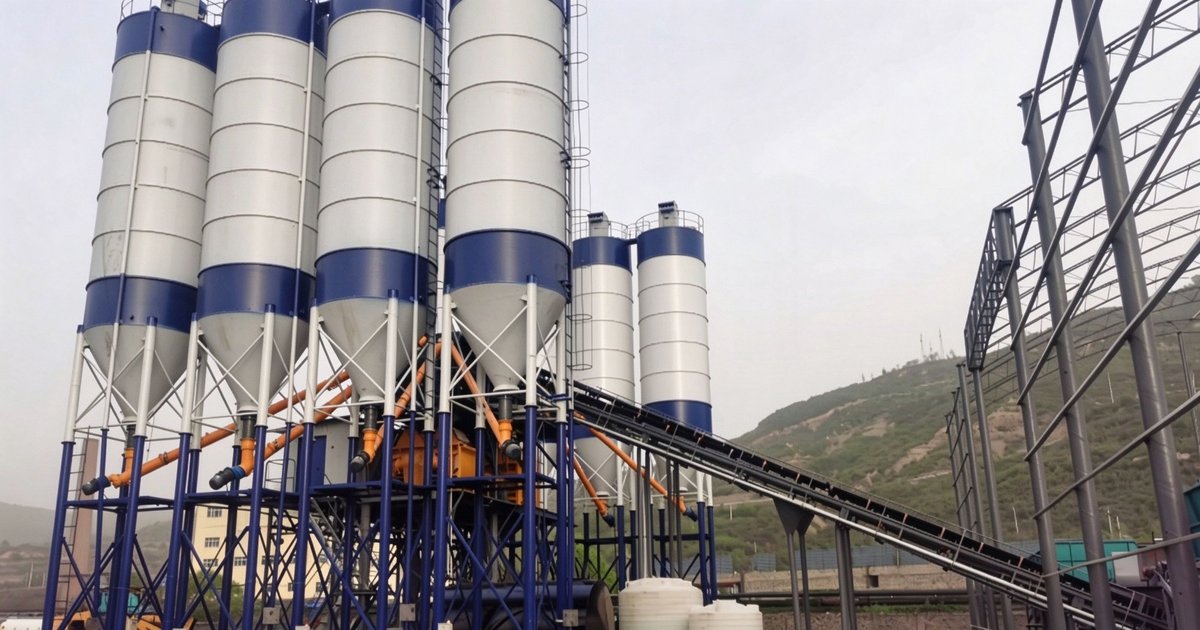


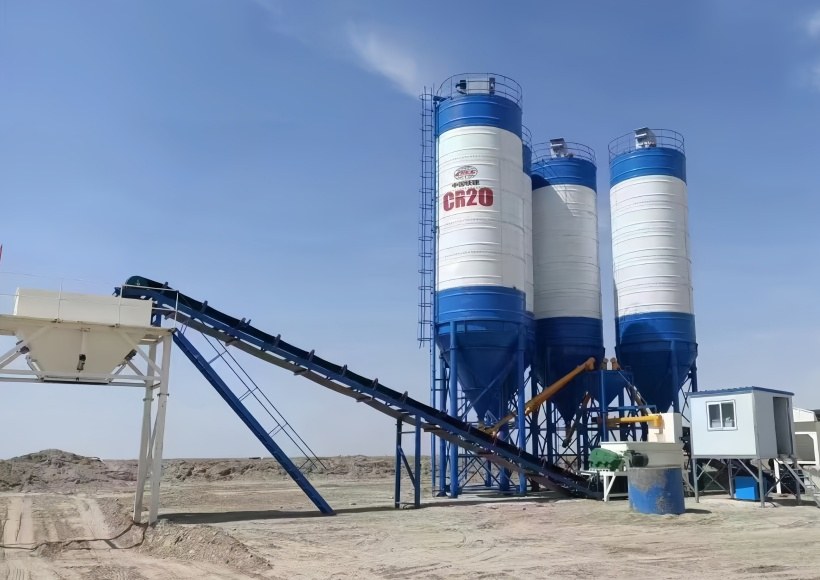
Bolted cement silos, also called modular or prefabricated cement silos, have become the mainstream bulk cement storage solution for concrete mixing plants, large construction sites, and industrial projects that need flexible relocation. Instead of shipping one welded monolith, the silo arrives in curved steel segments that are bolted together on site.
This article, written by a professional cement silo equipment manufacturer, covers the structure, operating principle, real advantages, the full installation process, and the price factors behind a bolted cement silo, so you can compare options with real numbers rather than marketing talk. Whether you are equipping a new plant, replacing an old silo, or exporting a complete mixing station, the bolted design changes how you plan transport, crane work, and future moves.
Structure and Operating Principle of a Bolted Cement Silo
A bolted cement silo keeps the same job as any bulk cement storage silo, but it is built from modular components. The cylindrical body is not one continuous welded shell. Instead, each silo wall panel is rolled into an arc by a large press brake and shipped flat, then assembled with high-strength bolts on site. This is what makes the bolted cement silo different from a monolithic welded silo, and it drives nearly every downstream benefit in transport, installation, and relocation.
1.1 Modular Steel Plate Body
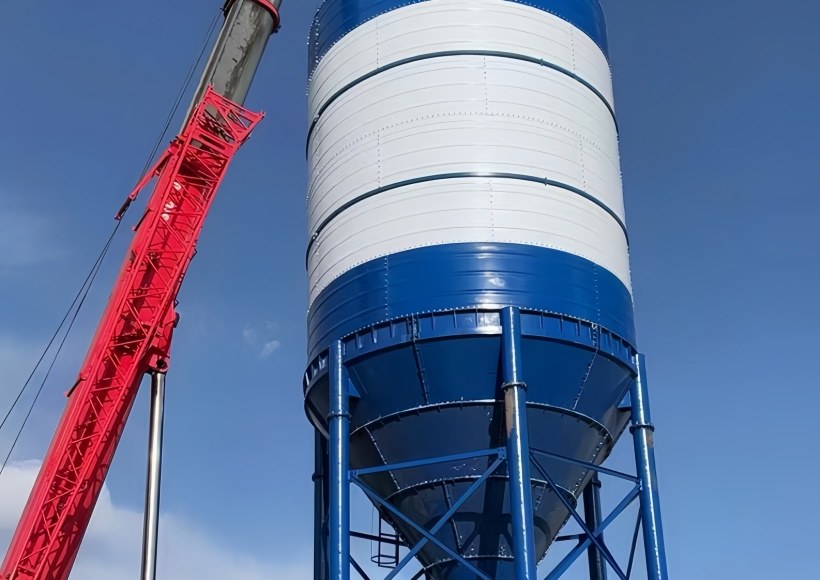
The silo shell is formed from several rows of curved steel plates. Each plate carries pre-drilled bolt holes along its edges, and adjacent plates are joined with high-strength bolts and sealing strips. The number of rings depends on the target capacity. A 100-ton bolted cement silo, for example, typically uses four to five stacked rings of plates. Because the plates bolt together rather than weld together, the silo can be disassembled later and moved to a new site without cutting or scrapping the shell.
1.2 Support Legs and Foundation Interface
Below the body, welded steel pipe legs carry the full load to a concrete foundation. The leg set includes cross bracing, and the bottom cone section funnels cement into the screw conveyor or pneumatic discharge. Leg height is standardized to match the inlet height of the silo feeding system, so the silo mates with the existing plant layout. If the site foundation is weak, an independent foundation plan can be designed before installation.
1.3 Dust Collection, Arch Breaking, and Level Monitoring
Three supporting systems keep the silo safe and accurate in daily operation. A pulse-jet bag dust collector on the top prevents cement dust from escaping during filling. An arch breaking device, available in air-blowing or vibration type, clears material bridges that form when moist cement compacts inside the cone. A level meter, typically rod-type or capacitance-type, reports the material level in real time so the batching system never runs a cement silo empty or overflows it. These components bolt onto the top structure and are serviceable from the safety railing platform.
| Component | Function | Typical Material / Type |
|---|---|---|
| Silo shell | Bulk cement storage | Curved steel plates, bolted joints |
| Legs | Support and discharge clearance | Welded steel pipe with cross bracing |
| Dust collector | Capture dust during filling | Pulse-jet bag filter |
| Arch breaking device | Prevent material bridging | Air-blowing or vibration type |
| Level meter | Real-time level monitoring | Rod or capacitance type |
| Ladder and guardrail | Safe access to top platform | Hot-dip galvanized steel |
In daily operation, cement is delivered pneumatically into the top of the silo through the filling pipe, passes the dust collector inlet, and settles into the cone. Discharge starts at the bottom, where the screw conveyor or pneumatic conveying system carries cement to the weigh hopper of the batching plant.
The level meter and arch breaking device work together: if the level reading stops changing while the conveyor keeps running, an arch has formed and the breaking device clears it before the batching cycle is interrupted. Because every component is bolted and flanged, a failed part is replaced in hours, not by cutting into the shell.
Main Features and Advantages Over Monolithic Cement Silos
The bolted cement silo exists because it solves the two biggest problems of a one-piece welded silo: oversized transport and impossible relocation. For concrete batching plant owners, rental operators, and contractors who move between projects, these differences decide the real cost of ownership.
2.1 Lower Transport Cost
Because the bolted cement silo ships as flat steel plates and small components, one container can carry a full silo that would otherwise need a low-loader or a disassembled-but-still-bulky load. In practice this cuts shipping volume and freight cost by more than 40 percent compared with a monolithic silo of the same capacity, and it makes export by sea container practical for overseas projects.
2.2 Real Relocation Ability
A monolithic silo can only be moved by crane as one heavy unit, and it is usually abandoned in place or sold with the site. A bolted cement silo can be unbolted, packed into containers, and reassembled at the next project. That makes it the standard choice for rental plants, mobile mixing stations, and highway or dam projects that relocate every one or two years.
2.3 Stability and Customization
Bolted construction is sometimes assumed to be weaker than welding. In practice the bolted cement silo uses the same structural steel grade as welded silos, and the bolted rings are pre-engineered for full load. The silo capacity can be customized from 50 to 200 tons, and the leg height, cone angle, and discharge flange can be adjusted to match the plant. If you run a non-standard layout, the manufacturer can adjust the silo size during production rather than forcing a standard unit onto your site.
| Comparison | Bolted cement silo | Monolithic welded silo |
|---|---|---|
| Transport | Flat plates, container-friendly | Oversized load, special transport |
| Installation | Bolted assembly, 1-2 days | Whole-unit crane lift |
| Relocation | Disassemble and reuse | Usually scrapped on site |
| Transport cost saving | Over 40% lower | Baseline |
| Best for | Rental, mobile, export projects | Permanent fixed plants |
Environmental rules for mixing plants in many markets now require dust control at every cement transfer point. A bolted cement silo ships with a pulse-jet bag collector sized to the filling rate, and the bolted joints with sealing strips keep the shell dust-tight in normal operation. When a plant must pass an environmental inspection, the bolted design avoids the common problem of welded silos whose top vents were never upgraded, because the top platform is designed from the start to carry a modern filter.
Detailed Installation Process
Installing a bolted cement silo follows seven steps, and a standard 100-ton unit is normally erected and commissioned within one to two days with a small crane and a four- to six-man crew. Site conditions are the main variable; the assembly sequence itself is fixed.
3.1 Foundation and Preparation
Step one is foundation inspection. The concrete pad must reach the design strength and the anchor bolt pattern must match the silo leg plan. Check the level across all anchor positions, because a tilt here cannot be fully corrected later by shims. At the same time, clear the assembly area so the crane has room to swing plates into position without reaching over workers.
Before ordering, confirm three site conditions: the crane radius available at the foundation position, the power supply for the dust collector and level meter, and the access road for the truck that delivers the plate bundles. None of these stops a bolted cement silo installation, but they change the crew plan and the time needed, and it is cheaper to adjust leg height or plate ring count in production than to fix a mismatch on site.
3.2 Assembly Sequence
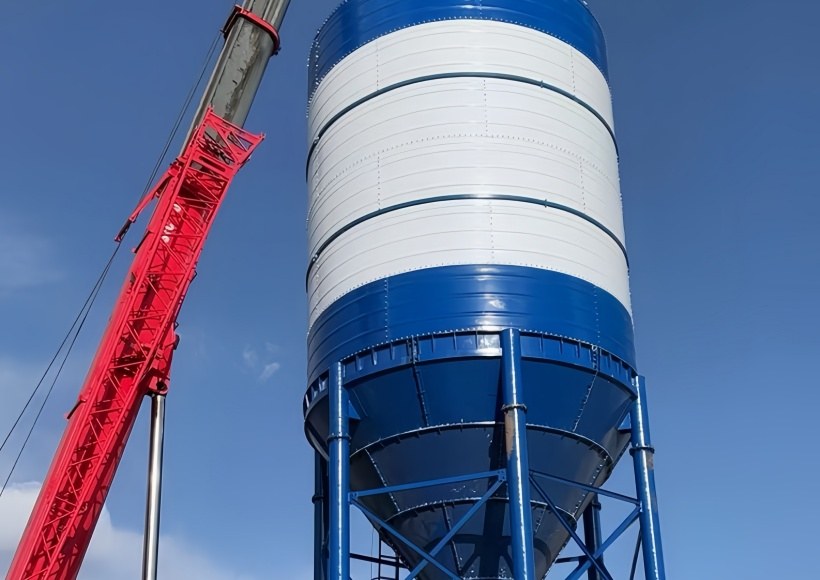
The sequence is bottom first, then walls, then top. The bottom bracket is leveled and bolted to the anchors. Silo wall plates are lifted and joined ring by ring, with bolts torqued to the specified value on each row before the next row starts.
The top structure, including the dust collector platform and safety railings, is installed after the last ring. Accessories, ladders, level meters, and the discharge system follow. Finally, the crew performs a full inspection of bolted joints, sealing strips, and the dust collector, then runs a load test by gradually feeding material and observing the level reading, the discharge flow, and the dust collector action.
| Step | Work content | Key check |
|---|---|---|
| 1 | Foundation inspection | Concrete strength, anchor pattern, level |
| 2 | Bottom bracket installation | Leveling and alignment |
| 3 | Silo shell assembly | Bolt torque, ring by ring |
| 4 | Top structure installation | Dust collector platform, railings |
| 5 | Accessory installation | Ladder, level meter, discharge |
| 6 | Overall inspection | Joints, sealing, collector |
| 7 | Load test run | Gradual filling, discharge, dust control |
Price Factors and Reference Ranges
The price of a bolted cement silo is set by capacity, material and surface treatment, accessory brand, and customization. Steel price fluctuations in the market also move quotes, sometimes noticeably between quarters, so treat any fixed number as a reference point and ask the manufacturer for a current quote.
4.1 What Actually Drives the Price
Capacity is the largest single factor because more plates, more rings, and a heavier leg structure are needed as volume grows. Material and craftsmanship come second: high-quality structural steel, shot blasting, and anti-corrosion treatment raise cost but extend service life well beyond 15 years, which usually pays back faster than saving a few percent on a cheaper coating. Accessory brand matters for the dust collector and arch breaking device, where the difference between a reliable pulse-jet filter and a budget unit shows up in maintenance hours.
Finally, customization such as non-standard height, special discharge flanges, or a strengthened leg set for high wind zones adds engineering and production cost.
4.2 Capacity-Based Price Reference
As a working reference from recent supply, a small bolted cement silo of 50-80 tons is priced around $6,429-$7,857. A medium unit of 100-150 tons falls around $7,143-$10,000. Large units of 200 tons and above start at about $11,429. These ranges assume standard dimensions, standard accessories, and sea-freight-friendly packaging. For a plant that moves between projects, remember to add the transport saving of a bolted silo into the comparison, because the effective cost difference against a monolithic silo is smaller than the list prices suggest.
| Capacity range | Reference price | Typical application |
|---|---|---|
| 50-80 tons | $6,429 – $7,857 | Small plants, single-cement batching |
| 100-150 tons | $7,143 – $10,000 | Standard commercial mixing plants |
| 200 tons and above | From $11,429 | Large stations, multiple silo banks |
For overseas orders, export packaging is included in the bolted design: curved plates are packed in bundles with edge protection, bolts and sealing strips are boxed and labeled by ring, and the whole silo fits a standard 20-foot or 40-foot container depending on capacity. That is why bolted cement silos dominate export projects, where a monolithic silo would require special oversized transport and break-bulk handling at the destination port.
Frequently Asked Questions
How long does it take to install a bolted cement silo?
A typical 100-ton bolted cement silo can be installed and commissioned within 1-2 days, assuming the foundation is ready and a crane is available on site.
What is the service life of a bolted cement silo?
With high-quality structural steel and proper anti-corrosion treatment, a bolted cement silo can serve more than 15 years, including multiple relocations if it is re-erected correctly.
Does Tongxin Machinery provide installation guidance?
Yes. We provide professional installation guidance with drawings, and we can dispatch technicians for on-site guidance on larger projects.
What maintenance does a bolted cement silo need?
Regularly inspect the dust removal system, clean or replace the filter element, and check the tightness of the bolted joints, especially after the first month of operation and after each relocation.
How good is the sealing performance?
The bolted cement silo uses specialized sealing strips and high-strength bolts at every joint. Properly assembled, the sealing performance fully meets normal operational requirements without visible dust leakage.
As a professional bolted cement silo manufacturer, Tongxin Machinery produces silos from 50 to 200 tons with full quality control and export packaging. Contact us for the current cement silo price and a technical solution matched to your plant layout. You can also review our concrete batching plant price analysis to see how silo cost fits into a full plant budget, or check how Tongxin Machinery builds its production and quality system.