
Mass concrete in a dam body bears little resemblance to the ready-mix that ordinary construction projects consume. Binder contents run as low as 120-180 kg/m³, coarse aggregate reaches 150 mm across four gradings, and placing temperature is commonly specified in the 7-14°C band regardless of ambient conditions. Meeting those numbers is not a mixing problem alone – it is a materials-handling, thermal-control, and automation problem that has to be engineered as one system from the aggregate bins to the ice plant. Experience on modern hydro projects has settled the argument: a batching plant for dam construction is specified, procured, and commissioned differently from the concrete batch plant that serves a highway interchange or a precast yard. The differences that matter are concrete family, thermal load, and placement tempo – and each one pushes project requirements back against conventional equipment design.
What Types of Concrete Must a Dam Batching Plant Produce?
Three families of concrete dominate dam work, and a plant optimized for one will under-deliver on the others if the mix-design brief was written loosely.
Mass concrete forms the dam body itself. Low heat of hydration governs everything: moderate-heat or low-heat cement, fly ash replacement of 30-50% where the specification allows, and the four-grade aggregate blend noted above. The result is a mix that may only need C15-C20 strength yet must demonstrate near-zero permeability and negligible drying shrinkage. In practice that means accurately batching 150 mm stone through 60-90 s mixer cycles without degrading the coarse fraction – as much a wear-part and discharge-aperture question as a weighing question.
Roller-compacted concrete behaves more like a zero-slump granular fill than a suspension. Consistency is controlled by Vebe time rather than slump, placement proceeds in 300 mm lifts, and the vibratory roller must compact each layer before the fresh window closes. The plant therefore becomes the pacing item for the entire crest: any interruption in concrete production longer than initial set breaks placement continuity and leaves a cold joint the owner’s engineer will want treated. Continuous batching capability and repeatable accuracy matter more here than peak nameplate capacity.
Structural concrete – C30 and C40 grades, high-strength work relative to the dam body – covers spillway walls, galleries, powerhouse substructures, and penstock surrounds, and it runs through the same site, often in the same shift as a mass pour. Batching different grades back to back, switching between a four-graded, ice-chilled dam-body mix and a pumped C40 wall mix within minutes, is precisely where commercial concrete plants built around a single high-performance product line fall short of modern construction project needs.
Stationary and Mobile: How Do Types of Batching Plants Fit Dam Project Needs?
Choosing among the types of concrete batching deployed on a dam – stationary, mobile, or both – is a question of sequencing, not preference.
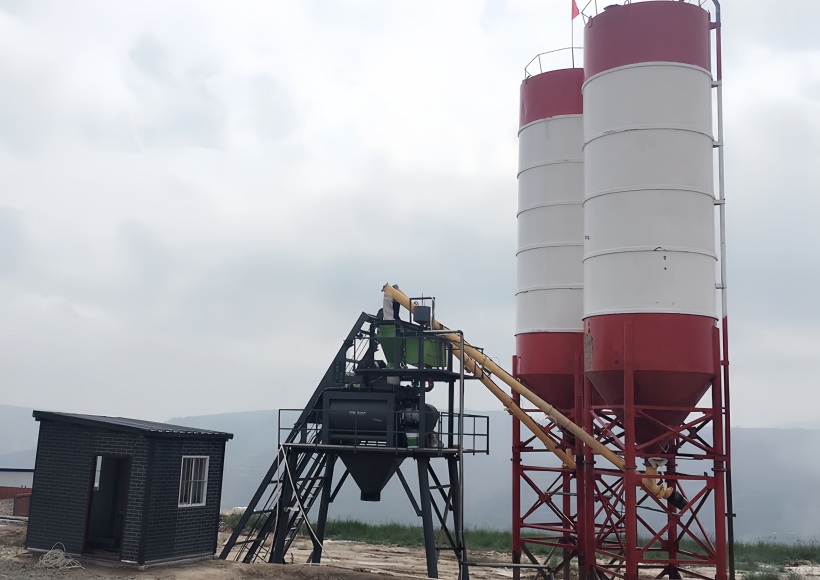
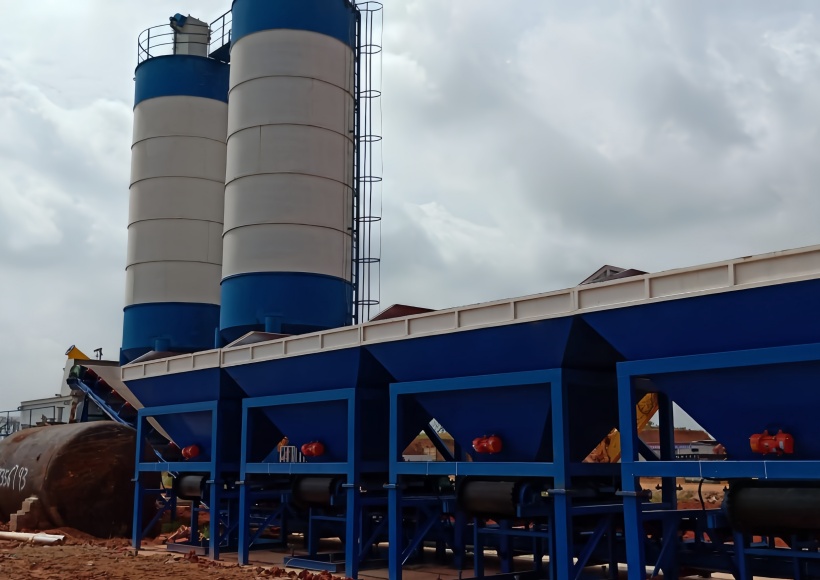
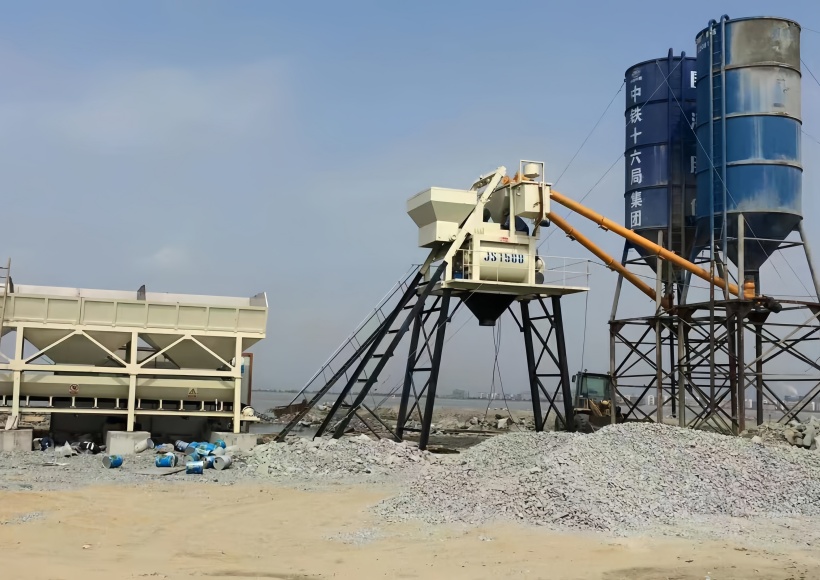
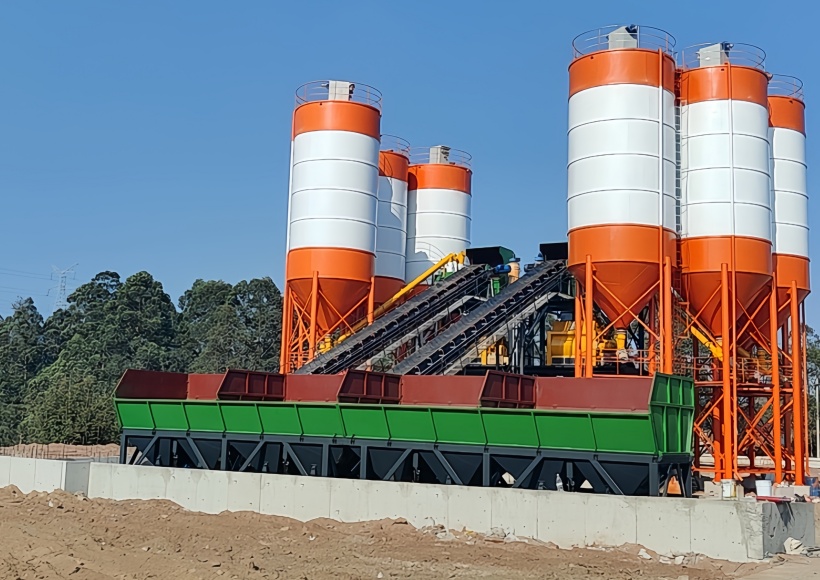
A stationary concrete batching plant anchors the dam-body pour for the life of the project – four to eight years of high-volume production is normal for a large-scale gravity section, a duration rare outside long-term projects. That justifies investment that would never pay back on shorter work: four to six aggregate bins of 200-500 t each with provision for chilled or insulated walls, multiple cement silos separated by binder type (cement, fly ash, and in some markets GGBS), and high-capacity screw conveyors feeding dedicated weigh batchers. Wet mix stationary lines in the 240-360 m³/h class are ideal for large-scale gravity sections and comparable large infrastructure pours; treat any figure as indicative until the placement schedule is loaded against the shift structure. A single line sized to the average monthly pour instead of the peak month is a scheduling error, not a saving.
A mobile concrete batching plant earns its keep on the perimeter: cofferdam sealing, diversion channel lining, access roads, and tunnel portals – early works that must be produced on-site and on demand before the central plant is commissioned, in space constraints that often rule out fixed civil works. Quick setup, faster installation, and relocation as work fronts move are the whole point, along with freedom from hauling ready-mix from distant concrete suppliers. Mobile plants in the 60-120 m³/h class typically cover these duties, and they retain value afterward as redundant capacity during the peak season – a buffer of operational efficiency and greater flexibility that most dam schedules eventually need.
What Mixer and Capacity Configuration Handles High-Volume Concrete Demand?
Twin shaft mixers are the construction industry’s default answer for dam duty, and the argument is not close.
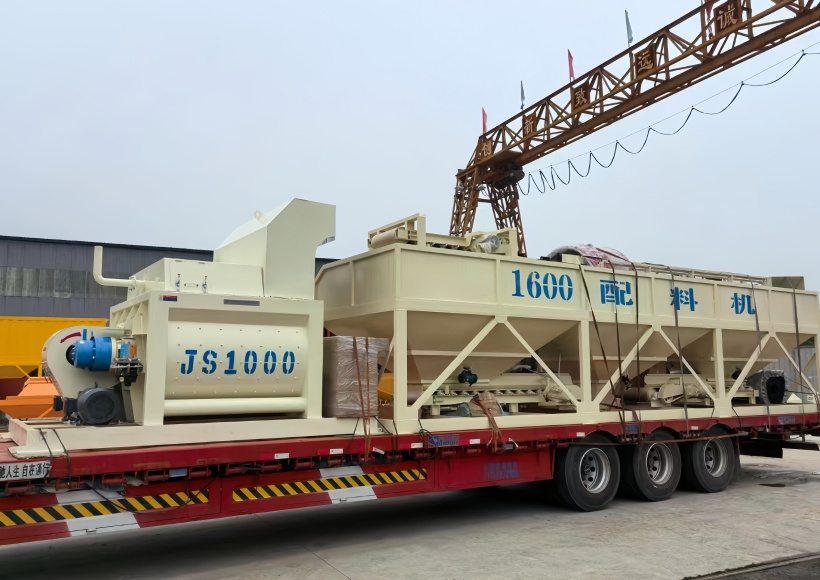
For 150 mm aggregate, large twin-shaft machines homogenize low-paste mass concrete in roughly 45-60 s per batch while the counter-rotating axes fold the coarse fraction rather than smashing it. Wear-part strategy matters more than the mixer’s purchase price: arms, liners, and discharge gates on a high-capacity line are consumables, and liner hardness, fit tolerance, and change-out time belong in the procurement specification rather than in a post-delivery discovery process. Tilting-drum mixers remain a defensible choice for very large stone in some legacy layouts, but they trade mixing intensity for gentleness, and the longer cycle times rarely suit RCC tempo. Anyone evaluating a Concrete Batching Plant for dam work should ask for the mixer power curve at target batch mass, not a brochure cycle time.
Production capacities follow the placement schedule, not the nameplate. Sum the peak month’s placement volume, divide by available plant hours in that month, then apply a 75-80% utilization factor for maintenance, aggregate handling, and changeovers between mix designs. On-site aggregate storage capacity should cover three to five days of peak production – at remote construction sites a barge or rail delay is a logistical certainty, not a contingency.
Why Is Thermal Control the Critical Factor in Dam Concrete Production?
Every special requirement on a dam plant traces back to one variable: heat.
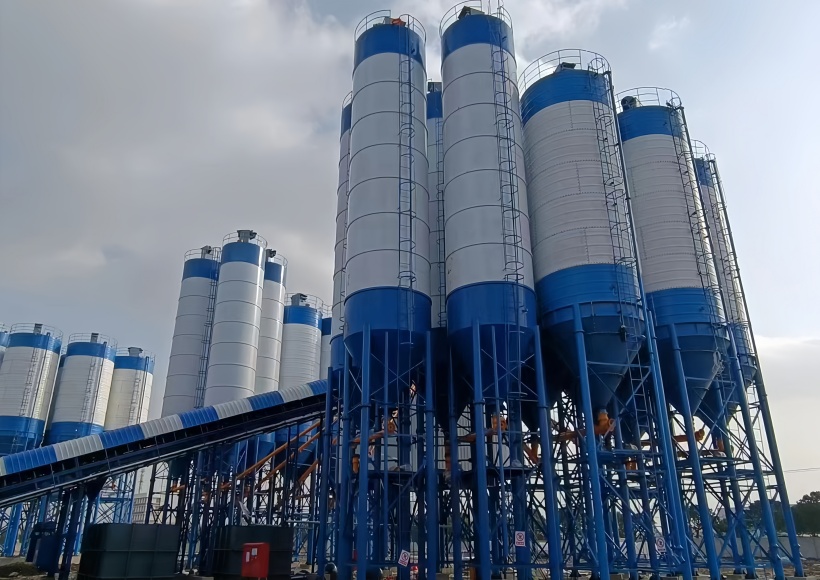
Hydration heat in a 2-3 m lift cannot escape quickly, and the adiabatic temperature rise of the binder drives a cracking risk that no downstream remediation fully repairs. The production-side levers are limited and well understood: chilled mixing water held near 2-5°C, flake ice replacing a large share of batch water at the summer peak (a ratio set by the project’s thermal model – 50-70% is a common working band, but it must be verified rather than assumed), and air-cooled or water-sprayed aggregate storage to pull stockpile temperature down before batching. The plant has to integrate all of it. When ice substitutes for water, moisture-probe compensation and dosing interlocks decide whether Vebe time – and with RCC, the compaction window – stays inside specification.
This is where automation separates adequate plants from excellent ones. Weighing ice, chilled water, and each admixture on separate scales with interlocked discharge, logging every batch, and alarming on out-of-tolerance dosing turns thermal control from an operator skill into an equipment guarantee – and the batch records the owner’s quality plan demands come out of the same system as a by-product, with production efficiency improving as a side effect.
How Do You Choose the Right Concrete Batching Plant for a Dam Project?
The most cost-effective plant solution is chosen on total operating costs across the pour schedule, not on purchase price. Energy consumption dominates that calculation – chilling, ice production, and conveyor runs dwarf the mixer’s draw – followed by maintenance labor and spare-part lead times to a remote site. A line with a higher initial investment but accessible wear parts and a control system that tracks calibration drift will usually beat a cheaper plant on cost per cubic meter by the second season.
Accuracy belongs in the contract in writing: cementitious materials within ±1%, aggregates within ±2%, water and admixtures within ±1% – the lineage of ACI 304 and ASTM C94, tightened where the dam specification demands it. Verify it at the factory before shipment. Tongxin Machinery subjects every dam-class line to witnessed load tests: batching scales calibrated against certified test weights to ±0.5% of full scale, twin shaft mixers run at full batch mass with vibration and power curves recorded, control cabinets checked point to point, and a 72-hour continuous dry-run of the batching logic. The same FAT pack – calibration certificates, mixer test curves, wear-part schedule – travels with the plant, so commissioning on a remote site starts from evidence rather than trust.
Track record matters in this narrow field. Tongxin Machinery has delivered Concrete Batching Plant lines for hydro and dam programs – twin-line RCC installations, mobile batch units for cofferdam and access-road works – and that experience shows in details owners notice early: discharge apertures sized for 150 mm stone, silo separation for fly ash, and bin walls prepared for cooling retrofits. The right batching plant for dam construction is ultimately the one whose builder has already made the expensive mistakes on someone else’s project.
FAQs
What production capacity does a dam concrete plant actually need?
Size to the peak placement month, not the average. Divide peak monthly volume by available plant hours, apply a 75-80% utilization factor, then confirm the mixer class and aggregate handling can follow. Large gravity sections typically land in the 240-360 m³/h band; RCC crests run higher through continuous placement.
Can one plant produce both RCC and conventional mass concrete?
Yes – provided twin shaft mixers and a control system holding multiple mix designs were specified from the start. The plant must switch formulas within one batching cycle and log every batch separately, so that consistent, high-quality concrete is documented rather than asserted.
How much flake ice does dam concrete require?
The ratio comes from the project’s thermal model; 50-70% of batch water at the summer peak is a common working band, but it must be verified against the specified placing temperature. Ice production capacity, not mixer capacity, is often the true ceiling in hot climates.
Stationary or mobile – which fits a dam site?
Both, sequenced. Mobile plants cover cofferdams, diversion channels, and access roads during early works; the stationary line carries the dam body once commissioned. Mobile units then stay on as redundancy at the seasonal peak.
What batching accuracy should the contract enforce?
Cementitious materials within ±1%, aggregates within ±2%, water and admixtures within ±1% – verified at factory acceptance with certified test weights, in the ACI 304 and ASTM C94 lineage, tightened where the dam specification requires.