

A wrong transformer can shut down a new concrete batching plant on its first production day. Sizing mistakes show up as tripped breakers, voltage sag, or a transformer that runs hot in summer and still cannot start the mixer motor. This guide walks through concrete batching plant transformer selection in five practical steps, with a worked example for an HZS120 plant, a full model-by-model sizing table, and a buyer checklist you can hand to your electrical engineer.
Tongxin Machinery has supplied mixing plants to projects from Vietnam to Uzbekistan, and the same question comes up in nearly every negotiation: how much transformer capacity does this plant really need? The answer is never the nameplate power of the mixer alone. This article explains how the complete concrete mixing plant electrical load is calculated, why power factor changes the kVA number, and how to make concrete batching plant transformer selection that is neither oversized nor undersized.
Why Transformer Sizing Matters for a Batching Plant
A concrete batching plant transformer selection error cuts two ways. Undersize the transformer and you get frequent motor starts that drag the voltage down, nuisance trips on the mixer contactors, and brownouts during the peak morning pour. Oversize it and you pay a higher demand charge every month, spend more on the transformer cabinet and cable, and run the unit at such low loading that no-load losses dominate your energy bill.
In most markets where Chinese-made batching plants are installed, the utility bills include both an energy charge and a capacity or demand charge based on the contracted kVA. That means the transformer rating you choose is not only a purchase cost — it is a monthly operating cost for the life of the plant. A plant with a 400 kVA transformer when 315 kVA would do will typically pay a noticeable capacity premium for years. This is why concrete batching plant transformer selection has to be treated as an economic decision, not just an electrical one.
Electrical Loads That Define Plant Power Demand
Total plant power is the sum of the rated power of every motor and heating element on site, not the power of the mixer alone. The main groups are:
- Mixer unit: the twin-shaft or planetary concrete mixer is the single largest consumer. A JS1000 twin-shaft mixer on an HZS60 plant draws roughly 37 kW under load; a JS2000 on an HZS120 plant draws about 75 kW.
- Aggregate conveying: inclined belt conveyors and flat belts, sized by output tonnage and lift height. An inclined belt for an HZS120 plant is usually in the 15–30 kW range.
- Powder conveying: screw conveyors for cement and fly ash, typically 2–4 units at 5.5–11 kW each depending on silo-to-mixer distance.
- Liquid supply: water pumps and admixture pumps, usually 3–7.5 kW combined.
- Pneumatic system: air compressor for silo aeration and butterfly valves, often 7.5–15 kW.
- Control and lighting: PLC cabinet, sensors, hydraulic station and site lighting, typically 5–15 kW depending on the automation level.
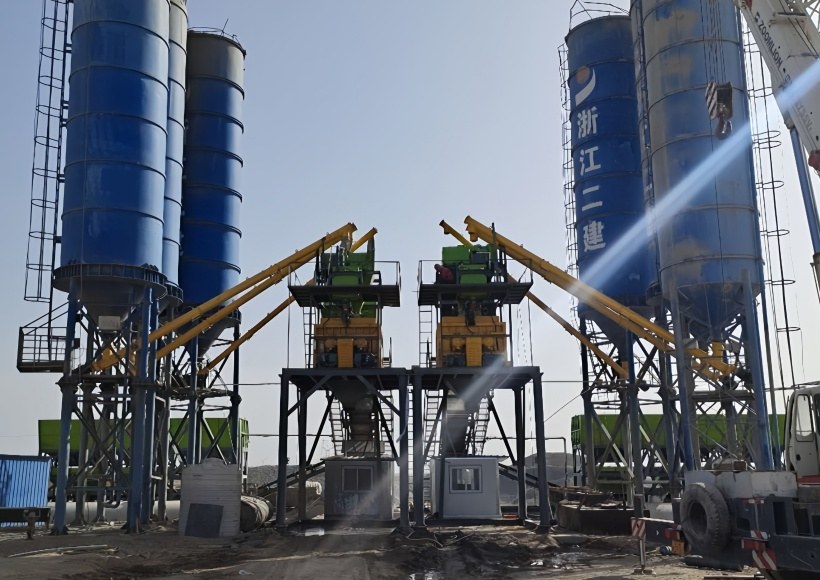
Adding these rated values gives the installed power. For an HZS120 plant the installed power is around 200 kW; for an HZS180 plant it reaches roughly 235–250 kW. These are the numbers you will see in the equipment manual, and they are the starting point for concrete batching plant transformer selection.
kW, kVA and Power Factor: What Actually Matters
A frequent confusion in concrete batching plant transformer selection is the difference between kilowatts and kilovolt-amperes. Motors consume both active power (kW), which does useful work, and reactive power (kVAr), which magnetizes the motor windings. The transformer must supply both, so its rating is expressed in kVA, the vector sum of the two.
The relationship is:
Transformer capacity (kVA) = Total active power (kW) ÷ Power factor (PF)
A typical batching plant runs with a power factor between 0.75 and 0.85 without correction, depending on the share of motor load and the number of lightly loaded motors. With capacitors installed, the plant can hold 0.9 or higher. The lower the power factor, the more kVA you must install for the same kW, which is why adding capacitor banks is often cheaper than buying a bigger transformer.
Five-Step Concrete Batching Plant Transformer Selection Method
Use the following sequence so the result can be defended to a utility engineer or an investor, not guessed.
Step 1: Build the Electrical Equipment List
Request a full list of motors, pumps, heaters and control loads from the plant manufacturer, with rated kW for each. Do not rely on the brochure’s headline figure — confirm whether it includes the compressor, the screw conveyors and site lighting.
Step 2: Apply a Demand Factor
Not everything runs at full load at the same moment. During a standard production cycle the mixer draws full current, but the screw conveyors alternate with it. A demand factor of 0.65–0.85 is typical for a batching plant. Multiply the installed power by the demand factor to get the calculated load. For an HZS120 with 200 kW installed, use 0.85 for a plant that runs heavy cycles: 200 × 0.85 = 170 kW.
Step 3: Convert to kVA with a Realistic Power Factor
If the plant has no power factor correction, assume PF = 0.8. Then the required capacity is 170 ÷ 0.8 = 212.5 kVA. If a capacitor bank is fitted and PF = 0.9 is maintained, the same load needs only 189 kVA — a real saving on the transformer and on the demand charge.
Step 4: Add Margin for Start-Up and Growth
Motor starting current is five to seven times the running current, and the transformer must ride through the worst simultaneous start without collapsing the voltage. Add 25–50% margin over the calculated kVA for starting surge, plus reserve for a second production line or an extra silo. The HZS120 example therefore moves from about 213 kVA to a practical 300–400 kVA range.
Step 5: Round Up to a Standard Transformer Rating
Transformers come in standard capacity steps — 100, 125, 160, 200, 250, 315, 400, 500, 630 kVA and above. Round the practical requirement up to the next standard size. The HZS120 plant lands at 315 kVA as the economic choice, with 400 kVA justified when ambient temperature is high, power quality is poor, or a second mixer is planned.
Transformer Size Reference Table by Plant Model
The table below is a practical reference compiled from Tongxin Machinery installations. Treat it as a starting check, then verify with the actual equipment list for your configuration.
| Mixing Plant Model | Mixer Unit | Installed Power (kW) | Recommended Transformer (kVA) |
| HZS25 | JS500 | 45–60 | 80–100 |
| HZS35 | JS750 | 55–75 | 100–125 |
| HZS50 | JS1000 | 80–105 | 125–160 |
| HZS60 | JS1000 | 95–120 | 160–200 |
| HZS75 | JS1500 | 120–135 | 200–250 |
| HZS90 | JS1500 | 145–160 | 250–315 |
| HZS120 | JS2000 | 180–200 | 315–400 |
| HZS180 | JS3000 | 235–250 | 400–500 |
| HZS240 | JS4000 | 275–300 | 500–630 |
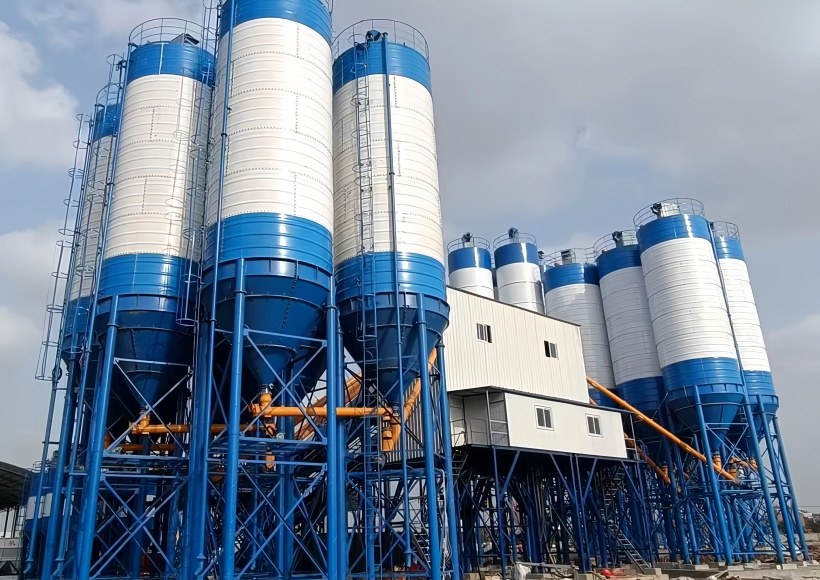
For HZS90-grade plants, our dedicated HZS90 concrete batching plant power transformer guide adds load tables, sizing schemes and a real Vietnam retrofit case. The same calculation discipline applies to every concrete batching plant transformer selection exercise.
Five Factors That Change the Transformer Size
Standard sizing gets adjusted by site conditions. The five factors below are the ones that actually change the final kVA figure in concrete batching plant transformer selection.
Power Supply Distance
Long feeder lines add voltage drop. If the transformer sits 200 m or more from the grid connection point, either increase the transformer one step or use a larger cable cross-section. Voltage drop under full mixer load is often the hidden reason a plant “cannot start” in the morning.
Grid Quality
Rural grids in many markets fluctuate by ±10% or more. Where voltage is unstable, a larger transformer and better surge handling pay for themselves in fewer downtime hours. Electrical components should comply with International Electrotechnical Commission (IEC) standards, and a voltage stabilizer or AVR is worth quoting for weak-grid sites.
Other Station Loads
Offices, weighbridge, laboratory and yard lighting are part of the plant’s total load and must be included in the transformer calculation. Forgetting the site office is a classic cause of an undersized transformer on the first full working day.
Ambient Temperature
Transformer rating assumes a reference ambient temperature. In tropical climates above 40 °C, derate the transformer by roughly 1% per degree above reference, or move up one standard size. A plant in Nigeria or Indonesia should not use the same sizing as one in a temperate region.
Production Nature
Continuous production with short idle windows stresses the transformer thermally; intermittent production lets it cool between batches. High-utilization projects justify a larger transformer, while a plant producing only a few hours a day can run closer to the calculated minimum.
Buyer Checklist for Transformer Procurement
When you negotiate transformer supply with the plant manufacturer or a local electrical contractor, use this checklist to keep concrete batching plant transformer selection disputes out of the contract.
- Confirm the electrical equipment list itemizes every motor and pump with rated kW, and that the total matches the installed power in the brochure.
- Ask for the calculation sheet behind the recommended transformer size, including demand factor and power factor assumptions.
- Check whether the quote includes the transformer cabinet, incoming cable, earthing kit and lightning protection — these are frequent omissions that surface as “extra costs” on site.
- Confirm the transformer brand and standard (IEC 60076 is the common reference) and ask for the type test certificate before payment.
- If your site has poor grid quality, request a quote for capacitor banks and a voltage stabilizer at the same time — cheaper than buying a larger transformer later.
Documentation matters as much as the hardware: a manufacturer that can hand over wiring diagrams, load calculations and a test certificate is also the one whose equipment manufacturing quality is worth trusting. When comparing suppliers, follow our step-by-step guide on how to choose a concrete equipment manufacturer to evaluate welding quality, quality control, documentation and lifecycle cost on the same terms.
Frequently Asked Questions
What is the minimum transformer capacity for an HZS90 concrete batching plant?
The theoretical minimum is about 160 kVA, but Tongxin Machinery recommends 250 kVA or higher so the plant starts cleanly and keeps a safety margin for voltage dips and future additions.
What are the risks of oversizing the transformer?
Oversizing raises the initial purchase cost, increases the monthly capacity or demand charge, and pushes the transformer into a low-load operating zone where no-load losses make up a bigger share of consumption — the “big horse pulling a small cart” problem.
Can one transformer power two production lines?
Yes, with a professional load study. Two HZS120 lines typically need 500–800 kVA, and the simultaneous-start current surge must be checked before connecting them to one transformer.
What is the difference between kW and kVA for a batching plant?
kW is the active power that does the mechanical work; kVA is the total apparent power the transformer must deliver, including reactive power from motor magnetizing. The two are linked by the power factor, and the transformer is always rated in kVA.
Do I need a standby transformer?
For a single-plant site, a standby transformer is usually not economical; a well-sized unit with a spare breaker and a quick-change procedure covers most practical failures. For ready-mix operations with a guaranteed supply contract, a second unit may be justified by the penalty cost of downtime.
Does a mobile batching plant need a different transformer?
Mobile and containerized plants face the same load math but are often connected at temporary sites with weaker grids. Budget for a larger transformer or a generator backup on remote sites, and confirm the site’s available short-circuit capacity with the utility before finalizing concrete batching plant transformer selection.
Conclusion
Concrete batching plant transformer selection comes down to five numbers: installed power, demand factor, power factor, start-up margin and standard rating. Work through them in order, keep the equipment list from the manufacturer, and round up to the next standard size. A 315 kVA unit serves an HZS120 well; a 400–500 kVA unit covers an HZS180. Include the site office in the load, derate for hot climates, and check the grid before you sign.
Tongxin Machinery supplies concrete mixing plants with complete electrical documentation, load calculations and one-stop after-sales support. Contact our engineers with your plant model and site conditions, and we will confirm the transformer rating for your project.