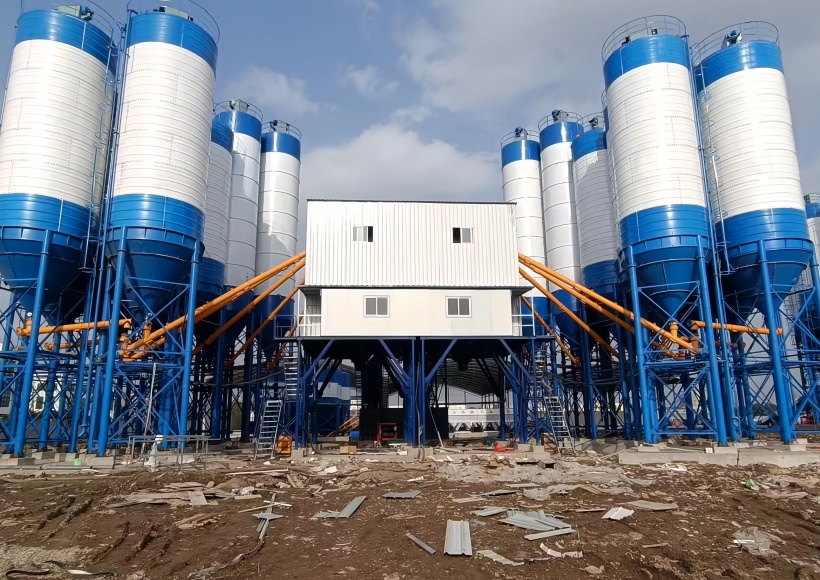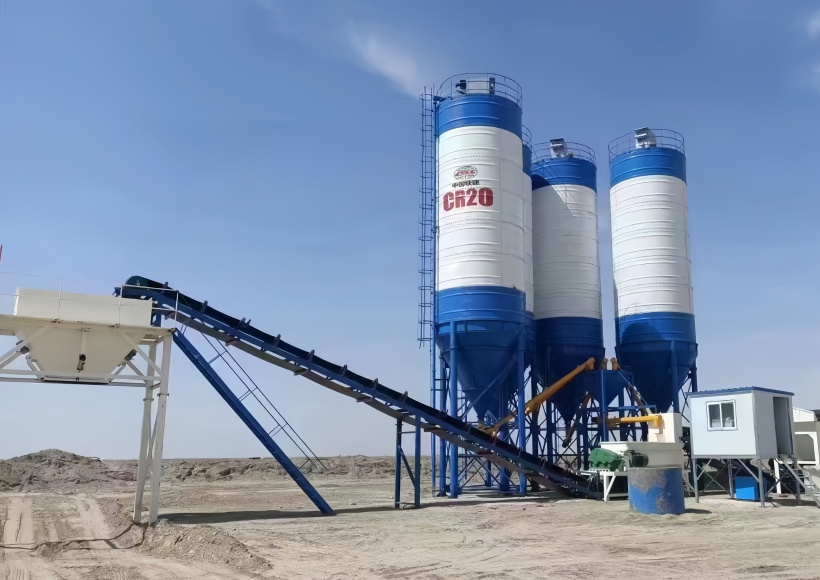









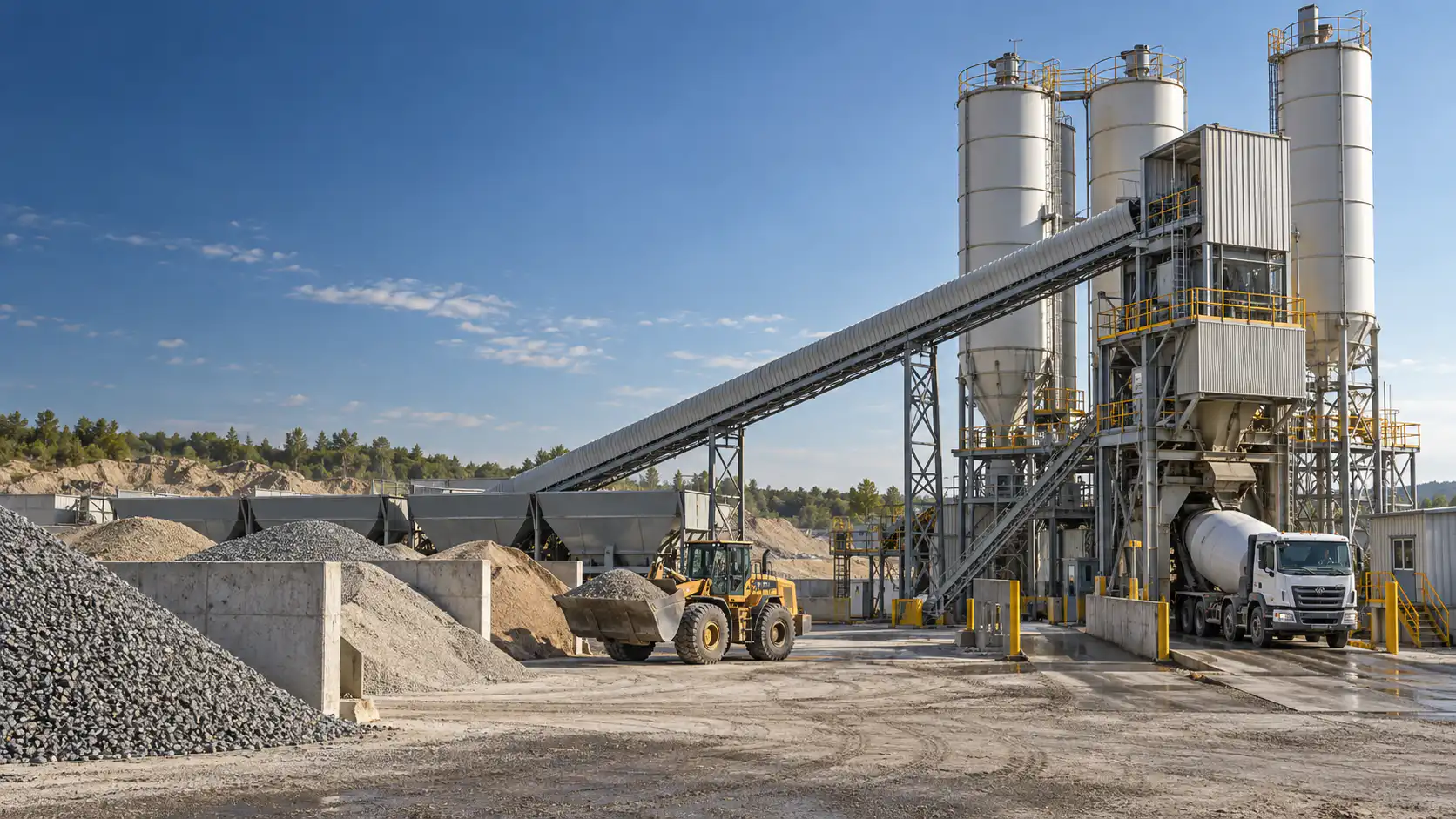
A бетонный дозатор, also called a concrete batch plant, is a production system that stores, measures, conveys and combines the materials used to make concrete. Those materials typically include aggregates, cementitious powders, water and admixtures. The system may mix the batch at the plant or load measured materials into a transit mixer for downstream mixing, depending on the production method.
For a first-time buyer, that explanation is useful but incomplete. The hard part is not recognizing the equipment on a site. The real decision is whether a proposed plant can meet the job’s concrete volume, mix designs, material deliveries, site footprint, truck flow, weather conditions, duration and support needs after commissioning.
This guide begins with the working principle, then moves into types, components and selection. It is aimed at contractors, ready-mix operators, precast producers and project teams assessing a concrete batching plant before requesting a quote.
Concrete Batching Plant at a Glance
| Buyer question | What needs to be established | Why the answer matters |
| What does the plant have to produce? | Peak hourly demand, daily demand, continuous-pour duration and project term | Prevents selection by model name alone |
| Where will concrete be mixed? | Dry batch, central mix or another defined process | Changes the mixer, discharge process, transport plan and quality-control responsibilities |
| Which materials will be used? | Aggregate fractions, powders, water, admixtures and moisture variation | Determines bins, scales, silos, conveyors and dosing equipment |
| How will the site operate? | Loader route, transit-mixer route, material deliveries, drainage, power and water | Determines whether the layout is workable after installation |
| What support is required? | Commissioning, training, wear parts, documents and troubleshooting route | Affects long-term availability, not only the purchase price |
What Is a Concrete Batching Plant and What Does It Do?
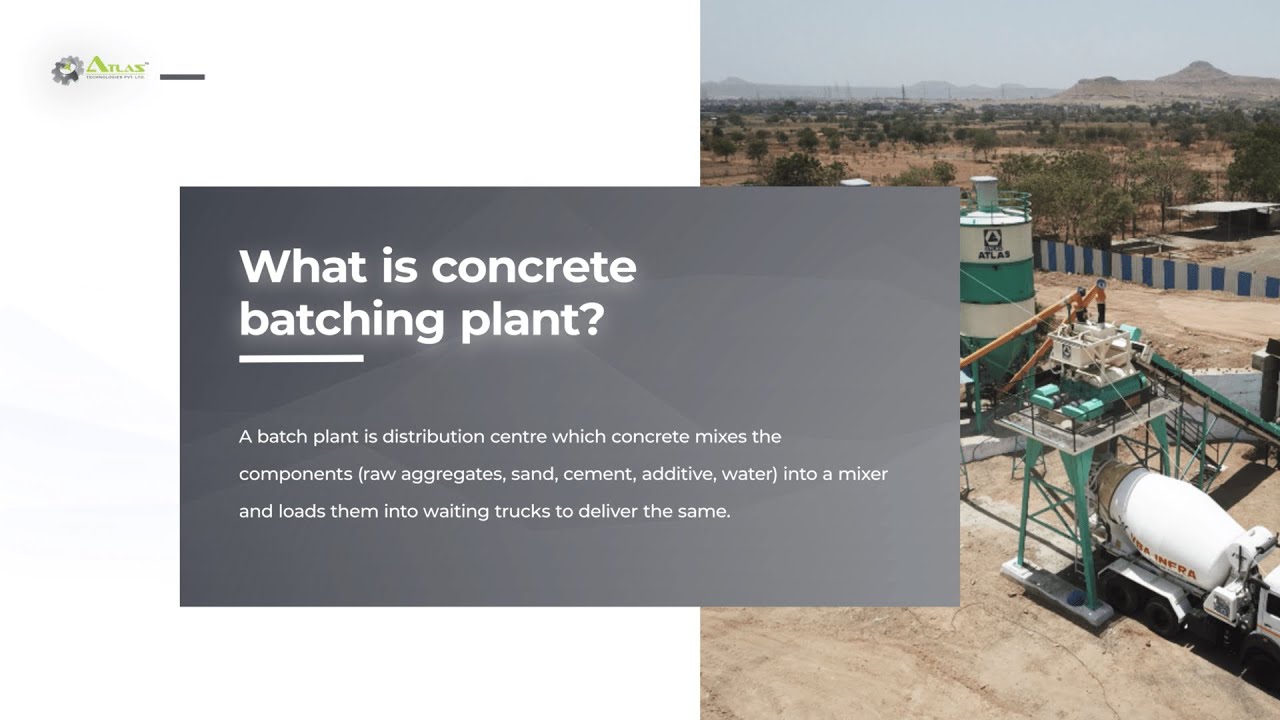
At its core, a concrete batching plant turns a mix design into repeatable batches. It does this by measuring each ingredient, transferring it in the planned sequence and controlling the point at which materials are mixed or loaded. The system exists to remove guesswork from proportioning. A loader bucket and a stand-alone mixer can make concrete, but they do not provide the same repeatability, batch records or production rhythm as a coordinated batching system.
The term can be confusing because a buyer may use “concrete plant,” “concrete batch plant,” “ready-mix plant” and “concrete mixer” as if they mean the same thing. They do not.
| Term | What it usually means | What the distinction changes |
| Concrete batching plant | The full system for measuring and handling concrete ingredients | How do we produce concrete consistently at the required scale? |
| Бетономешалка | The machine or drum that combines materials | What creates the mixing action, and is it suitable for the recipe? |
| Ready-mix concrete plant | A batching operation organized around producing and dispatching concrete to customers or project sites | Can the plant sustain storage, dispatch and quality control across a working shift? |
| Dry batch concrete plant | A plant that measures and loads materials for downstream mixing, commonly in a transit mixer | Where does final mixing occur, and how is the handoff controlled? |
| Central-mix plant | A plant that uses an in-plant mixer before discharge | Does the project need the mixing stage controlled at the plant? |
The distinction has purchasing consequences. A buyer who needs only a бетономешалка should not be quoted a full batching system by default. Conversely, a project that requires several aggregate fractions, powder storage, recipe control and sustained output needs more than a mixer. It needs an integrated plant with compatible material-handling and weighing equipment.
| Selection principle: The number printed in a model name does not define a concrete batching plant. What matters is whether the complete system can deliver the required recipe, at the required rhythm, under the actual site’s conditions. |
How Does a Concrete Batching Plant Work?
The working principle is a sequence of controlled material movements. Each step affects the next one. A perfectly sized mixer cannot compensate for inaccurate aggregate weighing; accurate scales cannot maintain output if a silo runs empty or aggregate delivery blocks the truck route.
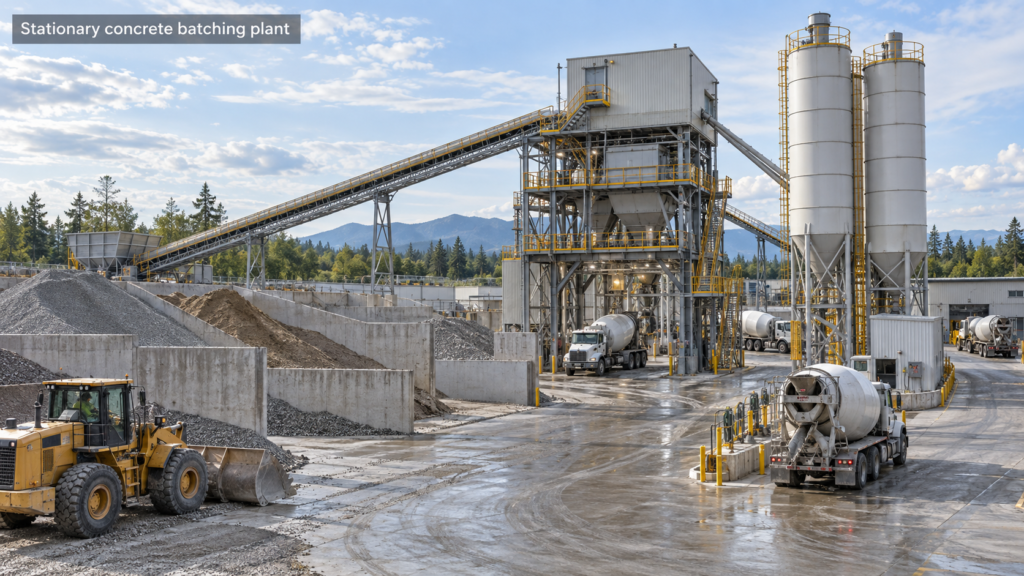
1. Aggregate is stored, separated and released
Sand, gravel and crushed stone are kept in separate bins or stockpiles. The plant releases the required fraction into a weighing hopper according to the active recipe. The number of bins should follow the mix design. A project using sand and two stone sizes needs a different aggregate arrangement from one using recycled aggregate, several stone grades or frequent recipe changes.
Сайт concrete batching machine is therefore not a minor accessory. It determines how materials are separated, how they are weighed and how quickly the next batch can be prepared. Before selection, confirm the number of aggregate types, maximum aggregate size, material moisture condition, bin capacity and how the loader will feed the bins.
2. Cementitious materials move from storage to the process
Cement and other approved powder materials are typically stored in silos and transferred through screw conveyors. The system must support the expected consumption rate without causing unnecessary delays, bridging or powder loss. Storage capacity should be considered alongside material-delivery frequency. A large silo does not solve a planning problem if delivery access is poor; a smaller silo can become a bottleneck if the plant consumes material faster than the supply plan allows.
Сайт cement silo category и screw conveyor category are useful places to inspect the equipment boundary. The supplier should still confirm the selected size, material path and connection arrangement against the actual layout.
3. Water and admixtures are measured at the correct stage
Water and admixtures are part of the recipe, not an afterthought added by feel. Water measurement needs to reflect the mixed design and the moisture already present in the aggregates. Admixtures may be used in relatively small quantities, but they can have a large effect on workability, setting behavior and repeatability. A plant that uses multiple admixtures or changes recipes frequently needs appropriate dosing, cleaning and control logic.
4. Each ingredient is weighed and verified
Load cells and control logic compare the released amount with the recipe target. The operator and control system need to recognize abnormal conditions, such as a scale failing to return to zero, a gate not closing correctly, an interrupted material feed or an out-of-range measurement. Batch records are useful only when the measurement system is maintained and the operator knows how to respond to exceptions.
5. Materials are mixed or loaded for downstream mixing
In central-mix production, materials enter a plant mixer and are blended before concrete is discharged. In dry-batch production, the plant measures and loads the ingredients into a transit mixer or another downstream mixer. The difference affects mixer selection, production sequence, truck coordination, cleaning requirements and quality-control responsibility.
6. Concrete is discharged and the next cycle begins
The batch is discharged to the appropriate vehicle, skip, hopper or process. At the same time, the plant prepares for the following cycle. Consistent production depends on this overlap being managed well: material must arrive before it is needed, trucks must not block the next discharge, and the operator must receive useful alarms before a small interruption turns into a lost pour.
Concrete Batching Plant Types: Which One Fits the Project?
Plant types describe two different things. Stationary, mobile, portable, compact and foundation-free describe how the plant is installed or deployed. Dry batch and central mix describe where the mixing stage takes place. One plant can sit in both groups, so treat these terms as configuration details rather than competing brand labels.
| Type | What it describes | A good fit when | Do not assume |
| Stationary | A long-term, site-built operating layout | Production will continue at one location and storage, dispatch and maintenance space are available | That every stationary plant is large or that civil work is simple |
| Мобильный | A configuration intended to move between projects | Relocation is part of the operating plan | That mobility removes setup, ground or material-storage requirements |
| Portable | A transport-oriented, rapidly deployable arrangement | The plant must be moved or installed with fewer permanent works | That it will meet every mix design or production rate |
| Compact | A reduced-footprint layout | Site area, access or surrounding infrastructure is constrained | That a small footprint solves material-delivery and loader-access problems |
| Foundation-free | A support approach that may reduce conventional foundation work | A temporary site and suitable ground have been assessed | That site preparation, leveling and load review are unnecessary |
| Dry batch or central mix | The location of the final mixing stage | The buyer needs to define process control and dispatch responsibilities | That one method is universally better |
Stationary concrete batching plants
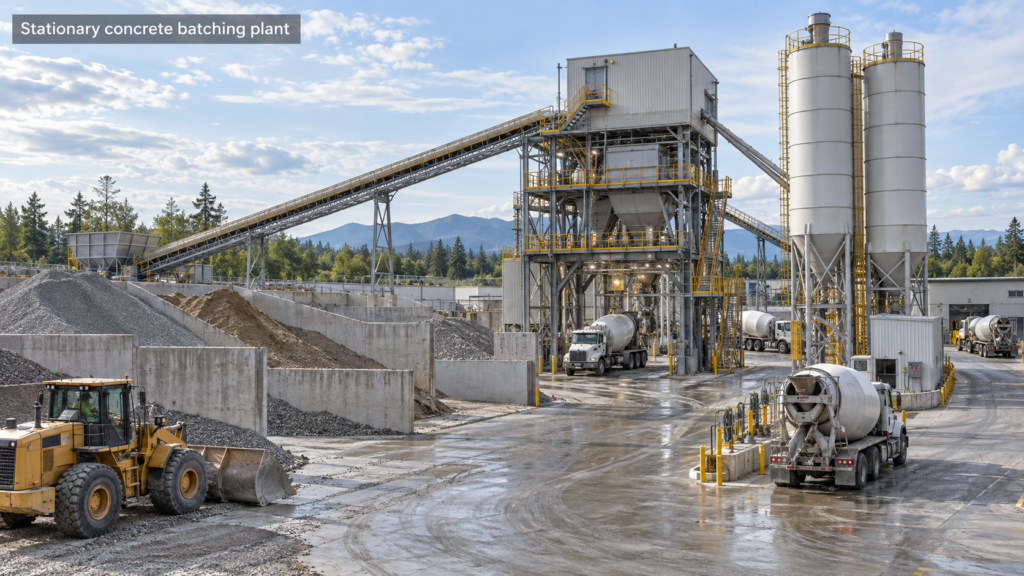
A stationary concrete batching plant is built around a durable operating layout. It commonly suits a ready-mix yard, a long-running infrastructure project or a precast facility where the team can justify defined truck lanes, aggregate stockpiles, powder storage, maintenance access and utility connections. Extra space can be used to reduce conflicts between loader movement, cement deliveries and concrete dispatch.
The trade-off is more upfront site commitment. Foundations or support works, drainage, electrical supply, dust management and installation planning must be resolved early. A stationary arrangement is a poor match for a site that will close soon or cannot support a safe material-flow layout, even if its quoted capacity is attractive.
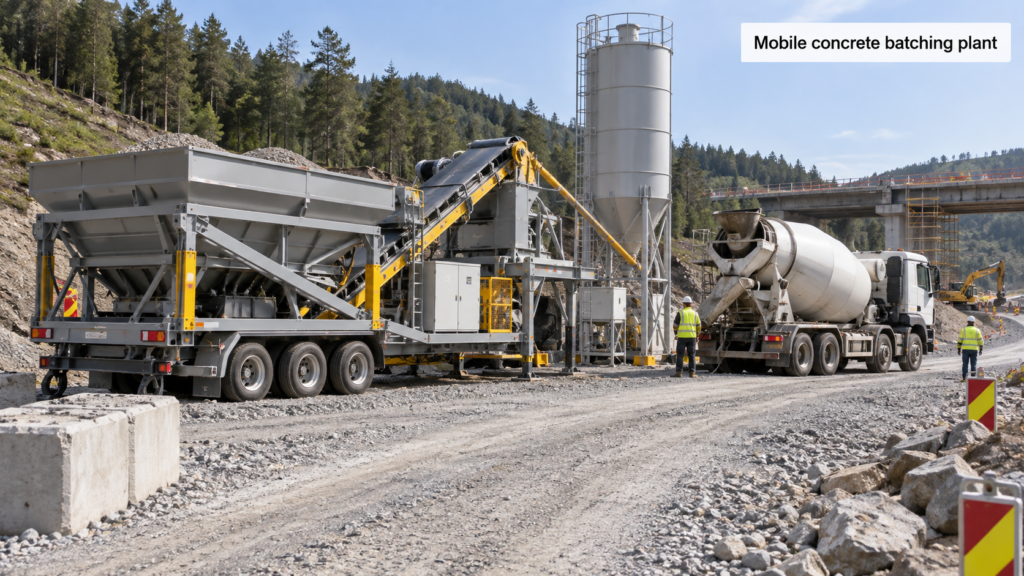
A mobile concrete batching plant is chosen when relocation is part of the job plan. Roadwork, remote infrastructure programs and contractors working across several sites may value a configuration that can be transported and recommissioned more readily than a permanent installation.
Moving the plant is only useful when the rest of the operation can move with it. Check the transport route, the number of loads, required lifting equipment, setup sequence, ground preparation, power and water connections, and the storage capacity available at each new site. A mobile frame does not prevent downtime caused by inadequate aggregate supply, silo access or truck circulation.
Portable concrete batch plants
A portable concrete batch plant emphasizes transportability and practical deployment. It can suit a smaller recurring job, a remote site or a contractor who needs local concrete production without creating a permanent yard. The term does not set a universal capacity or equipment list; suppliers use it for different configurations.
Before treating portability as the answer, map the busiest production hour. Confirm the number of aggregate fractions, usable bin capacity, loading method, expected powder consumption, available downstream mixer or transit mixer, and who will clean, inspect and operate the plant. A portable system is valuable when its material-handling limits still fit the work.
Compact concrete batching plants
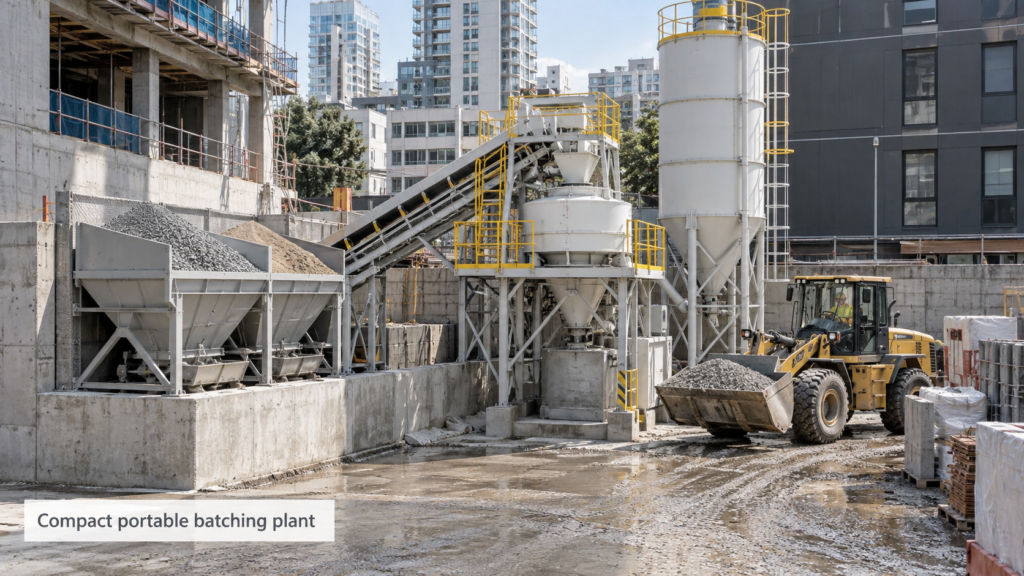
A compact concrete batching plant is designed to reduce the space occupied by the production line. This can be helpful in an urban project, a restricted industrial site or a location where access routes and stockpile space are tight. Compactness is about layout efficiency, not a guarantee of low output or low project cost.
The risk is transferring the space problem somewhere else. If a compact layout leaves no room for aggregate stockpiles, loader turning, cement delivery, washout or maintenance, the apparent space saving may slow the operation. Ask for a dimensioned layout that shows the equipment and the routes around it, rather than reviewing the machine footprint alone.
Foundation-free concrete batching plants
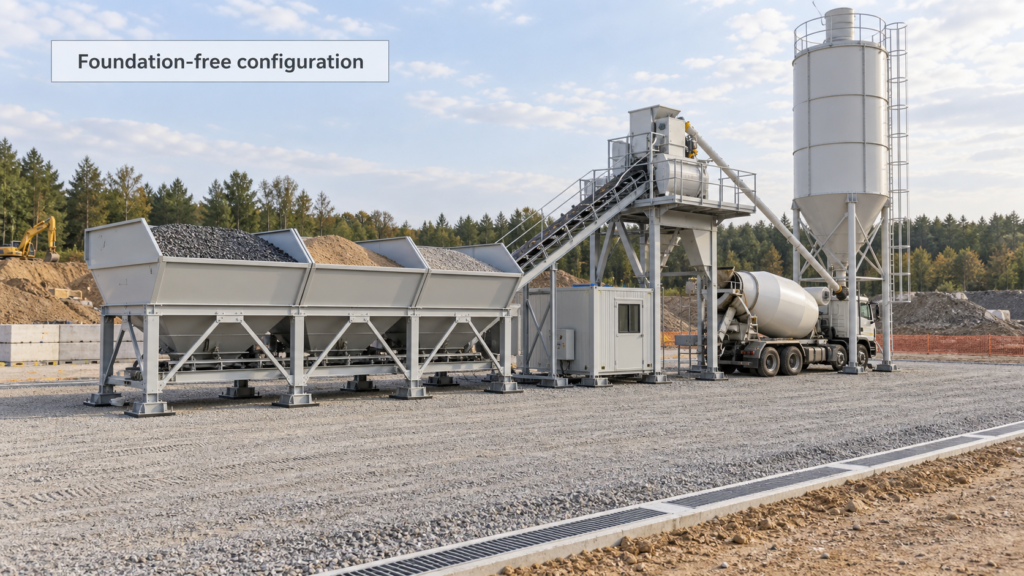
A foundation-free concrete batching plant may use a structural support arrangement intended to reduce conventional foundation work. It can be useful on a temporary site where civil work needs to be limited, provided the location has been reviewed for ground bearing, leveling, drainage, load distribution and safe access.
“Foundation-free” does not mean “site-preparation-free.” The responsible project team still needs to confirm the manufacturer’s support requirements, the site’s ground condition and applicable local requirements. Treat the term as a design feature that needs evidence in the proposed layout, not as permission to skip civil review.
Dry batch and central-mix plants
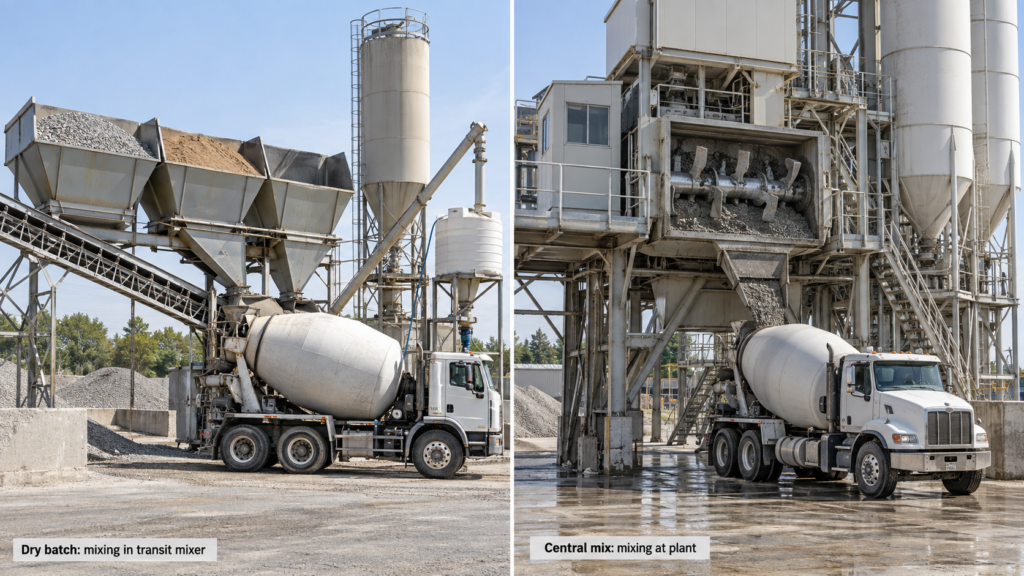
A dry batch concrete plant measures the ingredients and loads them for mixing downstream, commonly in a transit mixer. A central-mix plant uses an in-plant mixer to complete mixing before discharge. This changes the role of the бетономешалка, the batch cycle, cleaning routine, truck coordination and quality-control process.
Neither process is automatically the right choice. A ready-mix operation may use either arrangement depending on its mix designs, haul time, dispatch model and controls. Compare where final mixing occurs, who verifies the recipe, how long materials travel, how the mixer is maintained and how the team responds to moisture or weather changes. The wet mix versus dry mix concrete plant comparison explains that process distinction in more detail.
Main Parts of a Concrete Batching Plant
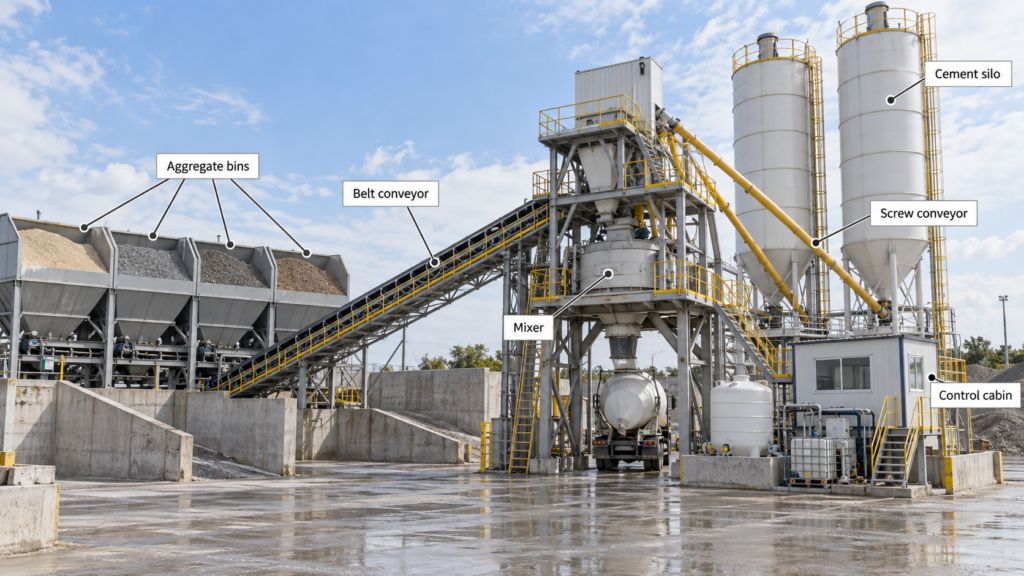
The main parts are easiest to understand in three groups: material storage and transfer, weighing and mixing, and control/support equipment. Each group carries a different risk if it is specified poorly.
Aggregate bins and batching machine
Aggregate bins hold separate sand and stone fractions. The batching machine releases them into a weighing hopper. This part of the system affects recipe flexibility, material segregation, loading efficiency and the time needed to prepare the next batch.
Buyers should verify bin count, usable volume, gate type, scale arrangement, maximum aggregate size, loading method and maintenance access. If the project switches recipes often, ask how the operator selects and confirms the correct aggregate proportion before the batch proceeds.
Aggregate feeding: belt conveyor or skip hoist
Aggregate must move from the weighing point to the mixer or discharge level. A belt conveyor can support continuous material movement and suits many larger layouts. A skip hoist can reduce the footprint where space is constrained. The choice has consequences for vertical clearance, maintenance, feed rhythm, wear, access and site design. The belt conveyor versus skip hoist article explains the selection questions in more detail.
In a central-mix system, the mixer is one of the core quality and output decisions. It needs to suit the mix design, aggregate size, required batch size, mixing time and cleaning routine. Mixer capacity should not be read in isolation. A large mixer paired with slow aggregate feeding or limited powder transfer will not produce its intended benefit.
Ask which mixer configuration is proposed, what the nominal batch volume represents, how wear parts are accessed, how the mixer is cleaned, and which materials or mix conditions would require a different configuration.
Cement silo and screw conveyor
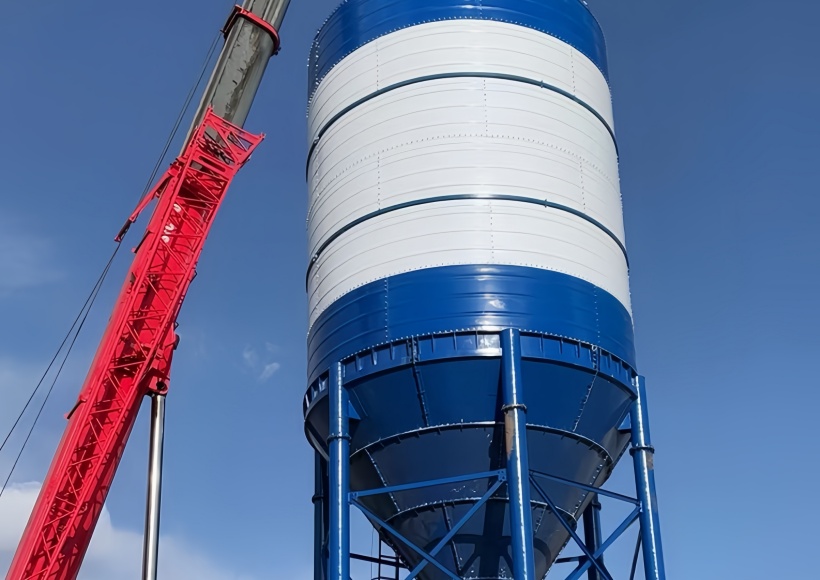
The cement silo protects and stores bulk powder. The screw conveyor transfers it into the weighing or mixing process. These components must work as a pair. A silo capacity decision depends on material consumption and delivery schedule. A conveyor decision depends on powder type, route, elevation, transfer rate and connection layout.
The buyer should request the silo capacity, number of silos, filter or dust-control arrangement, level indication, discharge equipment and screw-conveyor configuration. Selecting from the силос для цемента и screw conveyor categories is only the first step; the final configuration must match the material flow.
Water scales, water tanks, pumps, valves and admixture dosing equipment affect consistency one batch at a time. The specification needs to account for the number of admixtures, dose range, flushing method, cold or hot weather requirements and the way aggregate moisture is managed. A vague statement that a plant has “automatic water” is not enough for a project where water-to-cement ratio matters closely.
Control system, scales and batch records
The control system coordinates sequence, weighing, recipes, alarms and reports. It should be assessed by function: what data does it record, who can change a recipe, how are alarms displayed, how is calibration managed, and what happens if a sensor or power supply fails? The PLC versus manual batching plant control guide is useful background, but the operating team should still confirm the exact control scope in the quotation.
Dust control, washout and maintenance access
Concrete production creates practical housekeeping issues. Powder transfer can generate dust. Washout water and residual concrete require a planned handling process. Components also need safe access for inspection, cleaning and replacement. These are not optional aesthetic details. They affect compliance, safety, downtime and the working environment around the plant.
How Much Does a Concrete Batch Plant Cost?
The honest answer is that a concrete batch plant does not have one meaningful price until the required configuration and supply boundary are known. A compact dry-batch setup, a mobile plant with limited storage and a stationary ready-mix installation can require very different equipment, civil work and startup support. A low headline number can describe a smaller equipment package; it does not necessarily describe the cost of a plant ready to produce the specified concrete on the buyer’s site.
Txmixing publishes one useful configuration-level example for an HZS120 plant. Its HZS120 price analysis, published in February 2026 and described on the page as based on 2025 market trends, lists the following FOB ex-factory ranges. These are not a current all-in U.S. delivered price, and they should not be used as a price range for every 120 m³/h plant. They do show how the same nominal output can move materially when the mixer, controls and dust-control scope change.
| HZS120 configuration stated in the published guide | Published FOB ex-factory range (USD) | Scope described on the source page |
| Economic | $85,714–$114,286 | Domestic JS2000 main mixer and basic control system |
| Стандарт | $114,286–$142,857 | Imported Sicoma main mixer and complete dust-removal system |
| Высококлассный | $128,571–$157,143 | Imported Sicoma main mixer and Siemens intelligent control system |
The same published guide estimates transportation and installation at an additional $4,286–$5,714, depending on distance. Because those figures are FOB ex-factory and configuration-specific, a U.S. buyer still needs a written destination quote covering freight, insurance, unloading, site work, power connection, installation and any local compliance requirements.
For a useful comparison, separate the equipment quote from the project cost. The equipment quote may include a batching machine, mixer, scales, frame, conveyor or skip hoist, controls and selected material-handling equipment. The project cost can also include freight, off-loading, foundations or ground preparation, power connection, water supply, silos, dust control, commissioning, operator preparation, startup spares and ongoing wear parts. The buyer should also account for the commercial cost of idle time if the plant cannot run because materials, trucks or operators are not ready.
| Cost area | What can change it | Question that makes quotes comparable |
| Plant configuration | Stationary, mobile, portable, dry batch or central mix; output target and automation level | What exact plant type and nominal production basis are being quoted? |
| Materials handling | Bin count, silo capacity, conveyor route, aggregate feed and admixture lines | Which aggregate fractions, powders and admixtures are included in the price? |
| Site readiness | Ground condition, foundations, drainage, access, electrical and water connection | What must the buyer complete before delivery or installation? |
| Delivery and startup | Transport split, unloading, assembly, commissioning, training and spares | Which startup services are included, excluded or available as options? |
| Operating cost | Labor, energy, wear items, cleaning, calibration, maintenance and material logistics | What routine work and consumables are assumed after handover? |
| Cost-check note: Do not compare two concrete batching plant prices until both suppliers have stated the same production requirement, material boundary, control scope, transport terms and startup responsibilities. Otherwise, a cheaper quote may simply leave more of the project outside its stated scope. |
How to Buy or Choose a Suitable Concrete Batching Plant
The broad search term often hides a practical decision: which configuration will allow this specific project to produce concrete without creating a new scheduling or quality problem? The selection should move through the following checks.
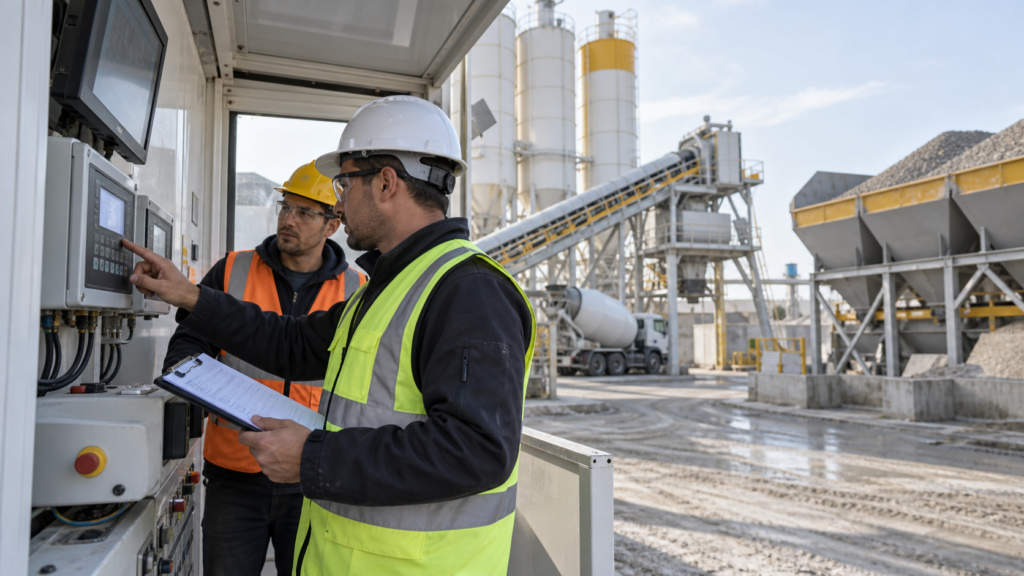
1. Turn the construction programme into a practical output requirement
Start with the busiest pour, not the average monthly volume. Record the largest planned concrete volume, the time in which it must be placed, the number of working hours that are genuinely available for production, the number of vehicles or discharge points, and any time lost to recipe changes, cleaning or material replenishment.
For example, a project that needs 360 m³ over a six-hour placement window begins with a simple planning requirement of 60 m³/h. That figure is a starting point, not an automatic instruction to buy a 60 m³/h-rated plant. The supplier should explain the proposed plant’s theoretical rating, expected cycle time, mixer batch size and the operating assumptions behind its practical output for the proposed mix. Aggregate loading, powder transfer, truck availability and moisture correction can each become the limiting step before the mixer rating does.
For U.S.-facing inquiries, state whether the requirement is in cubic yards per hour, cubic meters per hour or both. Include the peak pour, daily total, production shift, project duration and dispatch arrangement so the selection is based on the actual programme rather than a model code.
2. Decide whether the project needs a permanent or relocatable operation
Project duration matters, but it is not a universal cut-off measured in months or years. A long project with poor site access may still need a mobile or modular arrangement; a shorter project with repeated heavy pours may justify a more substantial layout. Compare the expected number of relocations, setup and dismantling time, ground preparation, storage demand, access for material deliveries and the likely value of the plant after the job.
Stationary configurations make sense when a site can support durable material storage, truck circulation, maintenance access and utilities. Mobile, portable or compact configurations deserve attention when relocation or restricted space is central to the project. Use the type section above as a first filter, then ask the supplier for a layout and transport plan for the actual site.
3. Check whether ownership solves the supply problem
For a small contractor, a batch plant is worth serious evaluation when concrete demand is recurring, ready-mix timing repeatedly disrupts the work, short loads are common or a remote site makes reliable delivery difficult. It is harder to justify when volume is irregular, material deliveries are unreliable, no trained operator is available or each job needs a setup that cannot be used again.
Build the comparison around the job rather than a headline saving. Put expected concrete volume, delivered-concrete cost, raw-material cost, labor, fuel or power, finance or capital cost, setup, maintenance, relocation and likely downtime in the same worksheet. That creates an estimate the buyer can test against local quotations and operating conditions instead of borrowing an ROI claim from an unrelated project.
4. Match the mixer and material systems to the concrete being produced
The proposed mixer, aggregate bins, powder silos and dosing lines should follow the actual concrete programme. A configuration designed for one routine mix may become inefficient when the job requires additional aggregate fractions, supplementary cementitious materials, multiple admixtures, higher-strength concrete, dry mixes or frequent recipe changes.
Send the supplier the expected aggregate fractions, maximum aggregate size, powder materials, admixtures, approximate aggregate moisture conditions and special concrete requirements. For central-mix production, also request the proposed mixer type, batch volume, expected mixing time, cleaning routine and access to wear parts. For dry-batch production, clarify which downstream mixer completes the blend and how the final process is verified.
5. Design the site around material flow, safety and environmental controls
A poor layout can erase the benefit of good equipment. The loader should not cross the route used by loaded concrete trucks, while cement delivery should not block aggregate access. The site also needs room for stockpiles, powder delivery, washout, drainage, electrical equipment, maintenance work and safe turning movements.
Environmental and operating requirements belong in the selection brief from the start. Confirm the local rules and project requirements for dust collection, noise, wash-water handling, runoff, site lighting and working hours. Ask the supplier to identify what equipment is included for those controls and what must be supplied or constructed on site. A generic emission or noise number is not a substitute for the applicable local permit or project specification.
Before equipment is finalized, prepare a simple site plan showing property boundaries, entry and exit, stockpile area, bins, silo locations, control cabin, discharge point, water source, electrical connection, drainage and truck circulation. A drawing does not have to be elaborate to expose a problem early.
6. Compare like-for-like scope and support
Two concrete batching plant quotations can show the same theoretical capacity and still describe different systems. One may include only the core frame and basic controls. Another may include extra aggregate bins, multiple silos, a larger mixer, dust control, dosing systems, shipping support, installation guidance, startup parts or a different control package.
Use the cost table above to ask each supplier the same questions. The objective is not to force identical solutions; it is to reveal where the proposed solutions differ before price becomes the deciding factor. Confirm what documents are supplied, what the commissioning sequence looks like, which spare parts should be stored locally, what training is included, and how the buyer reaches technical support if a problem occurs. A basic batching plant failures checklist can help the operating team identify recurring risk areas, but it should not replace a project-specific commissioning and maintenance plan.
| Project review boundary: This article helps build a technical and commercial brief. It cannot verify site foundations, power installation, traffic safety, emissions controls, local permits, concrete design requirements or structural loading. Those items require review against project documents and applicable local requirements by the responsible project team. |
The equipment that changes the buying decision
The most useful way to understand a plant is to group equipment by the decision it affects. A concrete batching machine controls how many aggregate fractions can be stored and measured. The бетономешалка governs mixing intensity and cycle time. A силос для цемента и screw conveyor determine how reliably powder materials can reach the process. The control system turns a physical plant into a repeatable production line.
The aggregate feeding method also changes the project fit. A belt conveyor can support continuous feeding and is common in larger layouts, while a skip hoist can reduce the footprint of a compact station. Neither is automatically better. The correct choice depends on throughput, vertical clearance, available land, maintenance access and the site traffic plan. This belt conveyor versus skip hoist guide explains the practical trade-off in more detail.
Common Selection Mistakes That Become Expensive Later
- Choosing on theoretical capacity alone: The stated number may be relevant, but it does not include every source of delay on a live jobsite. Confirm the bottleneck: aggregate loading, powder transfer, mixing, truck dispatch, quality checks or material deliveries. The slowest critical step usually governs the day.
- Treating layout as civil work to solve after equipment selection: Equipment can be physically installed and still be operationally awkward. Layout needs to be reviewed before the final model and feeding arrangement are locked. Truck turning, loader movement, cement delivery and maintenance access are production variables, not afterthoughts.
- Assuming all “automatic” systems provide the same control: Automation labels conceal major differences in recipe handling, data logging, alarms and operating workflow. Ask for the functional scope, not just the word “automatic.”
- Leaving commissioning and spares outside the purchase discussion: The first weeks of operation reveal alignment, calibration, material-flow and operator-training issues. Confirm what is supplied for commissioning, which consumable and wear parts should be held locally, and how technical support is accessed. The concrete batching plant failures checklist is a useful reminder of why these details matter.
Installation, Commissioning and Early Production Checks
Commissioning is where the equipment specification meets the real site. The aim is not only to make motors turn. It is to confirm that material routes, scales, controls, safety devices and operating procedures work together as intended.
Confirm that the plant is installed according to the approved layout; foundations or support points are prepared as required; power and grounding are complete; water and air connections are available where specified; safety guards and emergency stops are functional; bins and silos are accessible; and material-delivery routes are clear.
Run a controlled sequence that checks empty and loaded scale behavior, gate response, conveyor or skip operation, powder transfer, water and admixture dosing, mixer operation, discharge path, alarms and batch records. The responsible team should compare the results with the mix design and project acceptance requirements rather than relying only on the visual appearance of the first load.
The first production period is when weak assumptions become visible. Track loader waiting time, truck queues, material consumption, scale drift, dust, washout, mixer wear, recipe changes and alarms. Those observations can reveal whether the issue is equipment, layout, operator process or material supply. Fixing the right cause early is cheaper than accepting recurring interruptions as normal.
What Should Be Included in a Complete Concrete Batching Plant Quote?
A concrete batching plant price without a defined supply scope is not comparable. The total concrete batching plant cost can include the plant, supporting equipment, freight, site work, installation, commissioning, startup parts and later maintenance. Before comparing quotes, separate the plant itself, optional equipment and jobsite work. This prevents a buyer from treating two incomplete quotations as equivalent.
| Scope | Typical items | Confirm before comparing quotes |
| Core plant | Concrete batching machine, weighing system, main frame, бетономешалка or discharge arrangement, controls and aggregate feeding | Output target, materials, mix method and operating hours |
| Supporting equipment | Cement silos, винтовые конвейеры, dust control, admixture dosing, water system, conveyors and safety items | Site climate, material consumption, environmental conditions and maintenance plan |
| Site work | Foundation or ground preparation, electrical supply, water, drainage, roads, cranes and installation labor | Who supplies each item, sequence, specification and acceptance responsibility |
| Lifecycle support | Startup parts, wear parts, manuals, training, commissioning and troubleshooting process | Recommended spares, response route and responsibilities after handover |
The same rated output can therefore produce very different commercial scopes. One quotation may include one powder silo, limited aggregate storage and basic controls; another may include multiple silos, additional dosing equipment, dust collection, a broader control package and a different installation boundary. Compare the system line by line before comparing the total number at the bottom.
What to Send Before Requesting a Quote
A useful RFQ gives the supplier enough information to challenge an unsuitable configuration before fabrication starts. It does not need to be a formal engineering specification, but it should include the conditions that affect selection.
- Project location and the applicable voltage, frequency and control-language requirements.
- Project type: ready-mix supply, precast, roadwork, bridge work, remote construction or another application.
- Required peak hourly output, expected daily volume and project duration.
- Whether the plant must relocate and how often.
- Site dimensions, access-road constraints, ground condition and a simple layout sketch or photographs.
- Aggregate fractions, maximum aggregate size, powder materials and admixture requirements.
- Preferred dry-batch or central-mix process, if already defined.
- Required cement storage and expected material-delivery pattern.
- Environmental controls, drainage, dust collection or local permit requirements relevant to the site.
- Expected scope for shipping, installation, commissioning, training and spare parts.
| Engineering note: A plant is not correctly selected because its stated capacity matches a spreadsheet cell. The proposed system should explain the assumptions behind that capacity: batch size, cycle time, feeding method, mixer arrangement, material availability and the jobsite workflow.Project review boundary: This guide can help define a commercial and technical brief, but it cannot confirm a site’s foundations, electrical installation, traffic safety, emissions controls, permits or concrete specification. Those items should be reviewed against the project documents and applicable local requirements by the responsible project team. |
A concrete batching plant is a system that stores, measures and combines concrete ingredients according to a mix design. It may load ingredients for downstream mixing or mix the concrete at the plant before discharge, depending on the selected production method.
What is a concrete batching plant used for?
A concrete batching plant is used to produce concrete for applications such as ready-mix supply, precast production, roads, bridges, buildings and remote construction projects. The suitable plant configuration depends on the required concrete output, mix design, project duration, site conditions and whether the plant needs to be relocated.
How does a concrete batch plant work?
It batches aggregate, cementitious materials, water and admixtures; measures them according to the recipe; moves them to a mixer or discharge point; and records or monitors the batch through its control system.
What is the difference between a mobile and stationary concrete batching plant?
A mobile plant prioritizes transport and redeployment. A stationary plant prioritizes a longer-term layout, storage capacity and configuration flexibility. The better option depends on the project duration, required output, site conditions and relocation plan.
How do I choose the right concrete batching plant capacity?
Start with peak hourly demand, daily demand, continuous-pour requirements, batch cycle, material availability and truck dispatch. Then compare the required operating output with the supplier’s stated capacity assumptions rather than selecting solely by model name.
The right concrete batching plant is the one that fits the job’s actual production rhythm: the mix design, site layout, material deliveries, concrete transport, project term and support requirements. A mobile, stationary, dry-batch or central-mix configuration can all be appropriate when the surrounding system has been planned properly.
If you are evaluating a new setup, begin with the project inputs listed above and then compare Txmixing concrete batching plant configurations against those inputs. A quote becomes useful only when it explains what is included, what assumptions it relies on and how the proposed plant will operate on the real site.