

Power is the first item a buyer signs off and the last one a plant actually tests. An HZS50 concrete mixing plant power budget of about 98 kW reads like a single line on a specification sheet, while the transformer decision behind it decides whether the plant runs two shifts or stalls on the first cold morning of winter.
This guide turns that single line into a working calculation. It lists every load on the plant, shows how the diversity factor and the power factor convert kilowatts into the kVA a utility actually sells, and sets out what changes between a 125, 160 and 200 kVA connection on a real site.
Why the Total Load Decides the Transformer
Nameplate Total Versus Running Load
Nameplate totals add every motor at its rated output, and no plant ever draws that figure. Intermittent equipment runs in short bursts, and the mixer carries the heaviest single load. The gap between installed and drawn power is what a correct HZS50 concrete mixing plant power calculation has to close before a transformer is ordered.
The Starting Current Nobody Counts
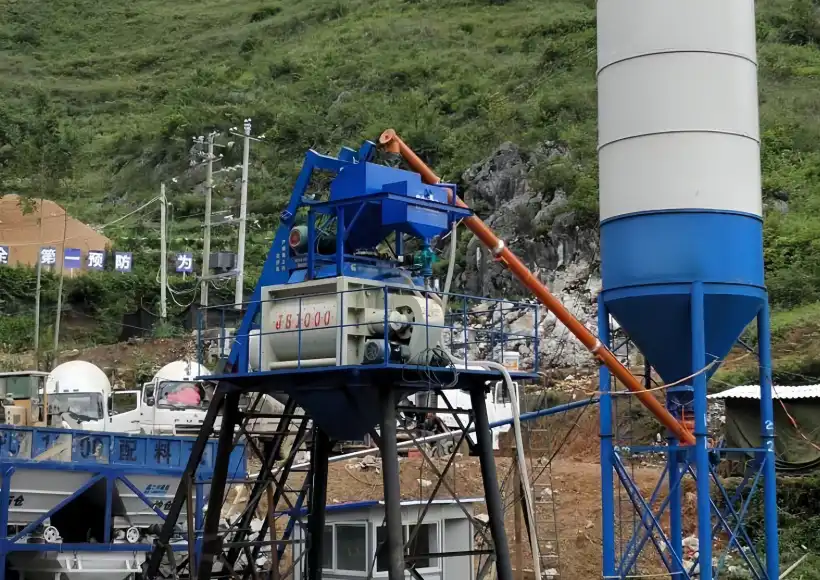
The JS1000 mixer starts against a full drum on many sites, and its starting current runs five to seven times the rated figure for a few seconds. A transformer sized only on the running total will dip at every start, and the lights in the control cabin will flicker while the batch is still being weighed.
Why Intermittent Loads Behave Differently
Screw conveyors, the batching machine and the dust collector all run on short cycles, so their average draw sits well below their rated draw. Treating them as continuous loads inflates the HZS50 concrete mixing plant power total by a third and pushes buyers toward a transformer size they do not need to pay for.
What an HZS50 Actually Draws
The Equipment List in Numbers
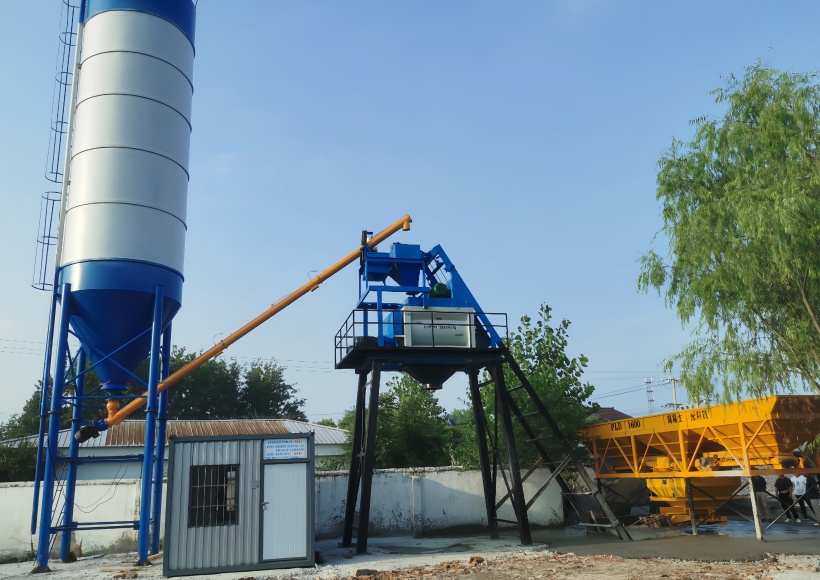
The table below is the load list for a standard HZS50 station with a JS1000 mixer, a PLD1600 batching machine, two cement screws and a two stage dust collection system. Every figure is a rated input, and the total is the installed power rather than the drawn power.
| Equipment | Rated power | Working pattern | Note |
| JS1000 twin shaft mixer | 37 kW (2 x 18.5) | Batch cycle, 60 to 70 seconds | Highest starting current on the plant |
| Aggregate elevator or skip hoist | 15 kW | One lift per batch | Runs 40 to 50 percent of the cycle |
| Cement screw conveyors | 22 kW (2 x 11) | Short bursts, timer controlled | One screw idles on most batches |
| PLD1600 batching machine | 15 kW | Weighing and discharge | Loads step in as bins open |
| Air compressor | 4 kW | Duty cycle on pressure switch | Supplies cylinders and pulse valves |
| Water supply pump | 2.2 kW | Per batch, metered | Draws while the batch fills |
| Drainage pump | 1.1 kW | Occasional | Washout and pit transfer |
| Admixture pump | 0.55 kW | Short dosing pulse | Small but runs on every batch |
| Dust collection system | 4.4 kW (2 x 2.2) | Continuous while feeding | Filters and pulse controller |
| Installed total | 98.25 kW | Basis for the calculation below |
Mixer and Hoist
The mixer carries more than a third of the installed HZS50 concrete mixing plant power on its own, and the hoist carries another fifteen percent. Both start under load, so both need to be considered on starting current rather than on average draw when the main breaker and the transformer are chosen.
Conveying, Weighing and Dust
Conveying and weighing equipment adds roughly 41 kW to the plant and runs a small fraction of each cycle in practice. Dust collection is the one continuous load in that group, since the filters run through the whole time material is being fed into the bins.
Auxiliary Loads Beyond the Plant
Site lighting, the PLC and control console, and office or dormitory power sit outside the equipment list. On a working HZS50 these add about 16 kW, made up of 5 kW lighting, 3 kW control and instrumentation, and 8 kW of household load that runs through the evening.
The Calculation Step by Step
Step One Installed Equipment
Start from the load list and confirm every motor plate against the order. Manufacturers sometimes substitute a motor during assembly, and a single change from 11 kW to 15 kW on the screws shifts the HZS50 concrete mixing plant power total by four kilowatts, enough to move the transformer choice at the boundary.
Step Two Auxiliary Demand
Add lighting, control and household load to the equipment total. These loads run at the same time as production, so they cannot be treated as background. A plant with a 98.25 kW installed total and 16 kW of site load is really carrying 114.25 kW of connected demand through the working day.
Step Three Diversity Factor
Not every load runs at once, so the connected total is reduced by a utilization factor. On a batching plant the accepted figure sits near 0.82, since conveying, weighing and dust collection overlap only partly across a cycle. Applied to the connected total, this returns about 93.7 kW as actual demand.
Step Four Power Factor and kVA
Utilities sell apparent power, not working power, so the kilowatt figure is divided by the power factor. At 0.85, which is typical for induction motors without compensation, 93.7 kW needs 110.2 kVA. That number is the minimum a transformer must supply, and it is the floor rather than the recommendation.
Why the Result Lands Near 110 kVA
An 110 kVA result sounds like a clean answer, and it is a poor one in practice. It leaves no room for starting current, no reserve for a silo addition, and no tolerance for the voltage dip that a rural feeder brings. Every real specification sits one step above that calculated figure.
Choosing Between 125, 160 and 200 kVA
The 125 kVA Connection
A 125 kVA transformer covers a single shift operation of eight hours with a load factor near 87 percent. It is the cheapest compliant choice for an HZS50 concrete mixing plant power budget, and it suits a plant running one production window a day with a stable grid and no silo or chiller planned within two years.
The 160 kVA Connection
Two shift operation of sixteen hours suits 160 kVA at a load factor near 68 percent. The spare capacity absorbs starting current on the mixer, carries a silo addition without a new transformer, and keeps the HZS50 concrete mixing plant power supply stable when grid voltage drops ten percent in the evening peak.
The 200 kVA Connection
Three shift continuous production takes 200 kVA at a load factor near 55 percent. The margin supports a chiller, a hot water boiler and a second silo together, and it is the only size where a plant can add cooling for summer pours without going back to the utility for a connection change.
Reading the Load Factor Correctly
Load factor is the share of transformer capacity in use at peak, and it should sit between 60 and 80 percent on a batching plant. Below 60 percent the transformer carries standing loss. Above 85 percent every mixer start risks a main breaker trip, which is why HZS50 concrete mixing plant power demand is held inside that band.
What Grid Quality Changes
Voltage Drop on Rural Feeders
A feeder that sags ten percent raises current by the same proportion for a fixed load, and a 125 kVA unit then runs into overload during a pour. Plants on rural feeders should price a voltage stabilizer into the electrical budget rather than discover the need on the first busy week.
Standby Generator Sizing
Where outages are frequent, a standby generator is sized on starting current rather than on the running total. A 120 kW set covers an HZS50 plant with soft starters in normal production, while direct on line starting may need a 160 kW set to carry the mixer start without stalling.
Protection, Earthing and Surge
Protection equipment belongs in the same package as the transformer. Thermal relays and motor overload protectors guard the mixer, secondary surge protection guards the control console, and a reliable earthing system protects both. A plant that skips these items pays for the gap in repairs.
Expansion Reserve and What Each Addition Costs
Adding a Cement Silo
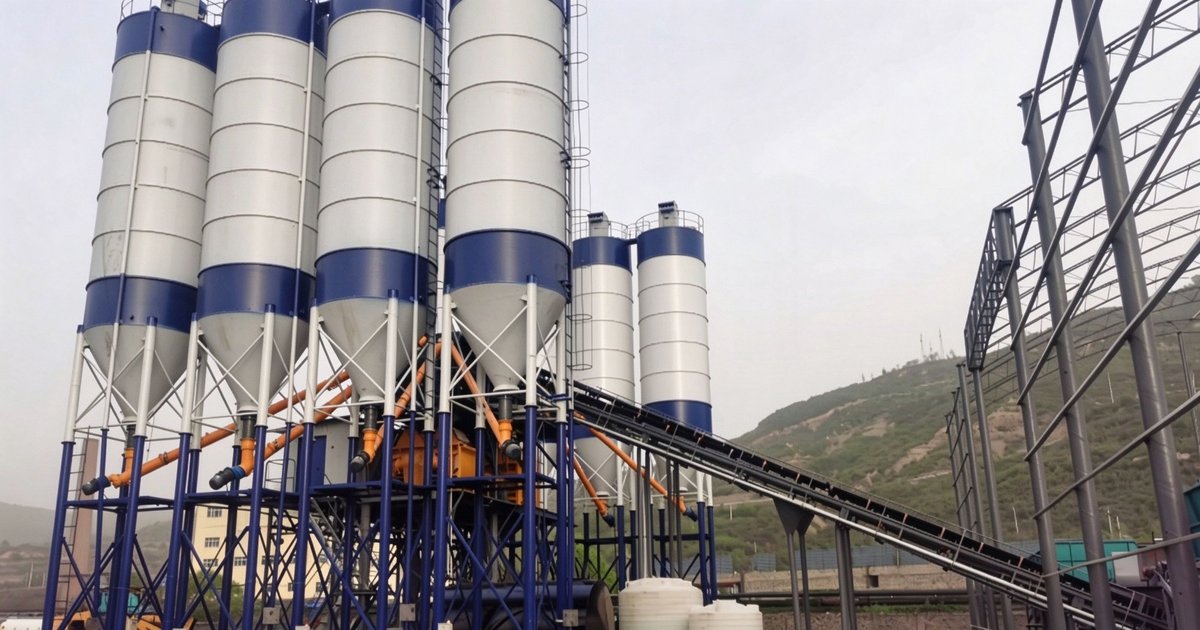
A second cement silo brings its own screw conveyor and dust collector, which adds about 13.2 kW to the load and roughly 15 kVA to the transformer requirement. When the plan includes a silo within two years, the 160 kVA connection pays for itself against a later upgrade fee and a production stop.
Adding a Chiller for Summer Pours
A chiller with its circulation pump adds about 18.5 kW and 20 kVA to the HZS50 concrete mixing plant power demand. In hot climates this item is not optional, since concrete poured above 32 degrees needs temperature control to meet specification, and the chiller quickly becomes the largest auxiliary load on site.
Adding a Hot Water Boiler
A boiler with a circulation pump adds about 22 kW and 25 kVA for winter work. Plants that pour through a cold season usually carry both a chiller and a boiler across the year, which is why the 200 kVA connection suits markets where a single plant serves a full annual programme.
| Expansion item | Added equipment | Added power | Transformer step |
| Second cement silo | Screw conveyor and dust collector | 13.2 kW | +15 kVA |
| Chiller for hot weather | Chiller unit and circulation pump | 18.5 kW | +20 kVA |
| Hot water boiler | Boiler and circulation pump | 22 kW | +25 kVA |
What Each Transformer Size Costs to Run
Monthly Consumption
A 160 kVA plant running two shifts consumes around 25,000 kWh a month. At a tariff of 0.11 USD per kWh, that lands near 2,857 USD of energy, and the mixer, hoist and screws account for most of it. Output per kilowatt hour, not the tariff itself, sets the cost per cubic meter.
Standing Loss Inside the Transformer
Every transformer loses energy whether the plant runs or not. At this size the standing loss and the copper loss together come to about 114 USD a month, and an oversized unit raises that figure without any production benefit. A unit chosen one step above demand is cheaper to run than one chosen three steps above.
Demand Charges and Power Factor Penalty
Many utilities bill the peak kVA demand as a separate line, and some apply a penalty when the power factor falls below 0.9. Capacitor compensation on the mixer and the larger motors lifts the factor toward 0.95 and removes that penalty, which often pays for the equipment within a year of two shift running.
Cable, Switchgear and Metering
Main Cable and Distribution
The main cable is sized on the transformer output rather than on the running total, with a margin for ambient temperature inside the container. Distribution inside the plant follows the load list, with the mixer on its own feeder so that a fault in one branch does not stop the whole HZS50 concrete mixing plant power supply.
Breaker Coordination
Breakers should be coordinated so that a stalled screw trips its own circuit without taking the main breaker with it. Coordination is a drawing exercise done before commissioning, and the HZS50 concrete mixing plant power distribution has to be drawn on paper before the first batch. A plant that skips it resets the main switch after each screw jam.
Metering and Records
A meter on the main incomer and a second on the mixer feeder give owners the two numbers that matter. The first shows consumption against the bill, the second shows whether mixer loading drifts as blades wear. Both feed the same maintenance log for output tracking, and they turn an HZS50 concrete mixing plant power budget into a measured figure.

Mistakes That Force an Upgrade Later
Sizing on the Brochure Total
The brochure lists installed power and says nothing about diversity, starting current or the site loads beyond the plant. A buyer who orders a transformer straight from that figure ends up with a 100 kVA unit that cannot start the mixer on a cold morning, and the correction arrives as an emergency purchase.
Ignoring the Mixer Start
Direct on line starting pulls the full starting current through the transformer winding. Soft starters and star delta arrangements cut that peak by half, and the saving is often the difference between a 125 kVA and a 160 kVA connection. The starter costs less than the transformer step it avoids.
Skipping Reactive Compensation
Uncorrected motors run at a power factor near 0.85, which inflates the kVA demand for the same kilowatts and invites a tariff penalty. Capacitor banks sized to the motor group lift the factor toward 0.95, and the HZS50 concrete mixing plant power bill drops without any change in production volume or in the number of shifts run each week.
Buying a Transformer Without a Spare Feeder
A single feeder into a plant means every cable fault stops production. Duplicate supply is unusual on a plant this size, but a changeover switch with a generator inlet costs little and covers the outages that a rural grid delivers several times a year in most markets.
Questions Buyers Ask About HZS50 Power
What total power does an HZS50 plant need?
About 98 kW of installed equipment power plus 16 kW of lighting, control and household load. After a 0.82 diversity factor the demand lands near 94 kW, and the transformer requirement works out at roughly 110 kVA before any reserve is added. That floor figure is only the starting point of a real HZS50 concrete mixing plant power decision.
Which transformer suits single shift production?
125 kVA covers eight hour operation at a load factor near 87 percent. It is the economic choice where the grid is stable, no expansion is planned and the mixer starts through a soft starter. Anything less leaves the plant exposed at every start of a full drum.
Does a 160 kVA transformer really matter for two shifts?
Yes, and the reason is margin rather than fashion. Sixteen hours of production at 68 percent load factor leaves room for a silo addition and for the voltage dip that comes with evening peak demand. The 160 kVA step is the size most two shift plants settle on.
How much does it cost to run the plant each month?
Roughly 25,000 kWh on two shifts, which is about 2,857 USD at 0.11 USD per kWh, plus around 114 USD of transformer loss. The exact figure follows the local tariff, and demand charges or power factor penalties can add a further line to the same bill.
Can a generator replace the transformer?
Only as standby. A 120 kW set covers normal production with soft starters, while direct on line starting may need 160 kW to carry the mixer. Running the whole plant on generated power costs several times the grid tariff per kilowatt hour and is not a substitute for a connection.
How much reserve should the transformer carry?
Reserve of 20 to 30 percent above calculated demand is the working range. Below 20 percent every expansion or voltage dip eats into safety margin, and above 40 percent the plant pays standing loss on capacity it will never use during a normal production year.
What to Send for a Power Quote
Site Data That Changes the Answer
Three inputs decide the final transformer step: the incoming voltage and its variation through the day, the highest ambient temperature inside the electrical container, and the equipment list with motor ratings. Send those along with the production schedule and any planned expansion within two years. From those three inputs the HZS50 concrete mixing plant power schedule follows directly.
Next Reading
For the mixer side of the same question, the JS1000 mixer guide covers drive options and starting behaviour. For plant output against power draw, the HZS50 capacity analysis sets the hourly figures this electrical budget has to serve. Read the two side by side when a plant is being specified for a fixed pour programme.
Tongxin Machinery supplies HZS50 stations with a documented load list, soft start options and a recommended transformer size for each production pattern. Send your site voltage data and shift plan, and the engineering team will return a matched HZS50 concrete mixing plant power schedule with the cable and switchgear list included.