
.You won the bid. The contract is signed. Then the schedule slips before a single cubic meter is batched, because the plant that will produce your concrete needs a permanent concrete pad poured underneath it first.
I have watched project managers burn their mobilization budget on these temporary foundations for years. You rent the excavator. You pay the steel crew for rebar. You pay for the pad itself. Then you wait two to three weeks for it to reach load-bearing strength while the clock runs on the actual contract. When the job wraps up, you pay a demolition crew to break it apart and haul the rubble away. Nothing about that sequence serves the project. You are building a structure for equipment that leaves. Every contract that repeats this loop pays for a foundation-free concrete batching plant twice — once to pour the base, once to break it.
The answer is not pouring faster. It is eliminating the foundation altogether. That is what a foundation-free concrete batching plant does: it replaces the poured base with an engineered steel chassis sized to carry the whole plant, and it moves the critical path from curing concrete to assembling modules.
Why Temporary Foundations Destroy Project Margins
Look at the cost stack on a conventional installation. Ground preparation alone involves excavation, sub-base compaction, formwork, rebar, and a concrete pour measured in dozens of cubic meters. The material is only part of it. The real money sits in the waiting: depending on ambient temperature and mix design, a pad needs roughly 7 days to accept light assembly loads and 21 to 28 days to reach its design strength. During that window your concrete batching plant sits on trailers, your crew stands idle, and your client’s schedule keeps moving without you.
The waste continues at the end. Demolition, breaking, loading, and disposal of a reinforced pad typically run into five figures and add another week of site work. On a twelve-month contract, that is four to five weeks of schedule consumed by a structure you deliberately destroy.
There is a second cost that rarely shows up in the estimate: the site you leave behind. A demolished pad is solid waste. The noise, dust, and haulage involved in removing it are exactly the things that attract complaints and clean-up orders on publicly funded work.
How a Foundation-Free Concrete Batching Plant Works
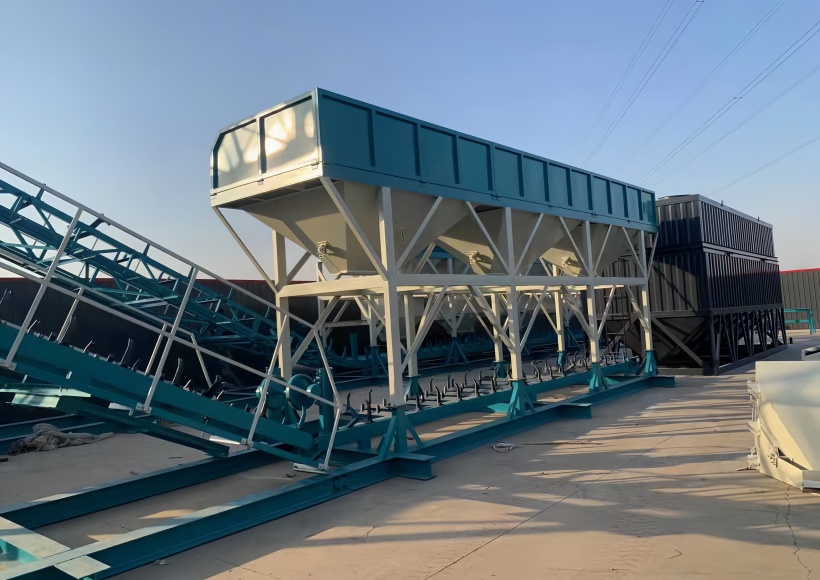
The plant does not float on hope. It sits on a rigid, interconnected steel frame that distributes static material weight and dynamic mixing loads across a large contact area, so the ground pressure per square meter stays within what compacted subgrade can carry.
Steel Chassis and Load Distribution
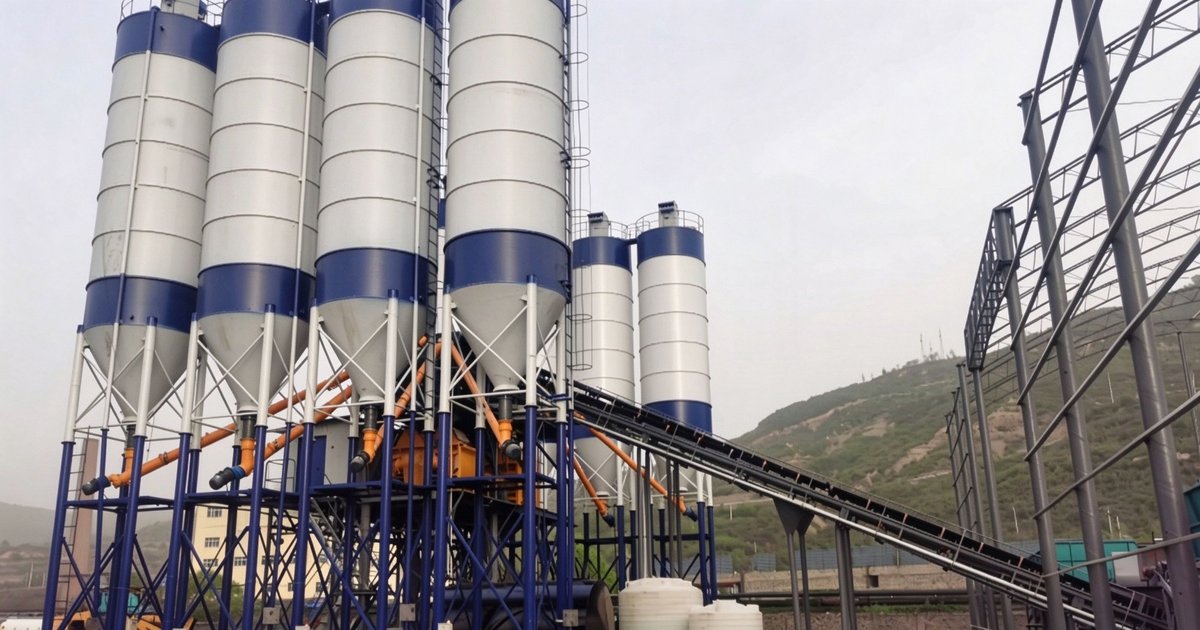
The chassis is structural steel, not fabricated sheet. Main beams are sized so that a fully loaded aggregate bin, a silo group, and a running twin-shaft mixer produce deflection well inside the tolerance that keeps weighing instruments honest. The aggregate bin mounts directly on the frame. Cement and fly ash silos use enlarged base plates that spread several dozen tons of stored powder over a footprint wide enough to avoid localized settlement. Nothing is anchored into poured concrete; the frame bears on a prepared, leveled surface.
Aggregate, Powder and Mixing Modules
Material handling stays conventional because reliability matters more than novelty. Sand, gravel, and crushed stone are batched by load cells under the aggregate bin. Depending on configuration, the plant feeds the mixer by skip hopper or by a belt conveyor integrated into a folding frame, which removes the need for separate ground supports. Powder travels from the silo through a screw conveyor into a weighing hopper above the mixer. At the center sits a heavy twin-shaft mixer — typically a JS1000 or JS1500 class unit for road and bridge work — bolted to the main module and sized to absorb the rotational forces of high-volume production without walking across the yard.
Because the plant ships as modules, most wiring and piping arrives pre-assembled. Site work is reduced to joining frames, connecting aviation plugs, and commissioning the control system. On a stationary versus mobile setup, this is the difference between an electrician pulling cable in mud for a week and a crew connecting pre-terminated harnesses in an afternoon.
What the Ground Actually Has to Do
“Foundation-free” does not mean “site-free.” It means no poured concrete. The ground still has two jobs: stay level, and stay put.
In practice, a foundation-free concrete batching plant needs a leveled, compacted subgrade or a 150–200 mm compacted graded gravel layer, with surface deviation held to a few millimeters across the chassis footprint and drainage arranged so water never ponds under the frame. A road roller handles preparation in hours. What you cannot skip is the compaction test, and the density acceptance criteria for a working slab that carries plant loads follow the construction guidance published by the Portland Cement Association. Soft spots, backfilled trenches, and thawing ground are the failure modes that show up later as tilted frames and drifting weighing accuracy.
That is also why silo placement deserves its own check. Silos concentrate load far more than the chassis does, and a cement silo foundation requirement review should confirm the base plate area, the bearing capacity of the prepared ground, and the leg spacing before delivery, not after.
Automated Control Without a Concrete Pad
A common assumption is that a relocatable plant is a glorified self-loading mixer that trades precision for mobility. That assumption is out of date. The control architecture on a modern foundation-free concrete batching plant is the same one used on permanent commercial stations.
Weighing Accuracy and Vibration Isolation
Accuracy depends on two things: instrument quality and mechanical stability. Aggregate scales are typically specified at ±2%, cement, water, and admixture at ±1%, which mirrors the batching tolerances published by the American Concrete Institute, with load-cell sampling rates high enough to catch in-flight material before the gate closes. The steel chassis plays a direct role here — it absorbs mixer vibration so the load cells stay zeroed instead of chasing movement. With a level, compacted base, batching repeatability matches a fixed plant.
Moisture Compensation and Recipe Control
Aggregate moisture is the variable that quietly ruins slump consistency. The control system reads moisture from the sand and stone bins, then recalculates the water setpoint per batch, holding the effective water-cement ratio inside a tight band. Recipes are stored and locked by permission level, every batch is logged with timestamp and actual weights, and deviations trigger tiered alarms rather than silent drift. On work governed by tight specifications — bridge deck concrete, precast elements, airfield pavement — that record is the difference between passing a review and repeating the pour.
For projects that want remote visibility, an advanced control system can push production data to a cloud dashboard over VPN or 5G, so the office sees output, downtime, and material consumption without a site visit.
Installation Timeline: Five Days Against Four Weeks
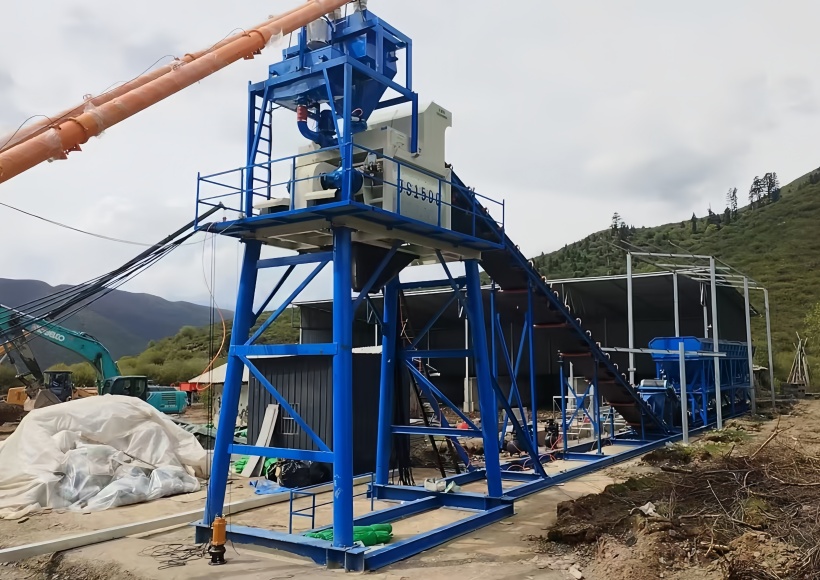
This is where the commercial argument is won. Take a twelve-month highway overpass contract and run both scenarios.
With a traditional plant, weeks one and two disappear into foundation construction and curing. Silos climb, the mixer is calibrated, and first production starts somewhere in week four. At the end of the contract, another week goes to demolition and disposal.
With a foundation-free concrete batching plant, the sequence compresses:
- Day 1: grade and compact the pad; run the plate test; confirm drainage falls away from the frame.
- Day 2: flatbeds arrive; crane sets the chassis modules and silo bases.
- Days 3–4: aggregate bin, conveyor, mixer, and silo group are landed and bolted; pre-terminated wiring is connected.
- Day 5: calibration, dry run, moisture sensor verification, and first test batches.
Three weeks of production time recovered on the front end, and one week recovered on the back end, is not a marginal gain. On a contract that bills by the cubic meter per day, it is the difference between a bid that clears its overhead and one that does not.
The Cost Comparison in Numbers
The table below reflects typical ranges for a mid-size foundation-free concrete batching plant serving a 6–18 month project. It follows the cost structure the National Ready Mixed Concrete Association uses when benchmarking plant operating costs, scaled down for smaller relocatable equipment. Actual figures depend on local labor rates, ground conditions, and plant capacity.
| Cost line | Poured foundation | Foundation-free plant |
|---|---|---|
| Site preparation | Excavation, formwork, rebar, 40–80 m³ concrete | Grade, compact, 150–200 mm graded gravel |
| Waiting time | 21–28 days cure before full load | Hours; calibration same day |
| Assembly labor | Steel crew plus foundation crew | Modular assembly, minimal welding |
| Disassembly | Demolition, breaking, disposal fees | Fold and load, typically one shift |
| Relocation | Rebuild foundation at next site | Reassemble in 3–5 days |
| Site reinstatement | Rubble removal, possible fines | Level the gravel, leave no structure |
Across projects of this length, the combined saving in civil works, schedule, and demolition commonly lands in the range of 20–30% of total installation cost. For a buying decision framed around capital outlay, the foundation-free concrete batching plant is often the lower-risk option even before the schedule value is counted.
Where This Setup Wins, and Where It Does Not
Honest equipment advice has boundaries, so here they are.
A foundation-free concrete batching plant is the right choice when the site is temporary, when you relocate at least once every 18 months, when ground preparation time is on the critical path, or when the site cannot be disturbed — protected land, leased plots that must be returned in original condition, and remote locations where hauling demolition waste is impractical. It also fits rapid-deployment work: rural highway paving, bridge packages, wind farm foundations, and short-term commercial builds.
It is not automatically the right choice for a permanent commercial ready-mix yard expected to run for a decade at high utilization, or for the largest station sizes where foundation engineering provides long-term rigidity that a relocatable frame cannot match at equal cost. If your output requirement sits in the HZS180 class and the site is fixed for years, priced conventional foundations usually win on lifecycle cost. The decision should follow project duration and relocation frequency, not fashion.
Capacity still has to match the pour schedule. A foundation-free concrete batching plant sized on nominal output alone tends to underdeliver, because real output depends on mix design, cycle time, and how many trucks can load simultaneously. Match the plant to peak demand, then confirm the chassis and silo arrangement can be transported on legal flatbed dimensions.
Relocation, Environment and Site Compliance
Relocation is where a foundation-free concrete batching plant pays a second time. Teardown of a mid-size plant generally takes one shift: disconnect harnesses, unbolt modules, fold the conveyor frame, load out. Reassembly at the next site, including calibration of weighing and control, runs three to five days. Compare that with pouring and curing a new pad at every move.
The environmental case is straightforward. No pad means no demolition waste, no breaking noise, no dust cloud from concrete removal, and no landfill tonnage. The remaining dust risk is controlled at source: high-efficiency filter units on the silo tops and the mixer vent capture airborne powder during filling and mixing, which keeps the site inside the particulate limits that inspectors actually test. For work near residential areas or protected land, that combination — a smaller physical footprint and controlled emissions — shortens the approval conversation.
Track record matters more than brochures here. Builders running relocatable plants on highway and infrastructure contracts can be asked one useful question: how many times has this specific chassis been moved, and what failed first. The answer tells you more about the design than any specification sheet.
Buying Checklist for a Foundation-Free Concrete Batching Plant
If you are specifying one, work through these points before signing.
Capacity and Configuration
Fix the peak hourly demand first, then choose the model class: HZS50 and HZS60 for smaller pours and tight sites, HZS75 and HZS90 for road and bridge packages, HZS120 for heavier continuous output. Confirm the mixer size, the number of aggregate bins, the silo tonnage split between cement and fly ash, and whether the plant needs a skip hopper or belt feed for your site layout. A model selection guide helps here, but the numbers must come from your own pour schedule.
What to Ask the Manufacturer
Ask for the chassis steel grade and main beam section, the design ground bearing pressure, the transport dimensions and weights per module, the load-cell brand and sampling rate, the moisture sensor type and calibration interval, and the commissioning procedure with acceptance criteria. Ask for a reference list of relocated units and their downtime between sites. Ask whether the control system logs every batch and exports it, because that file is your quality evidence if a dispute arises.
Also confirm service reality: spare parts availability for wear items, response time for control faults, and whether the supplier can send a commissioning engineer to site. A plant that arrives in five days and cannot be commissioned is not fast — it is late with extra freight.
Manufacturers with a long record in modular and foundation-free design publish their concrete batching plant configurations openly; compare those against your checklist rather than against marketing claims. Productive sites also tend to invest in the surrounding equipment — adequate cement silo capacity to avoid constant refills, and a twin-shaft mixer matched to the aggregate gradation you actually use.
Frequently Asked Questions
Do we literally need zero ground preparation?
No. You do not need poured concrete, but you do need stable ground: a leveled, compacted subgrade or a 150–200 mm graded gravel layer, free of soft spots, with drainage that keeps water away from the frame. A road roller prepares the surface in hours; a plate load test confirms it is fit to carry load.
How fast is teardown and relocation?
Teardown of a mid-size unit usually takes a single shift. Modules break down into transportable pieces within legal flatbed limits. Reassembly at the next site, including wiring and control calibration, typically runs three to five days.
Does the missing foundation hurt weighing accuracy?
No, provided the ground is level and compacted. The steel chassis absorbs mixer vibration, and the load cells deliver the same ±1% and ±2% accuracies specified for fixed plants. Accuracy problems on relocatable plants almost always trace back to poor site preparation, not to the absence of a concrete pad.
What project types actually use these plants?
Temporary but demanding ones: rural and highway paving, bridge packages, wind farm foundations, remote dam and water works, and short-term commercial builds. Anything needing serious volume for six to eighteen months, with an obligation to leave the site clean afterward, fits a foundation-free concrete batching plant.
Can it handle continuous high-volume production?
Yes. Capacity is set by the mixer and the batching cycle, not by the foundation. A properly sized foundation-free concrete batching plant with a large twin-shaft mixer keeps pace with infrastructure pours; what it cannot do is exceed the output its mixer and aggregate feed were designed for.
Is a foundation-free plant more expensive to buy?
The equipment itself can carry a modest premium over a bare stationary plant because the chassis and modular frames are heavier. That premium is usually recovered within one or two relocations, or on the first project where foundation curing would have delayed production. Total cost of ownership, not purchase price, is the number that matters.