
Foundation-Free Concrete Batching Plant at a Glance
| What the label removes | The cast-in-place foundation: buried rebar cage, anchor bolts, 28-day cure. Not all ground preparation. |
| What it still needs | A 150 to 200 mm reinforced slab, or a compacted gravel pad with steel bearing plates on soft ground. |
| Same-machine check | HZS120 either way: 120 m³/h, MAO3000/2000 mixer, 2 × 37 kW, PLD3200 four bins, 4.1 m discharge. |
| Saving, one setup | About 11% against a conventional plant on the same site. |
| Saving, five years | Up to 30% once two relocations are counted. A plant that never moves will not reach it. |
Foundation-Free Concrete Batching Plant: What the Label Actually Means
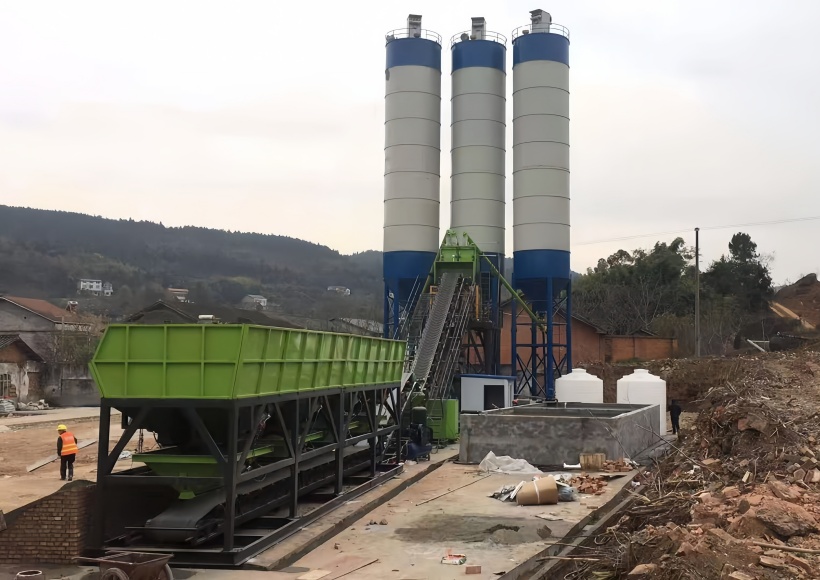
Most buyers read “foundation-free” as “can sit on bare ground.” It cannot. The frame still needs a flat, compacted, load-bearing surface, usually a 150 to 200 mm reinforced slab, or a compacted gravel pad with steel bearing plates where the soil is soft. What disappears is the cast-in-place foundation: the buried rebar cage, the anchor bolts poured into concrete, and the 28-day cure that has to finish before commissioning starts.
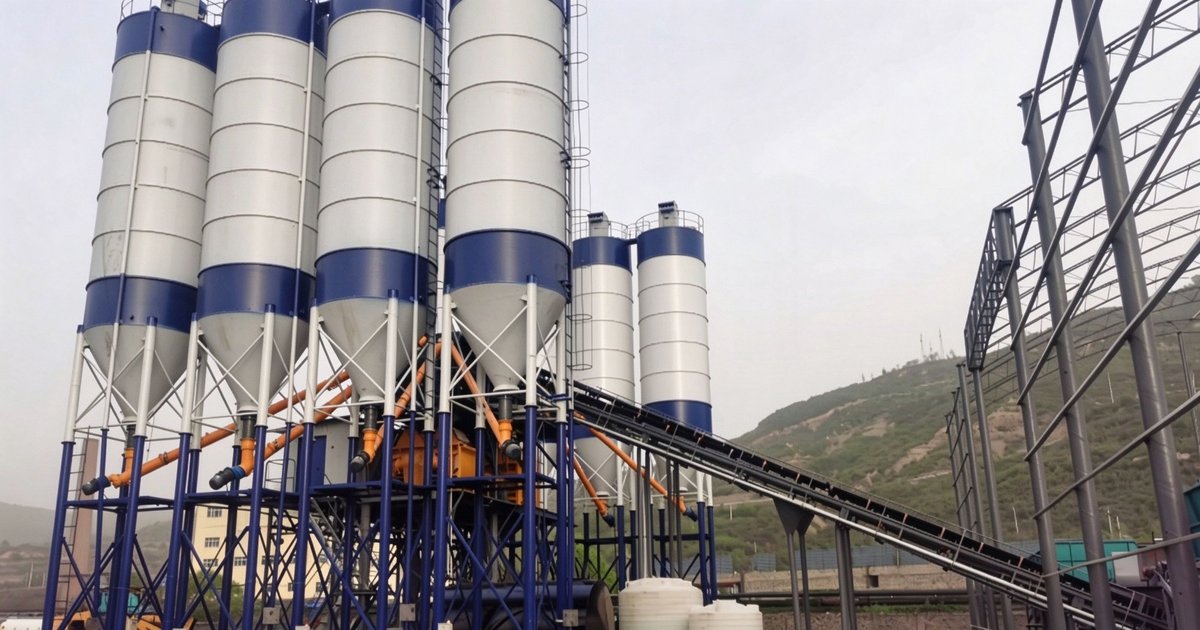
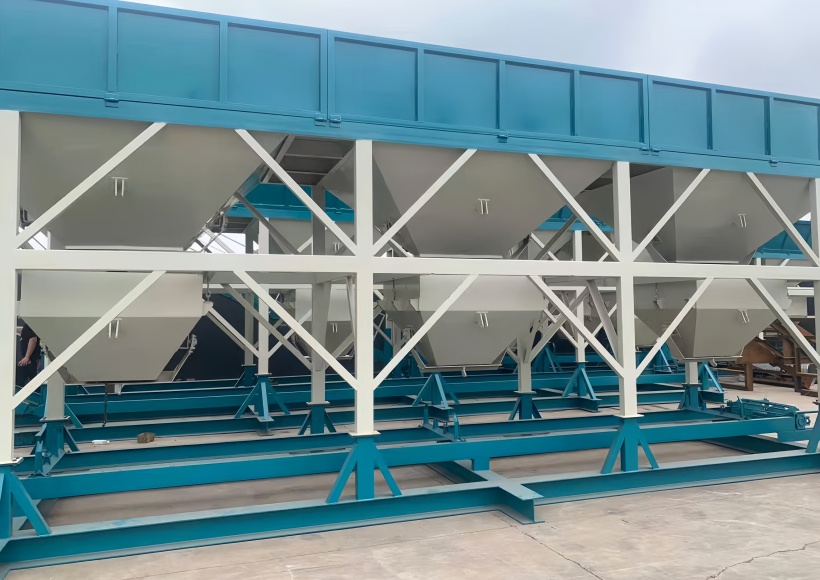
A foundation-free concrete batching plant instead lands on a steel base frame, and that frame spreads the load through a wider footprint plus counterweight. A conventional HZS120 needs somewhere between 100 and 150 cubic metres of foundation concrete, plus rebar, formwork and curing time. The HZS60 and HZS120 foundation-free units on this site need a slab, and a slab can be poured and cured in a fraction of that schedule.
Where the Money Actually Sits
Two costs matter here, and most buyers only count the first one. The visible cost is concrete and steel, which for an HZS120 is a real line item and one that varies with soil: soft clay and backfill may need piling before any foundation can be poured, which pushes the figure up further.
The hidden cost is the calendar. A cast-in-place foundation has to cure before the tower goes up, which is three to five weeks in which the equipment is on site and producing nothing. On a project with a contracted start date that delay either idles your plant or forces you to rent a stopgap unit, and neither option appears in the purchase order.
Then there is the exit cost. A poured foundation cannot leave with you. When the project ends it stays in the ground, and demolition means cutting the anchor plates and breaking out the concrete. That work produces no resale value, and on a leased site it may be a restoration obligation you owe the landlord. The general economics of concrete batching plant selection run on the same logic: the purchase price is the smallest number on the sheet.
HZS120, Foundation-Free vs Conventional
Put the two side by side and the equipment above the frame is the same machine.
| Item | Conventional HZS120 | Foundation-free HZS120 |
|---|---|---|
| Theoretical output | 120 m³/h | 120 m³/h |
| Mixer model | MAO3000/2000 | MAO3000/2000 |
| Mixer motor | 2 × 37 kW | 2 × 37 kW |
| Aggregate batching machine | PLD3200 | PLD3200 |
| Aggregate bins | 4 (2 stone, 2 sand) | 4 (2 stone, 2 sand) |
| Max aggregate size | 80 mm | 80 mm |
| Discharge height | 4.1 m | 4.1 m |
| Cement weighing accuracy | ±1% | ±1% |
| Aggregate weighing accuracy | ±2% | ±2% |
| Ground connection | Cast-in-place foundation with anchor bolts | Steel base frame on a slab |
| Disassembly | Cut the embedded plates | Unbolt and lift |
The only structural difference is how the tower meets the ground. Everything above the frame is identical: mixer, batching machine, conveyors, weighing system, control cabinet. Capacity, mix quality and weighing accuracy do not change. Anyone who tells you a foundation-free concrete batching plant produces less is describing a smaller model, not a different foundation, so compare the model number first and the mounting method second. The conventional HZS120 specification is listed separately if you want to check the numbers line by line.
What Changes on Site
Three things, in practice. The slab replaces the foundation, so civil work drops from weeks to days. The frame arrives pre-welded and pre-tested, so erection is bolt-together work rather than site welding on embedded plates. And the dismantling sequence reverses cleanly, which is what makes relocation practical at all rather than a demolition project.
The 30% and the 11%: Two Numbers, Two Questions
This site has quoted both figures, and they look contradictory until you see what each one measures. The 30% is a five-year total-cost figure that assumes two relocations. Most of that saving comes from the second and third moves, because the first installation is exactly where you pay the foundation-free premium.
The 11% is a single-project figure with one relocation. You pay roughly 10% more for the equipment, save the entire foundation, and cut installation labour. Net, about 11% on that project. A plant that never moves will not return 30%, and a plant that moves three times will beat it.
| Cost line | Conventional HZS120 | Foundation-free HZS120 |
|---|---|---|
| Equipment purchase | $114,000 | $131,000 |
| Foundation and civil work | $29,000 | Slab only |
| Installation and commissioning | $21,000 | $14,000 |
| Total, one installation | $164,000 | $146,000 |
| Difference | About $18,000 less |
Same project, one setup, roughly 11% cheaper. The figure moves toward 30% only when you add relocations, because each move costs the conventional plant far more than it costs the foundation-free one. The wider price model and configuration comparison covers the other cost lines that sit outside this table.
Eighteen Months, One Relocation: The Arithmetic
A contractor ran an 18-month highway package that required one mid-project move, and both options were priced on the same HZS120 specification.
Conventional: $114,000 for equipment, $29,000 for the foundation, $21,000 for installation and commissioning, $164,000 total. Foundation-free: $131,000 for equipment, slab only, $14,000 for installation and commissioning, $146,000 total.
The saving on the first setup was about $18,000. The larger effect came at the move. Dismantling a bolted frame took about 40% less time than cutting out a poured foundation, and the frame came through with minimal damage, which is what protects the resale value of a foundation-free concrete batching plant when the project closes.
Across the whole package the gap widened to roughly $47,000 once the relocation was costed in. That is the number that matters for a project with a move built into its schedule, and it is the reason the 30% figure exists at all. If you are comparing equipment line by line, the HZS120 equipment list covers what sits inside the $114,000 and $131,000 figures.
When a Foundation-Free Plant Is the Wrong Choice
A foundation-free concrete batching plant is not the default answer. There are site and schedule conditions where the conventional plant wins, and pretending otherwise wastes a buyer’s money.
Long-Life Sites
If the plant will sit in one place for ten years or more, the foundation cost amortises to almost nothing per cubic metre. Over that horizon the foundation-free premium buys you a capability you never use, and a poured foundation starts to look cheap.
Ground That Cannot Carry the Frame
The frame spreads load, but it still needs bearing capacity. On deep fill, peat, or ground over old workings you may end up building a piled slab that costs as much as the foundation you were avoiding. Foundation design practice for structural concrete assumes you know what is under the slab, so get a geotechnical report before you choose, not after.
High Wind or Seismic Exposure
A bolted frame resists overturning through footprint and counterweight. Where design wind speed is high, or where seismic loading governs, the counterweight and anchoring requirements can grow enough to erase the saving. Ask for the wind and seismic assumptions behind any quotation, and check them against the European structural standards your insurer or authority expects.
Very High Discharge or Unusual Layout
If your mixer trucks need discharge above the standard 4.1 m, or the site layout forces an unusual tower height, the frame geometry gets more complicated and the foundation-free advantage narrows quickly.
Site Conditions That Decide It
Four questions settle most of these cases before any quotation for a foundation-free concrete batching plant is written, and all four can be answered in a single site survey.
How long will the plant stay? Under three years, or any project with a planned move, favours foundation-free. Over eight years in one location favours conventional. What is under the slab? Compacted granular soil is straightforward, while soft clay, fill or karst means a geotechnical report and possibly piling, which changes the arithmetic for both options.
How much concrete will you place? A plant running below 30% of rated capacity rarely justifies either premium, because utilization is what converts a fixed cost difference into a per-cubic-metre number. Is ready-mix available nearby? If trucks can deliver, some projects skip the on-site plant entirely, and the ready mixed concrete industry benchmarks give you a way to price that third option before you commit to either of the first two.
Frequently Asked Questions About Foundation-Free Concrete Batching Plants
Does a foundation-free plant need no ground preparation at all?
It needs a level, compacted, load-bearing surface. In practice that is a reinforced slab of 150 to 200 mm, or a compacted gravel pad with steel bearing plates on firmer ground. What you skip is the cast-in-place foundation with anchor bolts and a 28-day cure, not all civil work.
Is the output lower than a conventional plant?
No, provided you compare the same model. An HZS120 foundation-free plant and an HZS120 conventional plant both rate 120 m³/h theoretical, both use the MAO3000/2000 mixer and PLD3200 batching machine. Differences in output come from the model, not the mounting.
How long does relocation take?
Moving a foundation-free concrete batching plant runs about 40% faster on dismantling than cutting out a poured foundation, and reinstallation avoids rebuilding the foundation entirely. The exact schedule depends on site access, crane availability and distance, so ask for a sequence rather than a single number.
What does the price difference look like?
Budget roughly 10% more for the equipment and expect to save the whole foundation line. On an HZS120 that usually nets out between 10% and 15% lower on a single-installation project, before any relocation is counted.
Will a bolted frame hold up over years of production?
The frame carries the same loads as a foundation-mounted tower, distributed through a wider base and counterweight. What you should check is the bolt torque schedule and the inspection interval in the manual, because a bolted connection is a maintenance item, not a one-time installation step.
Can it be converted back to a fixed installation later?
Yes. The frame can be anchored to a poured foundation if the site becomes permanent. That conversion is worth pricing at the start if long-term fixed operation is plausible, since doing it later costs more than doing it during the first build.
Next Step
Send us your site conditions and we will tell you which way the numbers fall. What we need: project duration, whether a relocation is planned, the geotechnical summary if you have one, required output, and discharge height.
With those five inputs we can price a foundation-free concrete batching plant against a conventional one on the same specification and show you the crossover point, rather than quoting a percentage that only holds for one schedule.