
JS750 Concrete Mixer at a Glance
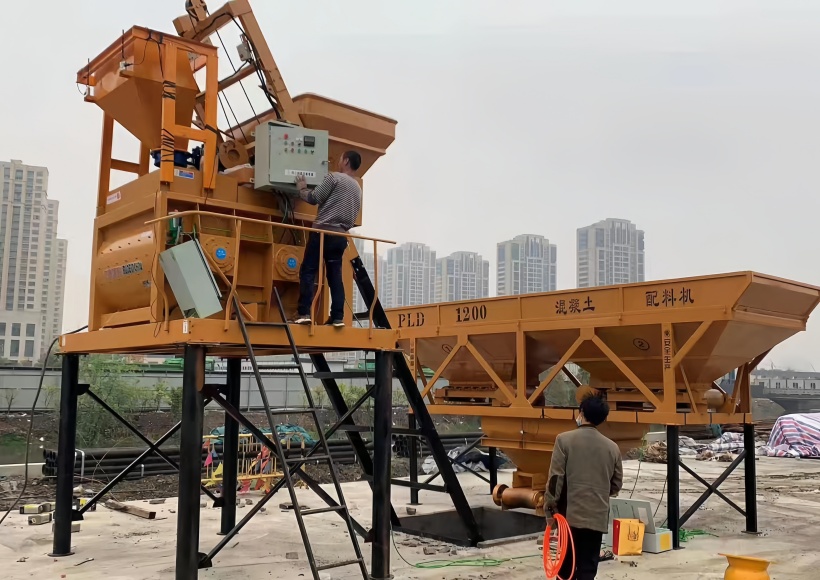
The JS750 concrete mixer is a twin-shaft forced mixer with a 750-litre discharge capacity, 1,200-litre feed capacity and a rated output of 35 cubic metres per hour. It draws 39 kW in total and weighs about 4,000 kg. The table below is the short version; the full specification follows further down.
| Question | Short answer |
| How much does it mix per batch? | 0.75 m³ (750 L) |
| How much per hour? | 35 m³/h rated, 25 to 30 m³/h in real site conditions |
| How much power does it need? | 39 kW total: 30 kW mixing, 7.5 kW lift, 1.5 kW water pump |
| How big a site does it suit? | 150 to 250 m³ per day on medium commercial, highway, bridge and multi-building work |
| When should you buy bigger? | Above 250 m³ per day, or when pours run continuously through the shift |
Why the JS750 Concrete Mixer Suits Medium-Sized Projects
Highway and bridge work, property development, water conservancy projects and rural self-build schemes all use this size, which is why it has become the default choice for contractors who need more than a small site mixer but are not ready for a full plant. The twin-shaft action keeps the mix uniform even on higher-grade concrete such as C60.
The number that matters most is not the 750 litres on the nameplate. It is the 72-second cycle time, because that decides how many batches you actually get through in a shift. The sections below cover the full specification, where this model stops being the right answer, and how it compares with the JS500 and JS1000.
JS750 Concrete Mixer Technical Specifications
Every rated figure below comes from the JS750 concrete mixer nameplate and factory test sheet. Buyers comparing models from different suppliers should check these values first, because capacity and installed power are the two places where quoted specifications most often diverge.
| Parameter | Value |
| Discharge capacity | 750 L / 0.75 m³ per batch |
| Feed capacity | 1,200 L |
| Theoretical production rate | ≥ 35 m³/h |
| Mixing motor power | 30 kW |
| Lift motor power | 7.5 kW |
| Water pump power | 1.5 kW |
| Total installed power | 39 kW |
| Maximum aggregate size (pebble / crushed stone) | 60 / 40 mm |
| Mixing blade speed | 35 rpm |
| Number of mixing blades | 2 × 7 (14 total) |
| Cycle time | Approximately 72 seconds |
| Machine weight | Approximately 4,000 kg |
What Each Number Means in Practice
The 1,200-litre feed capacity against a 750-litre discharge capacity is a 1.6:1 ratio. That headroom is deliberate: it lets the skip charge the drum in one pass without spilling, and it tolerates slightly uneven aggregate dosing. If you are weighing your own aggregates rather than buying pre-batched material, this margin is what keeps your cycle time stable from batch to batch. Where material arrives pre-batched, delivery is assessed against ASTM C94/C94M, and the drum still has to carry that same consistency through discharge.
The 30 kW mixing motor is the single largest load on site. Combined with the 7.5 kW lift and the 1.5 kW water pump, the machine needs 39 kW of installed capacity, which in practice means a supply that can carry the starting current of a 30 kW motor without tripping. Contractors running off a generator should size it above the nameplate total, not at it, because the mixer draws heavily during the first seconds of each batch.
The 60 mm pebble and 40 mm crushed stone limits are not interchangeable. River pebble is rounded and passes through the drum more easily, so the larger figure applies. Crushed stone has angular edges and the smaller figure is the safe ceiling. Exceeding it does not fail immediately, it shortens blade and liner life and eventually shows up as incomplete mixing at the corners of the drum.
From Theoretical 35 m³/h to What You Actually Place
Thirty-five cubic metres per hour assumes uninterrupted batching at the 72-second cycle. Real sites lose time to aggregate loading, cement feeding, transport turnaround and shift changes. A realistic planning figure for a single JS750 working with one wheel loader and two to three transit mixers is 25 to 30 cubic metres per hour over a full shift. If your daily requirement is 200 cubic metres, you are looking at roughly seven to eight productive hours, which leaves very little slack for breakdowns or weather.
When you cross-check a supplier’s hourly figure against what a plant actually delivers, the production benchmarks published by the National Ready Mixed Concrete Association give a useful sense of how much of the rated rate survives a full shift.
That gap between 35 and 25 is where most JS750 concrete mixer sizing mistakes happen. Buyers compare the nameplate figure against their peak demand instead of their average demand, and end up with a machine that runs flat out every day with no maintenance window.
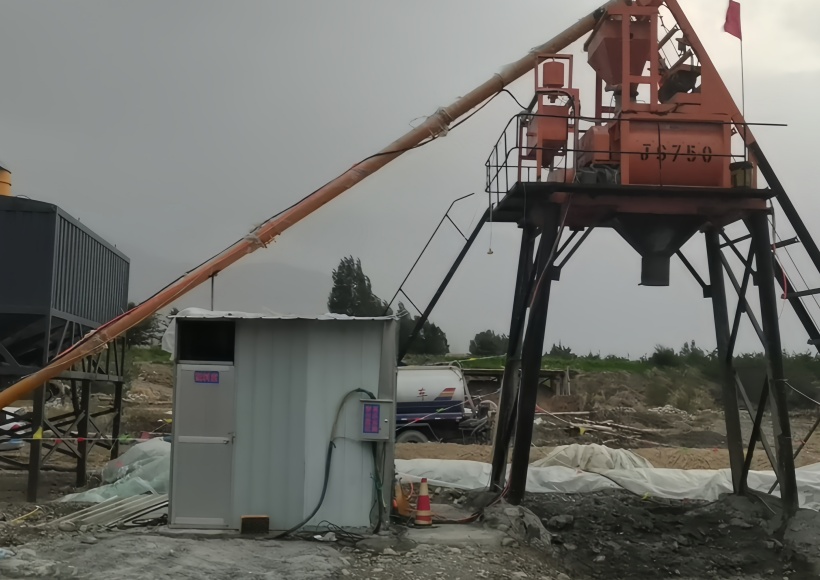
Is the JS750 the Right Size for Your Project?
Four Situations Where It Fits
Commercial concrete supply at small to medium volume, where daily demand sits between 150 and 250 cubic metres and a single mixer can carry the shift with one standby unit. Highway and bridge sections where the pour is spread over a long alignment and a stationary plant would mean hauling concrete too far. Property development sites of a few buildings, where pours are intermittent and a full concrete batching plant would be idle most of the week. Rural and township self-build projects, where the electrical supply is limited and 39 kW is close to what the local transformer can carry.
Three Signs You Should Move Up to JS1000 or JS1500
Your daily demand regularly exceeds 250 cubic metres, which pushes the JS750 past 35 batches an hour and leaves no room for the cycle time losses described above. Your concrete specification calls for consistent high-slump or high-strength mixes that need longer mixing time than 72 seconds, because extending the cycle cuts output in direct proportion. Your site already runs a concrete batching plant and you are adding a second mixer, in which case the batch size should match the plant rather than the other way round.
Moving up is not only a mixer decision. A JS1000 needs a larger charging skip, a heavier support frame and more receiving capacity downstream. Sites that upgrade the mixer alone usually find the bottleneck moves to aggregate handling within the first month. The ACI 304R guide treats measuring, mixing, transporting and placing as one chain, which is the practical reason a single link in that chain is rarely worth upgrading by itself.
JS500 vs JS750 vs JS1000: Which Model to Buy
The selection logic is one line: pick the smallest model whose realistic hourly output, not nameplate output, covers your average daily demand in eight hours with one unit held in reserve.
| Model | Discharge per batch | Typical use |
| JS500 | 500 L / 0.5 m³ | Small sites, precast yards, single-building projects with intermittent pours |
| JS750 | 750 L / 0.75 m³ | Medium commercial supply, highway and bridge sections, multi-building developments |
| JS1000 | 1,000 L / 1.0 m³ | Higher daily volume, continuous pour schedules, sites feeding a concrete batching plant |
Contractors who buy on peak demand end up with an oversized machine running at low load, which wastes fuel and wears the drive train unevenly. Contractors who buy on nameplate output end up short every afternoon. If you are comparing the JS750 concrete mixer against a full concrete batching plant rather than another standalone mixer, the relevant reference is the HZS50 concrete batching plant capacity analysis, which covers how a 750-litre mixer behaves once it is built into a plant with aggregate batching and cement weighing.
Configuration Options for the JS750 Concrete Mixer
The standard JS750 concrete mixer build covers most sites. These four options change the machine materially, so they are worth deciding before the order rather than after delivery.
The standard motor is a national-standard copper-core unit. Explosion-proof motors apply where the site handles combustible dust or operates under specific safety classification. Variable-frequency drives suit sites paying high peak-demand tariffs, since the soft start reduces the current spike at each batch and the tariff penalty that comes with it.
Manual control is the cheapest and depends entirely on operator skill. Semi-automatic adds timed water and cycle control. Fully automatic ties the mixer into a batching controller with weighing, which is what you want if concrete consistency is a contract requirement rather than a preference.
Standard wear parts are adequate for river pebble and normal-duty cycles. High-chromium alloy liners and blades extend service life where crushed stone with high silica content is used daily. Ceramic composite parts are for abrasive aggregate combined with continuous operation, and they cost more up front than they save unless the duty really is continuous.
Site-specific treatment covers anti-corrosion coating for coastal or high-humidity locations, explosion-proof electricals where required by classification, and mobile mounting where the mixer has to move between pour locations on the same project.
Manufacturing and Quality Control
Every JS750 concrete mixer is built at the Tongxin Machinery production base of 50 acres, with intelligent production lines, robotic welding and CNC laser cutting. The same process applies regardless of model, which matters more than it sounds: the failure points on a mixer are almost always welds and shaft alignment, and both are process-dependent rather than design-dependent.
The company employs 50-plus engineers and holds 37 national patents. Quality control runs 30 inspection steps from incoming raw material through to finished unit testing. After-sales support responds within two hours and puts a technician on site within 48 hours.
Frequently Asked Questions About the JS750 Concrete Mixer
How much concrete can a JS750 produce in one day?
At the 72-second cycle and 0.75 cubic metres per batch, the theoretical ceiling is about 35 cubic metres per hour. Allowing for aggregate loading, cement feeding and transport turnaround, plan on 25 to 30 cubic metres per hour across a full shift. Over eight productive hours that is 200 to 240 cubic metres per day. Sites that report higher figures are usually counting truck departures rather than mixer cycles.
What is the difference between the JS500 and the JS750?
Batch size is the main difference: 0.5 cubic metres against 0.75. The JS750 also carries a larger motor and a heavier frame, which is why it handles higher daily volume without running at its limit. For a site pouring under 150 cubic metres a day, the JS500 is usually the more economical choice; above that, the JS750 pays for the difference in reduced cycle pressure.
Can the JS750 be built into a concrete batching plant?
Yes. It is the standard mixer for concrete batching plant configurations in the HZS35 to HZS50 range, where aggregate batching, cement weighing and control are added around it. When upgrading an existing standalone mixer into a plant, the support frame and discharge arrangement usually need to be rebuilt rather than reused, so it is worth confirming the intended layout before ordering.
What power supply does it need?
Total installed power is 39 kW, made up of a 30 kW mixing motor, a 7.5 kW lift motor and a 1.5 kW water pump. The supply must carry the starting current of the 30 kW motor, which is the constraint most often missed. On generator power, size the generator above the 39 kW total rather than at it, because the draw peaks in the first seconds of every batch.
How long does installation take?
A standalone JS750 on a prepared foundation is typically a two to three day installation including alignment and test running. Built into a plant, the schedule follows the plant rather than the mixer. Foundation preparation should be completed before delivery, since the machine weighs approximately 4,000 kg and needs a level base to keep the drum aligned.
How often do the wear parts need replacing?
It depends on aggregate abrasiveness and daily tonnage. With river pebble and normal duty, standard liners and blades commonly run a full season or longer. With crushed stone of high silica content on continuous operation, high-chromium or ceramic composite parts are worth the premium. The practical check is mixing quality rather than a calendar: when the mix stops coming out uniform at the corners of the drum, the blades have worn past their useful geometry.
What does a JS750 concrete mixer cost?
Pricing moves with three things: the power and control configuration, the wear-part grade, and the site-specific treatment. A standard machine and a fully automatic unit with high-chromium liners and explosion-proof electricals are effectively different products. Rather than quote a single figure that will not match your build, Tongxin sends a configuration-specific price against your project parameters. The concrete mixer price and configuration analysis explains which options carry the largest cost impact.
How quickly does it pay back?
Payback follows utilization, not the machine. Sites running the mixer across two shifts on commercial supply commonly recover the investment within six to eight months. Sites using it intermittently on self-build projects take longer, and the arithmetic is driven by how many cubic metres per month the machine actually places rather than by the purchase price.
Why Contractors Choose Tongxin Machinery
Reliable build quality, with a failure rate below the industry average on the same duty cycle. Energy consumption roughly 30 percent lower than older equipment in the same class, which shows up in the electricity bill rather than the brochure. Full service coverage including installation guidance, operator training and maintenance support. And a customer base of more than 500 enterprises, including large state-owned contractors such as China Railway and China State Construction.
For buyers comparing this model against the larger JS series, the JS1000 comparison with HZS50 and HZS60 concrete batching plants sets out where the extra capacity starts to pay. For buyers who need the mixer itself rather than a plant, the full JS series overview lists every model with discharge capacity side by side.
Request a Configuration and Price for Your Project
Tongxin provides free selection guidance, site inspection and technical solution design. To get an accurate JS750 concrete mixer price, send four things: your average and peak daily demand in cubic metres, your concrete grade and slump requirement, your available power supply, and whether the mixer will run standalone or be built into a concrete batching plant. With those, the config