
A half-million-dollar purchase order signed on the strength of a spec sheet is the most expensive shortcut in concrete production. The spec sheet lists capacity, motor power, and footprint. It never lists where cement and aggregate actually meet water, and that single detail decides hourly output, fleet life, and rejection rate.
This wet mix vs dry mix concrete batching plant comparison is written for the people who sign that order: ready-mix suppliers adding a second line, contractors building a plant for a fixed-duration project, and plant engineers asked to justify one configuration over another. The question is not which plant costs less. The question is which plant survives site conditions for the next five years.
The article follows a fixed order. It gives the answer in a table first, then traces where mixing happens, then compares throughput, quality, weather tolerance, and cost, and closes with a procurement checklist and the questions buyers ask last. Every figure in this wet mix vs dry mix concrete batching plant review is a range taken from equipment documentation or field reports.
Start With the Answer: Wet Mix vs Dry Mix Concrete Batching Plant in One Table
Read the table before the arguments. For a wet mix vs dry mix concrete batching plant, each row marks a point where the two configurations diverge, and each row carries a cost that lands somewhere in your first two years of operation, either in capital or in lost hours.
| Buyer question | Wet mix plant | Dry mix plant | Where the cost lands |
|---|---|---|---|
| Where is the concrete mixed | Stationary twin-shaft mixer | Transit truck drum | Slump control and repeatability |
| Minutes a truck spends in the yard | 60 to 90 seconds at the loading lane | 8 to 12 minutes for feeding and mixing | Trips per truck per shift |
| Upfront capital | Higher, mixer and control included | 30 to 40 percent lower | Cash at signing |
| Fleet wear | Drum agitates at 2 to 4 RPM | Drum mixes at 15 to 18 RPM | Liner and drive train replacement |
| Where it fits | Commercial supply, long pours | Remote sites, scattered low volume | Haul distance and job duration |
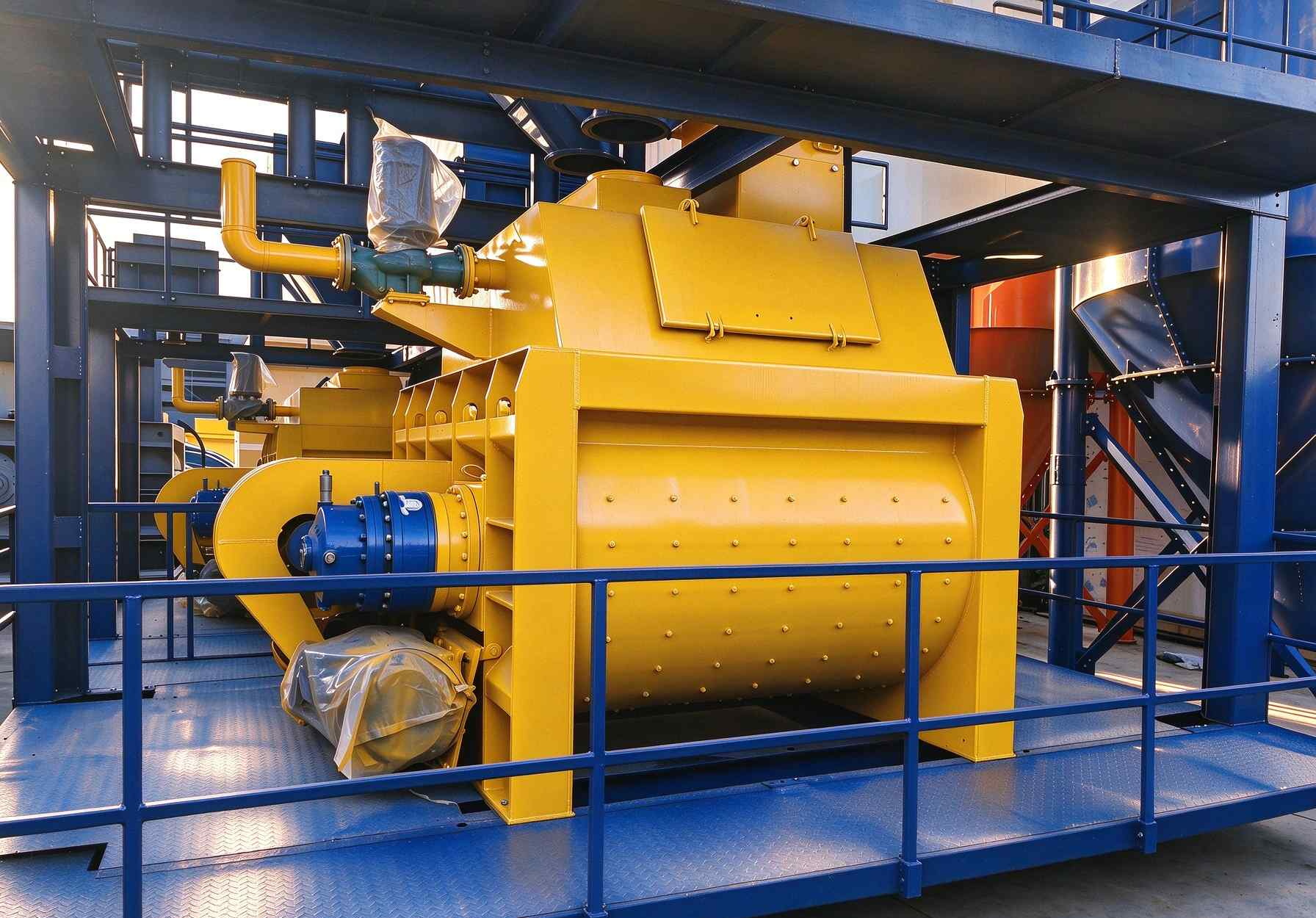
The table answers the easy half. A wet mix plant places a stationary twin-shaft mixer between the batching scales and the truck. A dry mix plant omits that machine and lets the drum finish the job. Everything else in this article follows from that one structural difference.
Buyers weighing a wet mix vs dry mix concrete batching plant who read only the capital column usually choose dry mix. The saving at signing is real, and the footprint is smaller. Buyers who read the last column usually choose wet mix, because those savings reappear later as truck hours, rejected loads, and dust compliance work.
Where a Wet Mix vs Dry Mix Concrete Batching Plant Puts the Mixer
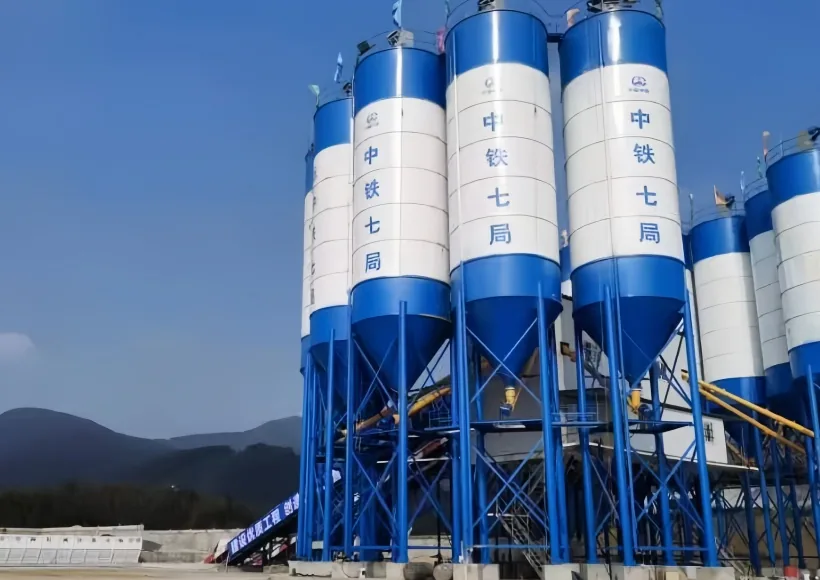
The wet mix vs dry mix concrete batching plant difference starts at the silo outlet, and the structural gap deserves a slowed-down look, because material flow rather than machine count determines what each configuration can honestly promise. Follow cement from the silo outlet to the discharge chute and the trade-offs become visible.
Trace the Cement Path From Silo to Truck
Cement leaves the silo through an aeration or gravity outlet, passes a rotary valve, and lands on a weighing belt or in a weigh hopper. From there the path splits. In a wet plant the weighed cement enters a central mixer with aggregate, sand, water, and admixture. In a dry plant it drops straight into the drum, and water arrives later.
Storage behavior matters before either configuration starts. Discharge reliability depends on cone angle, aeration pads, and moisture control, and the storage side of the plant is set out in the cement silo selection guide. A plant that cannot empty its own silo cannot batch at rate, whatever mixer sits downstream.
Volume sizing follows the same logic. Silo capacity should cover a full day of production plus a buffer, and the method is shown in the cement silo capacity calculator. Undersized storage turns a wet mix advantage into a queue of waiting trucks at the gate.
Why the Drum Is Not a Mixer
A transit mixer drum is designed to agitate and transport. Its fins fold material over at 2 to 4 RPM during travel, which keeps an already-mixed load alive without changing its chemistry. That motion is gentle on purpose, because the shell is a road-legal steel vessel on a truck chassis.
Dry batching asks that drum to do a job it was not built for. Mixing from dry ingredients needs high shear and enough revolutions to wet every particle, and the drum reaches that intensity only at 15 to 18 RPM held for 70 to 120 revolutions. Fins, liners, and drive train absorb the difference.
Fleet managers report drum and liner work arriving earlier on trucks tied to dry plants, with rebuild intervals shortened by roughly 40 percent in continuous service. That figure comes from maintenance records rather than a laboratory, and it is the reason fleet cost belongs in this comparison at all.
What 70 to 120 Revolutions Actually Cost
Revolutions convert into minutes, and minutes convert into trips. At mixing speed the drum needs 5 to 8 minutes of rotation after charging, and charging itself takes 3 to 4 minutes because dry material must be fed into the drum in layers to avoid segregation.
A wet plant discharges a fully mixed 10-cubic-yard load in 60 to 90 seconds. The truck arrives, receives one drop, and leaves. The gap per load is 8 to 11 minutes, and at 150 cubic yards per hour that gap becomes a queue rather than a rounding error.
Multiply the gap by the loads in a shift and the yard becomes the constraint. The plant may hold a headline rating it never reaches, because the bottleneck moved from the mixer to the traffic loop in front of it. Loop capacity, not mixer capacity, then decides how many cubic meters leave the gate before dark.
Do Not Confuse Either Plant With a Volumetric Mixer
A volumetric mixer carries aggregate, cement, and water in separate bins on one truck and blends them at the pour point. It solves a different problem: small pours, scattered locations, short notice. It is not a substitute for either configuration in this comparison.
Buyers sometimes compare a volumetric unit against a dry mix plant on price and conclude the plant is overpriced. That comparison is invalid, because the volumetric truck cannot sustain a commercial pour rate and the dry plant cannot match its mobility.
Throughput: What Each Wet Mix vs Dry Mix Concrete Batching Plant Delivers Per Hour
A wet mix vs dry mix concrete batching plant comparison measured on paper is not a throughput comparison. Rated capacity is measured in ideal conditions with a single truck at the chute. Real output is measured at the gate, and the two numbers rarely agree. The gap comes from loading time, queue discipline, and truck count.
Count the Trips, Not the Cubic Meters
A 10-cubic-yard truck that spends 12 minutes in the yard completes five loads in an hour at best. The same truck loaded in 90 seconds completes six or seven, and the plant feeding it reaches rating with fewer vehicles on the payroll.
Fleet size follows directly. A dry plant rated at 120 cubic yards per hour may need six trucks to hold the loop. A wet plant at the same rating may hold it with four, and the two trucks not bought are the real capital saving.
The component list behind that rating decides how the number holds up under load. A full HZS120 configuration, covering mixer, batching machine, silos, and conveyor, is broken down in the HZS120 equipment list, and component sizing shows where the queue forms.
Watch the Yard Queue Build at Peak
Peak demand arrives with the first pour of a large slab, not at midday. Every truck on site wants concrete within the same forty minutes, and the plant either absorbs that burst or the pour stops waiting for it.
Dry batching spreads the burst across the yard, because trucks mix on site while parked. A wet plant compresses the burst into the loading lane, and the lane clears quickly by design. Queue length at peak is a property of the configuration, not of the operator.
Calculate the Break-Even Volume Before You Sign
In any wet mix vs dry mix concrete batching plant business case, the capital gap between the configurations has to be repaid from operating savings. Estimate the gap per plant, divide by the saving per load in truck time, and the result is the volume at which the wet mix vs dry mix concrete batching plant decision flips toward central mixing.
The saving per load is the value of 8 to 11 minutes of truck time plus avoided drum wear. At commercial volumes repayment lands inside 18 months. At low volumes repayment never lands, and dry mix stays rational regardless of quality arguments.
Check Whether Your Fleet Can Absorb the Extra Minutes
Fleet age changes the answer. A newer fleet with spare capacity absorbs eight extra minutes without purchases. An older fleet already at maximum utilization converts those minutes into overtime, rental trucks, or missed pours.
Walk the yard with the dispatch sheet in hand. Count how many trucks sit idle at 10 a.m. and how many queue at 2 p.m. The shape of that curve says more about the correct configuration than any brochure figure on mixer power.
Quality and Weather: The Wet Mix vs Dry Mix Concrete Batching Plant Test
Consistency tests for a wet mix vs dry mix concrete batching plant usually collapse into opinion. They do not have to. Three variables decide consistency in either configuration, and each one can be assigned to a person, a machine, or a sensor.
Slump Control Depends on Who Holds the Water Valve
In a wet plant the control system holds the water valve. Moisture readings, batch weights, and mixing time are locked into a recipe, and the operator supervises rather than improvises. Loads of the same design mix leave with the same slump.
In a dry plant the driver holds the valve in many setups, adding water at the plant or on site. Judgment replaces measurement, and two drivers on the same mix can produce two different slumps. Consistency becomes a staffing question rather than an engineering one.
Inspectors test slump at the point of placement. A load outside tolerance is rejected whoever caused it, and the rejection cost includes material, truck time, disposal, and the schedule slip that follows.
Moisture in Sand Changes the Batch, Not the Recipe
Sand arrives wet. In a wet plant, probes in the bins report the water already present and the control system deducts it from the batch. Total water stays on recipe, and aggregate weight adjusts automatically without operator input.
Dry batching has no correction loop at the plant. Wet sand bridges in hoppers, sticks to belts, and arrives in clumps the drum may not break down, which is how sand balls reach the pour. The defect shows up after placement, when correction is expensive.
Humidity compounds the problem in coastal and tropical markets. Storage that keeps cement dry and sand drainable is covered in the cement silo troubleshooting guide, and the same discipline applies to aggregate bins, belt covers, and stockpile drainage.
Dust Rules Decide Whether You Can Run at All
Loading dry material into an open drum displaces air and carries cement fines with it. The visible cloud is the part regulators photograph, and permit conditions usually set the limit at the property boundary rather than at the mixer itself.
A wet plant contains mixing inside a sealed housing and vents displaced air through a baghouse on the mixer or the silo. Capture rates above 99 percent are achievable with correctly sized filter area, and the design logic is described in the dust removal design guide.
Dry plants can meet the same standard with suction boots, enclosed loading spouts, and a dedicated collector. The equipment exists, and the cost moves from the plant budget to the dust control budget. Compliance is available in both configurations, at different prices.
Long Hauls Reverse the Calculation
Wet concrete begins hydrating the moment water meets cement. Beyond 60 to 90 minutes of travel, slump loss and early set make the load risky regardless of admixture strategy, and the practical radius shrinks further in hot weather.
Dry batching exists because of that radius limit. Material travels dry, water is added at the pour point, and the concrete is fresh when it lands. For remote highway work, isolated camps, and mountain routes, the configuration is a constraint solution rather than a preference.
The trade-off inside any wet mix vs dry mix concrete batching plant decision shows up in the same yard. A wet plant at the edge of its radius runs at the limit of its quality control, and a dry plant covering the same distance gives up consistency for reach. Neither choice is wrong, and both have to be priced honestly.
Choosing a Wet Mix vs Dry Mix Concrete Batching Plant by Job Type
Choosing a wet mix vs dry mix concrete batching plant is a matching exercise. Four job profiles cover most purchases, and each profile points to one configuration once volume, radius, and duration are written down.
Commercial Ready-Mix Supply: Set the Floor at Central Mix
A supplier selling to contractors needs repeatable slump, fast truck turnaround, and a rejection rate near zero. All three depend on mixing inside the plant rather than in the drum, and the control system carries the consistency burden instead of the driver.
Volume confirms the choice. Once daily output passes roughly 100 cubic yards on a regular schedule, the capital gap repays itself and the fleet savings continue after repayment. Suppliers who start dry rarely stay dry as volume grows.
Road Patching and Remote Camps: Accept the Drum
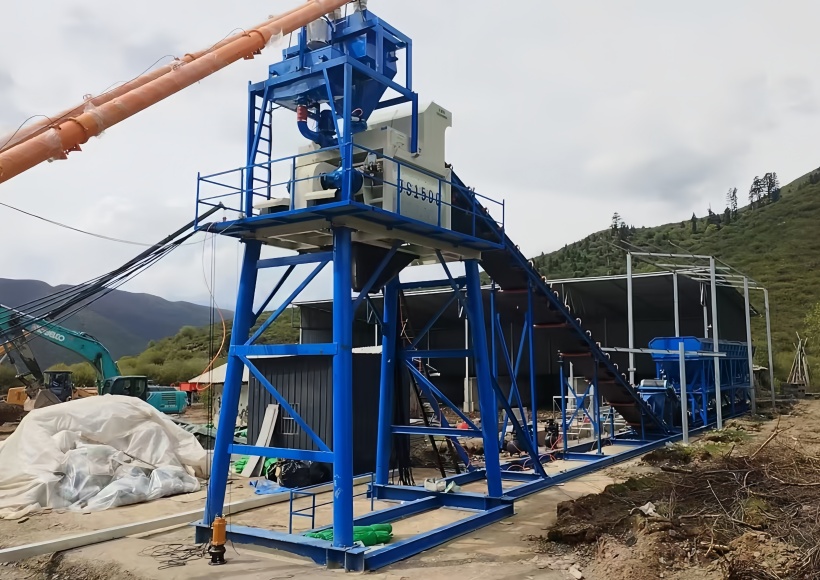
Scattered pours across a wide radius reward mobility and haul tolerance. A dry mix plant can be dismantled, moved, and re-erected on a new site in weeks, and material arrives fresh even when the drive takes two hours.
Volume stays low in these applications, so the throughput penalty never becomes the binding constraint. The correct question is whether the site can service a dry plant’s dust controls and whether the crew can hold slump discipline on site.
Upgrade Path: Why Retrofitting Rarely Works
Adding a central mixer to an existing dry plant touches structure, control, and power. The frame has to carry mixer weight plus dynamic load, the discharge path has to be rebuilt, and the electrical gear has to handle a second large motor starting under load.
Project teams that price the retrofit usually find the total within range of a new plant. Duration matters too, because a retrofit stops production while a new unit is commissioned beside the old one. Plan the configuration from day one and the question disappears.
What a Wet Mix vs Dry Mix Concrete Batching Plant Costs Over Five Years
Five years is the shortest horizon that makes a wet mix vs dry mix concrete batching plant comparison honest. Capital, consumables, fleet wear, and rejection cost all land inside that window, and anyone quoting only the purchase price is quoting a fraction of the total.
Split the Quote Into Three Buckets
Bucket one is the plant itself: frame, batching machine, mixer or skip, controls, and installation. Bucket two is storage and dust control, which both configurations need and both often forget. Bucket three is the fleet that feeds the plant.
Storage quotes vary widely for the same nominal tonnage. The variables behind that spread, from plate thickness to transport, are ranked in the cement silo price guide, and comparing two storage offers requires those variables side by side.
Price the Drum Wear You Are Handing to Your Fleet
Drum liners, fins, and drive train are consumables with a service life measured in cubic meters. A dry plant loads that consumption onto every truck in the loop, and the cost appears in the maintenance line two years after purchase.
A wet plant moves wear into the central mixer, where liners and blades are replaced on a planned schedule with the plant idle. Planned downtime on one machine is cheaper than unplanned downtime across a fleet serving active pours.
Read Two Quotes Side by Side Without Getting Fooled
Compare four lines before comparing totals: rated output with the stated truck count, mixing time, control system scope, and dust capture responsibility. A quote silent on truck count is quoting a rate it cannot sustain.
Vendors that publish component brands make verification easier, since load cells, dust collectors, and pneumatic valves can be checked against published specifications. Tongxin Machinery lists those components in its plant documentation, which lets buyers compare like with like instead of trusting a total figure.
A wet mix vs dry mix concrete batching plant quote is rarely the final number, so ask what is excluded. Foundations, silo erection, electrical supply, commissioning labor, and spare parts kits are commonly outside the equipment price, and the excluded items often decide which offer is genuinely lower.
A Procurement Checklist You Can Walk Through on Site
Walking a wet mix vs dry mix concrete batching plant is different from reading about one, so the checklist below is written for a site visit rather than a desk review. Each item can be confirmed in an hour with a tape measure, a stopwatch, and the plant’s own records.
Verify the Numbers Before the Site Visit
Confirm the rated output against the batching cycle, not the mixer nameplate. Ask for the cycle time in seconds, the discharge volume per cycle, and the number of trucks the vendor assumes in the loop.
Sequence matters as much as capacity. Foundation loads, silo erection, and commissioning are ordered in the batching plant construction plan, and a vendor who cannot describe that sequence has not commissioned many plants.
Storage and foundation dimensions set the civil work. Anchor layouts and load assumptions for each shell size are listed in the silo dimensions and foundation guide, which should be requested before the concrete slab is poured.
Ask Five Questions That Expose the Configuration
First: how long does a truck stay in the yard from entry to exit. Second: who adjusts water when sand moisture changes. Third: what happens to slump when the driver is new. Fourth: what capture rate the dust system is rated for. Fifth: what the vendor includes in commissioning.
Answers separate the offers quickly. A vendor who quotes yard time in minutes, names the moisture correction method, and states a capture rate is describing a plant. A vendor who answers in adjectives is describing a brochure.
Set the Acceptance Test in Writing
Acceptance should name the mix design, the batch size, the slump tolerance, and the number of consecutive loads tested. Output tests should run over a full shift rather than a single hour, because peak behavior is what the plant is bought for.
Silo discharge belongs in the test too. Rated discharge at the outlet and at the mixer inlet rarely match, and the gap is documented in the HZS silo specification guide. A plant that passes on paper and stalls at the gate has failed the test that matters.
Questions Buyers Ask Before Signing
Is a wet mix vs dry mix concrete batching plant cheaper to run when dry saves 30 percent upfront?
Only below a volume threshold. The upfront saving is real, and it is repaid by higher truck hours, earlier drum wear, and a wider quality spread. Above roughly 100 cubic yards per day the operating gap exceeds the capital saving within two years, and the wet mix vs dry mix concrete batching plant answer reverses.
How many more trucks does a dry mix plant need at the same output?
Two to three more on a 120 cubic yard per hour plant, because in a dry mix concrete batching plant each truck spends 8 to 12 minutes in the yard instead of 60 to 90 seconds. Fleet size, not plant price, is the number that decides whether the capital saving survives.
Can a wet mix vs dry mix concrete batching plant hold slump tolerance without a central mixer?
It can, with tight dispatch discipline, calibrated on-truck water meters, and drivers trained on the same mix. The tolerance then depends on staffing consistency rather than on a locked recipe, and every new driver is a new variable in the quality system.
What haul distance makes a wet mix plant impractical?
Beyond 60 to 90 minutes of travel, slump loss and early set become difficult to control without reformulating the mix. Hot weather shortens that window. Distances past the limit favor dry batching, or a satellite plant placed closer to the pour.
Can a dry mix plant be converted to a wet mix plant later?
It can be done, and it is rarely economic. Structural reinforcement, a rebuilt discharge path, a new control system, and larger electrical gear together approach the price of a second plant, while production stops during the work. Correct configuration at purchase is cheaper than correction later.
Which plant handles wet sand and clumped aggregate better?
The wet mix plant, because the central mixer breaks clumps under high shear and the control system deducts sand moisture automatically. A dry plant pushes that problem into the drum, where clumps may survive into the pour as sand balls.
Does a wet mix plant need a different silo setup?
Not a different type, but a tighter discharge specification. Continuous feeding rewards reliable silo outlets, and aeration design for each powder is set out in the cement silo aeration system guide. Storage that stalls at peak defeats a fast mixer.