

When a ready-mix company moves up from mid-size output, the HZS180 concrete batching plant is usually the first station that forces them to think in terms of real engineering numbers instead of catalogue ratings. The nameplate says 180 m³/h, but every plant manager who runs one will tell you that sustainable output, weighing precision and site preparation decide whether the machine actually pays for itself. This guide walks through the full technical specifications of the HZS180 concrete batching plant, explains the gap between theoretical and real production rates, and answers the questions our engineers hear most often on overseas projects.
HZS180 Concrete Batching Plant Core Technical Specifications
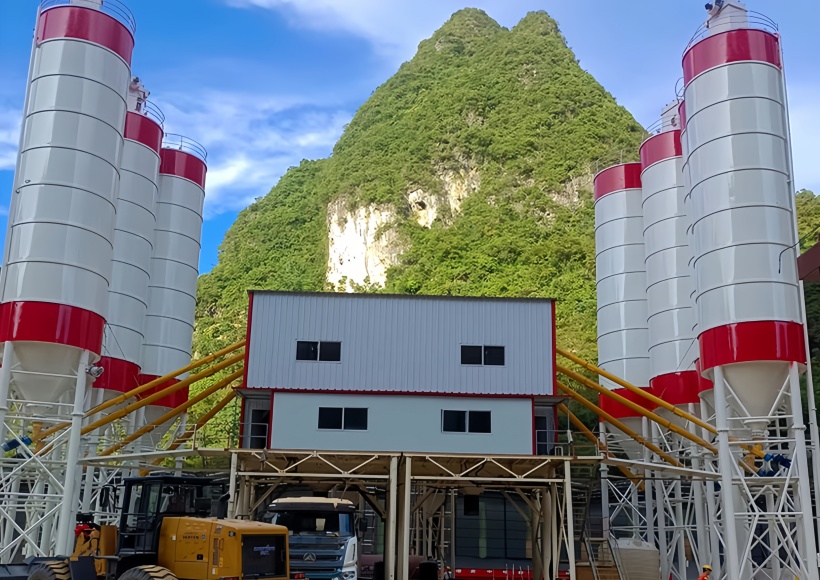
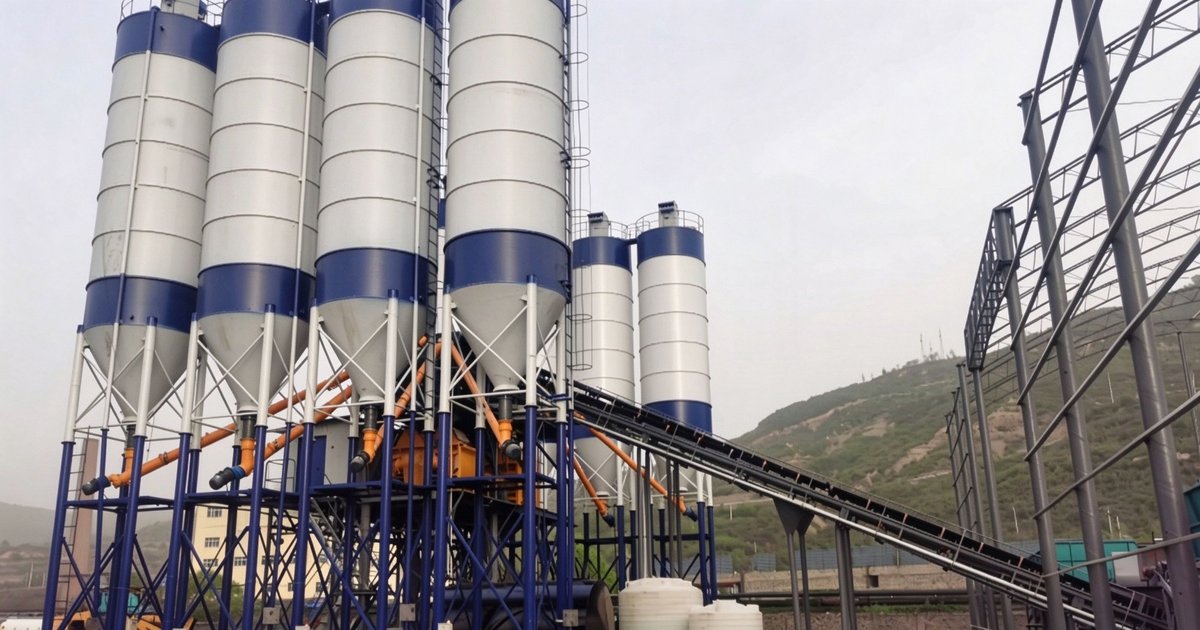
The HZS180 concrete batching plant is built around three systems that must be matched as one: the JS3000 mixing unit, the weighing and batching system, and the material handling line. Mismatch in any one of them caps the whole station, no matter how strong the other two are.
| System | Key Parameter | Specification |
| Mixing Unit JS3000 Twin-Shaft Forced Action Mixer | Nominal capacity | 3,000 litres (3 m³) |
| Theoretical peak output | 180 m³/h | |
| Drive motors | 2 × 75 kW | |
| Mixing shaft speed | 33–37 RPM | |
| Liner material | High-chromium alloy cast iron, hardness ≥ 58 HRC | |
| Weighing & Batching | Aggregate range | 0–4,000 kg, static accuracy ±0.5% FS |
| Cement range | 0–1,500 kg, static accuracy ±0.2% FS | |
| Mineral admixture | 0–800 kg, static accuracy ±0.2% FS | |
| Water | 0–600 kg, static accuracy ±0.5% FS | |
| Additive | 0–50 kg, static accuracy ±0.1% FS | |
| Material Handling | Aggregate storage | 100 m³ total (4 × 25 m³ compartments) |
| Belt conveyors | 1,000 mm wide; inclined 2.5 m/s, 45 kW, 18° | |
| Peak conveying capacity | 900 t/h | |
| Cement silos | 4 × 100 t (standard) | |
| Screw conveyor | Ø325 mm × 9 m, 90 t/h, 18.5 kW |
The three-stage weighing sequence — coarse feed, fine feed and in-flight compensation — keeps the dynamic deviation within ±1% to ±2% depending on the material, which matters more than the static accuracy figure for consistent mix quality on a high-throughput line.
Theoretical vs Real Output: What 180 m³/h Actually Means
The rated 180 m³/h assumes a perfect 60-second cycle with the mixer discharging at full nominal volume. In day-to-day operation the HZS180 concrete batching plant typically sustains 120–130 m³/h, and that figure is a realistic basis for truck fleet planning. The same logic applies across the industry — batch plant capacity in practice follows cycle-time reality rather than the nameplate rating, a point also reflected in concrete production guidance such as ACI‘s practice documents. Three factors create the difference:
- Effective discharge volume: a twin-shaft mixer discharges about 90% of nominal capacity per batch, which protects mix quality and avoids spillage.
- Real cycle time: batching–mixing–discharge cycles average 70–75 seconds on site, about 20% longer than the ideal 60-second cycle.
- Logistics allowance: aggregate replenishment, truck positioning and minor stops account for roughly 15% of shift time on most projects.
When we size the plant for a customer, we always run the calculation on 120 m³/h sustainable output and then add one reserve truck. A station bought against the nameplate number is chronically short of trucks by the second week.
Weighing Precision and Long-Term Calibration
| Batching Item | Measurement Range | Static Accuracy | Dynamic Deviation | Sensor Type |
| Aggregate weighing | 0–4,000 kg | ±0.5% FS | ±2% | Impact-resistant weighing module |
| Cement batching | 0–1,500 kg | ±0.2% FS | ±1% | Precision weighing sensor |
| Mineral admixture | 0–800 kg | ±0.2% FS | ±1% | Precision weighing sensor |
| Water batching | 0–600 kg | ±0.5% FS | ±1% | Weighing and flow dual-mode |
| Additive batching | 0–50 kg | ±0.1% FS | ±1% | Micro-precision weighing system |
Accuracy on this plant is maintained by three layers working together. The hardware side uses high-resolution load cells with a 1:3,000 ratio, three-point suspended weigh hoppers and fast pneumatic valves with a response time under 0.3 seconds. The software side performs an automatic zero-tare before every batch and applies real-time drop compensation so the target weight is hit even when material is still falling through the valve. The maintenance layer is what most plants neglect: quarterly calibration, keeping sensors dry and free of vibration, and scheduled lubrication of the mechanical parts of the hopper suspension.
Environmental Protection and Site Requirements
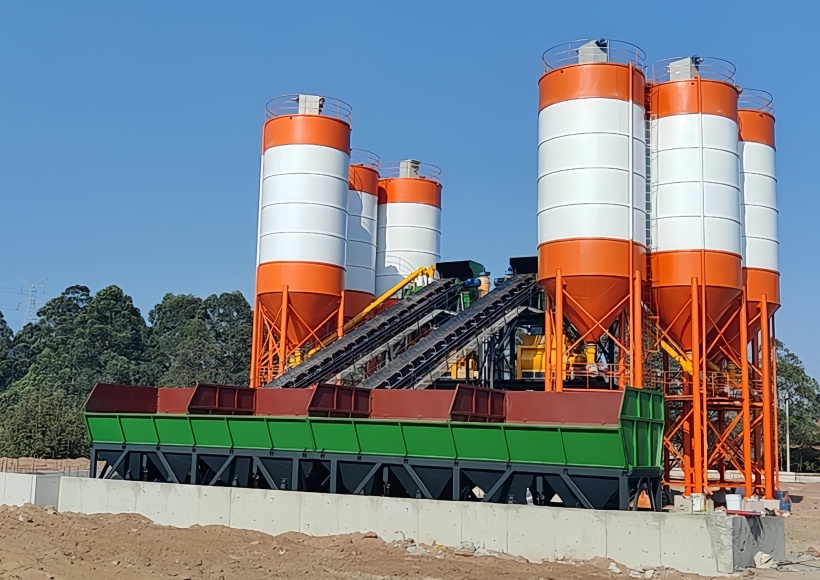
Modern HZS180 concrete batching plant installations have to pass local environmental inspection before they can run at full volume, so the green package is a production issue, not an optional extra. The standard configuration keeps dust leakage below 0.5% with fully enclosed structures, uses pulse-jet bag filters at over 99.5% efficiency, and holds dust emissions under 20 mg/m³, tighter than the 30 mg/m³ national limit. Noise is controlled to ≤75 dB(A) at 1 m around the mixer and ≤65 dB(A) during the day across the site, with vibration-damping foundations cutting transmission by 60%. Water is handled by a sand and gravel separator rated for 30–40 m³/h with a process water recovery rate above 85%, designed toward zero liquid discharge.
| Site Item | Requirement |
| Level area | Minimum 50 m (L) × 20 m (W) |
| Foundation | Reinforced concrete C30, min. 500 mm thick, designed for ≥ 15 t/m² |
| Embedded parts | Level tolerance ≤ 3 mm, elevation tolerance ≤ 2 mm |
| Drainage | Min. 1% slope, trenches ≥ 400 mm deep |
| Electrical supply | 400 kVA transformer recommended |
| Water supply | 0.2–0.4 MPa, flow ≥ 10 m³/h |
| Compressed air | 0.7–0.8 MPa, ≥ 1.2 m³/min |
Maintenance Schedule and Expected Service Life
| Interval | Tasks |
| Daily (per shift) | Check the 10 mixer lubrication points, drain air system moisture, clean weighing sensors |
| Weekly | Check and adjust belt tension, verify liner clearance (3–5 mm), retighten structural bolts |
| Monthly | Calibrate the weighing system, check hydraulic oil quality, inspect electrical connections |
| Annually | Inspect or replace main shaft bearings, evaluate liner and blade wear, full control system diagnostic |
On component life, the numbers our after-sales records support: mixing blades last 80,000–120,000 batches depending on aggregate abrasiveness, liners 60,000–100,000 batches, main shaft bearings five years or 10,000 operating hours, and core electrical components such as the PLC well over ten years. The plant itself is designed for a service life above 15 years when the maintenance schedule above is followed.
HZS180 Concrete Batching Plant Buying Considerations
For the commercial side — configuration packages, pricing logic, delivery lead time and total cost of ownership — read our dedicated HZS180 concrete batching plant buying guide. For smaller scales, the HZS50 concrete batching plant guide and the HZS75 guide cover those classes, and our HZS90 power configuration guide explains transformer sizing if you are comparing that model. All models are listed on the concrete batching plant overview page.
Frequently Asked Questions
Q1: What is the real-world production rate of an HZS180 concrete batching plant?
A1: Sustainable output is typically 120–130 m³/h. The theoretical 180 m³/h assumes a perfect 60-second cycle; real cycles run 70–75 seconds with a 90% effective discharge volume and about 15% logistics time.
Q2: How is weighing accuracy maintained on the HZS180 plant?
A2: Through high-resolution load cells (1:3,000), three-point suspended hoppers, fast pneumatic valves under 0.3 seconds, automatic zero-tare before each batch and real-time drop compensation. Quarterly calibration keeps it reliable.
Q3: What environmental protections come standard?
A3: Fully enclosed dust control below 0.5% leakage, pulse-jet filters over 99.5% efficiency, dust emissions under 20 mg/m³, noise at ≤75 dB(A) around the mixer, and a sand and gravel separator with over 85% water recovery.
Q4: What site conditions are needed for installation?
A4: A level area of at least 50 m × 20 m, C30 reinforced concrete foundation 500 mm thick rated for 15 t/m², and utilities including a 400 kVA transformer, water at 0.2–0.4 MPa and compressed air at 0.7–0.8 MPa.
Q5: How often should the plant be calibrated?
A5: Weighing systems should be calibrated quarterly, with belt tension, liner clearance and lubrication checks on the weekly schedule and a full control system diagnostic once a year.
Q6: How long do the main wear parts last?
A6: Mixing blades 80,000–120,000 batches, liners 60,000–100,000 batches, main shaft bearings five years or 10,000 hours, and PLC and core electrical components over ten years.
Q7: How much power does the HZS180 concrete batching plant require?
A7: With the JS3000 dual 75 kW drive, belt conveyors, screw conveyors and ancillary equipment, the plant typically needs a 400 kVA transformer. A full load calculation should be done against your site layout.
Q8: How does the HZS180 compare with the HZS120 or HZS90?
A8: The HZS180 concrete batching plant delivers roughly 50% more output than an HZS90 with a correspondingly larger mixer, weighing ranges and silo bank. It suits large commercial concrete suppliers and infrastructure projects rather than small ready-mix yards.
If you are planning a new HZS180 concrete batching plant or upgrading an existing station, our engineering team can review your site drawings and production targets and provide a specification-matched quotation. The full range of HZS-series plants is shown on the concrete batching plant overview page.