

A batching plant that runs short of cement mid pour loses a truck load of concrete and the customer call that follows. Storage decides whether that happens, and the shape of the storage decides what the plant pays long before the first bag arrives. A bolted cement silo has become the usual choice for plants buying cement in bulk and expanding in phases.
Plates travel in containers, crews assemble them on site, and capacity grows by adding a ring. That property also makes the bolted cement silo the wrong answer for a plant that must seal fly ash absolutely, since every flange joint is a potential leak. The material decides more of this question than the budget does.
What follows covers the FBS modular range, the assembly sequence, the safety devices worth verifying, and the checks to run before a purchase order. Model data and service terms come from the manufacturer specification sheet, and every capacity figure is quoted as built rather than as promised.
| Buyer question | What to establish | Why it changes the decision |
|---|---|---|
| Which peak tonnage must be held | Daily consumption plus a buffer for delayed deliveries | Capacity drives diameter, and diameter drives yard space |
| Whether a container reaches the site | Road width, turning radius, unloading space | Container delivery removes the lowboy trailer and crane from the budget |
| Which powder the silo holds | Cement, fly ash, or both in separate units | Fly ash needs welded seams, cement tolerates gasketed flanges |
| Whether capacity will grow | Expansion plan over three to five years | An extra ring costs less than a second silo and a second foundation |
| Which service terms are contractual | Warranty length, spare parts, commissioning support | Terms decide who pays when a valve fails in the first season |
Why Bolted Storage Suits a Batching Plant
Compare the Two Ways to Build a Silo Wall
A welded wall leaves the workshop as one continuous shell, produced on a rolling mill and welded along a single seam. A bolted wall leaves as curved plates, each punched with flange holes, and becomes a shell only after a crew joins them on site. The finished cylinder looks similar, but the supply chain behind it does not.
That difference reaches the invoice in three places. Freight drops because plates stack inside standard containers. Handling drops because no lowboy trailer or heavy crane is needed at either end. Field labor rises because bolting is slower than lifting a finished section into place.
Read the Capacity Table Before the Price
The FBS range runs from 100 to 2000 tons, with body diameters from 3 meters to 12 meters. Capacity rises faster than diameter, so a jump from 500 to 1000 tons widens the shell by two meters rather than doubling its footprint. Yard layout follows the diameter, not the tonnage.
| Model | Capacity | Body diameter (m) | Typical fit |
|---|---|---|---|
| FBS-100 | 100 t | 3.0 | Single line batching plant with daily bulk deliveries |
| FBS-150 | 150 t | 3.2 | Plant holding two cement grades |
| FBS-200 | 200 t | 4.2 | Standard stationary batching plant |
| FBS-300 | 300 t | 5.0 | Continuous pour schedules and remote sites |
| FBS-500 | 500 t | 6.0 | Ready-mix yard with weekly bulk intake |
| FBS-1000 | 1000 t | 8.0 | Central plant feeding several sites |
| FBS-2000 | 2000 t | 12.0 | Terminal storage with rail or bulk vessel intake |

Diameter beyond 8 meters changes the foundation conversation, because the loaded shell transfers a larger overturning moment into the pad. Buyers planning the 1000 or 2000 ton models should have the geotechnical report before the drawing is released, since pile design may cost more than the bolted cement silo body.
Confirm What the Container Actually Carries
A modular build cuts transport volume by more than 60 percent against a finished shell, which is why a 40 foot container can carry a mid sized unit. Plate count, rib count and the number of flange sets decide how many containers a bolted cement silo of that capacity needs.
Ask for the packing list before booking freight. A 500 ton unit typically ships in several containers, and the loading plan determines whether the crew can start assembly on the day the first container clears customs or waits for the last one.
How the FBS Modular Silo Is Built
Plate, Rib and Flange: What Each Does
The wall plate carries the powder pressure, the vertical rib carries the bending, and the flange carries the bolted joint. Ribs are welded to plates in the workshop, so site work stays limited to joining sections and sealing joints. That division is what keeps installation inside a few days.
Plate thickness should be stated in the drawing rather than in conversation. Small units commonly use 4 to 6 mm plate, and large units move toward 8 to 10 mm once wind load and hoop stress are calculated. A quote that omits thickness is a quote that can be adjusted later.
Double Anti-Corrosion in Coastal Air
Two treatments stack here. The first is a galvanized coating applied to the steel, and the second is a paint system applied over it, which together resist salt air and industrial atmosphere. Coating weight matters more than coating name, so the specification should name a coating class.
A single coating class serves an inland plant for decades and fails within a dozen years on a coast. Buyers within five kilometers of salt water should specify the heavier class and budget a repaint interval, because recoating a bolted cement silo in service requires scaffolding and a production pause.
Pulse Dust Collection at the Fill Point
Pneumatic filling displaces air, and that air leaves the shell through a filter rather than through the relief vent. The pulse jet collector on this range is rated to hold outlet concentration below 20 milligrams per cubic meter, which meets the stricter local limits in most markets.
Rating and sizing are separate questions. A collector that meets the concentration limit but is undersized for the fill rate will run at high differential pressure and blind its bags early. Ask for the rated air volume in cubic meters per minute and compare it with the blower that fills the silo.
Assembly on Site in Days, Not Weeks
Sequence From Base Ring to Roof Ring
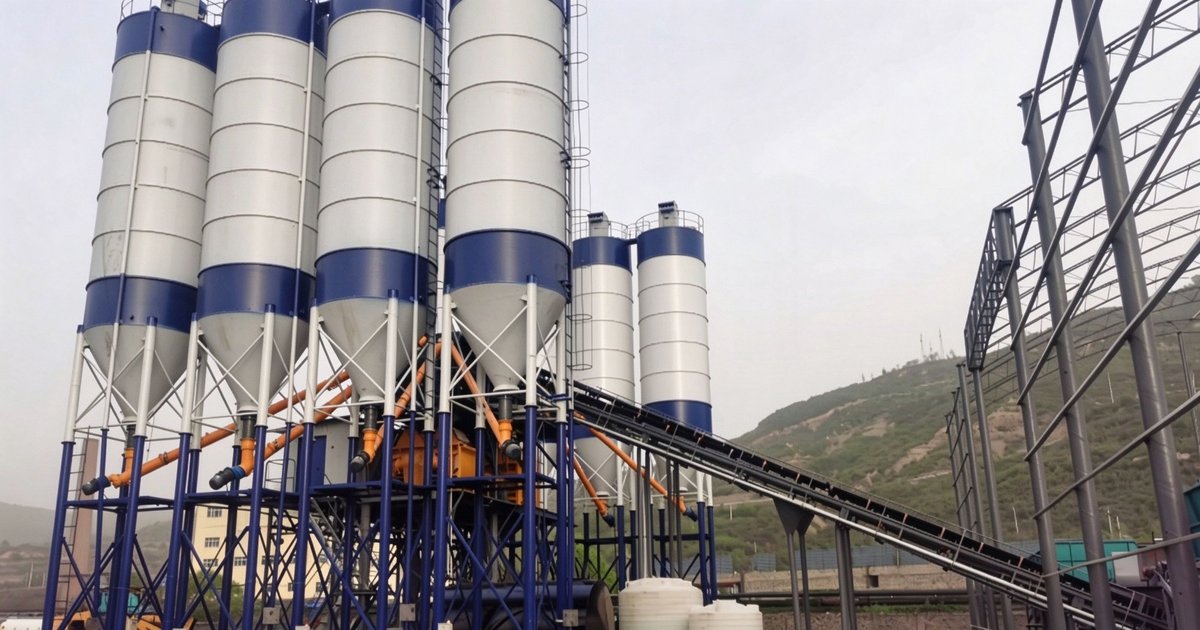
Assembly of a bolted cement silo begins with a base ring fixed to the foundation anchor bolts and levelled with shims. Curved plates rise ring by ring, each ring bolted to the one below and sealed at the flange as the crew climbs. The roof cone closes last, followed by the access platform and the dust collector.
A 100 ton unit closes in two to three days with a small crew and no crane, which is the practical argument for a bolted cement silo on remote sites. Larger diameters need a crane to lift plate bundles and the roof assembly, and that machine sets the schedule more than the crew size does.
What the Crew Needs on Day One
Day one needs anchor bolts set in cured concrete, a levelled base, torque wrenches, sealing compound and a working platform. Missing consumables stop the job faster than missing plates, because a crew that cannot seal a joint cannot close a ring. Confirm the sealant specification before the container arrives.
Power and lifting equipment belong on the same list. The dust collector and the aeration blower need a supply sized for their running load, and the crane, where one applies, needs a firm surface to stand on. A pad that carries a silo also carries the crane that builds it.
Inspection Points Before the First Fill
Three checks close the assembly: bolt torque verified ring by ring, sealant inspected at every flange, and the shell checked for plumb within tolerance. Records should be signed, because an insurer asking about a shell failure will ask for those sheets first.
The fourth check is functional. Run the blower, confirm the aeration pads fluidize, watch the relief vent and the dust collector respond, then fill slowly while watching the level alarm. A bolted cement silo that passes these checks can be handed to the plant without a trial period.
Capacity Selection Follows Daily Demand
Size From Peak Pour, Not Average
Average consumption describes the month, and peak pour describes the day that decides whether the plant keeps the contract. Size the buffer to cover the longest delivery interval the plant expects, plus the largest single pour on the schedule. Anything smaller creates a stockout risk on exactly the wrong day.
A common error is sizing to the truck that delivers, which gives roughly one day of coverage. Two cement grades in one plant usually mean two smaller units rather than one large unit, since switching grades inside a shared shell wastes cleaning time on every changeover.
Match the Diameter to Yard Space
Footprint follows diameter, so a 500 ton unit at 6 meters needs a wider pad than a 300 ton unit at 5 meters, even though the tonnage gap is modest. Yard drawings should show the bolted cement silo, the conveyor run, the truck turning circle and the crane standing area together.
Height matters as much as width. Overhead cables, galleries and neighbouring structures set the maximum erectable height, and a height limit can push a buyer toward a wider, shorter shell that holds the same tonnage at a higher plate cost.
Plan the Expansion Ring Before You Buy
A bolted cement silo grows by adding a ring, and that decision costs almost nothing at the drawing stage and a great deal afterwards. A buyer who expects volume to rise should specify anchor bolts and a foundation designed for the final capacity, not for the first season’s capacity.
The saving is real. Adding a ring to an existing shell avoids a second foundation, a second dust collector and a second set of site works, which together exceed the cost of the extra plates by a wide margin. Say the five year plan out loud during selection.
Safety Devices Buyers Should Verify
Over-Limit Alarm and Level Sensing
Overfilling is the failure that damages equipment and people at the same time, so the level system deserves specification rather than assumption. The range carries an over-limit alarm as standard, and the sensing method should match the powder: radar for cement, capacitance where dust is heavy.
Rotary paddle switches work as a backup indication and fail as a primary instrument in fine powder, because cement packs around the paddle. Ask which sensor drives the fill cut off, which one drives the alarm, and whether the two are independent. Independent signals prevent a single failure from silencing both.
Pressure Relief and Vacuum Protection
A pneumatic tanker pushes air into the shell at a rate the vent must absorb. If the vent is undersized or blocked, pressure builds and the roof lifts, and the repair cost lands on the buyer. Relief devices belong on the bill of materials, not on a verbal assurance.
Vacuum protection matters on the way out, because a discharge that outruns the incoming air can pull a partial vacuum into the shell. Both devices are cheap against the failure they prevent, and both should be listed with their set points in the technical annex.
Access, Ladder and Roof Manway
Access exists for maintenance, and maintenance happens at height. A caged ladder, a working platform at the collector and a roof manway large enough for a person with tools are baseline requirements rather than options. Buyers should check the platform height against the collector position.
Fall protection details vary by jurisdiction, and the drawing should follow the destination market rather than the factory’s home standard. A bolted cement silo that arrives without a compliant access arrangement may not receive an operating permit, whatever its mechanical condition.
Bolted Against Welded: Decide by Site
Where Bolted Wins on Freight
Freight decides most bolted cement silo projects below 300 tons, because the shell is a small share of the landed cost. Plates consolidate with other equipment in the same container, which lets a plant ship a mixer, a batcher and a silo in one booking rather than three separate movements.
Site access decides the rest. Where a lowboy trailer cannot turn into the yard, the welded option disappears from the discussion and the bolted cement silo becomes the only practical route. Confirm the turning circle with the haulier before the order, not after the container is on the water.
Where Welded Wins on Sealing
Fly ash is finer than cement and fluidizes more easily, so it finds any joint that is not gasketed correctly. A welded shell removes the joint entirely, which is why fly ash service is dominated by welded and spiral construction. Cement service tolerates a properly sealed joint on a bolted cement silo without complaint.
Moisture is the second argument. Cement hydrates on contact with water, and a seam that weeps in a humid climate hardens material against the wall. A plant that stores cement through a monsoon season should weigh sealing quality above the initial price difference.
What the Seam Costs Over Ten Years
A joint on a bolted cement silo needs re-torqueing after the first season and inspection at intervals afterwards. Sealer degrades in ultraviolet light and salt air, and replacement means a crew at height on every joint. Those visits are routine and cheap individually, and they accumulate.
A welded shell has no such routine, so its maintenance line stays near zero while its purchase price sits higher. Buyers comparing the two should compare ten year totals, not invoices, and should include the cost of a scaffold or a boom lift in the bolted cement silo figure.
What Ships With a Standard Unit
Mechanical Scope
A complete unit carries the shell with ribs and flanges, a hopper with aeration pads, a discharge valve, a pressure relief vent, a vacuum breaker, a dust collector, a caged ladder and a roof manway. Anything missing from that list becomes a later purchase order.
Variations are normal and should be priced, not assumed. A butterfly valve suits cement and a slide gate suits fly ash, and buying the wrong one costs a full day of plant downtime to change. Write the valve type into the specification with the material it handles.
Electrical and Control Scope
Electrical scope covers the level sensor, the alarm circuit, the dust collector controls and the aeration blower starter. Whether the panel arrives assembled or as loose components is a commercial question, and it changes the on site electrical work by several days.
Control voltage and frequency should match the destination market before the panel is built. A panel wired for one voltage arrives unusable in another, and rewiring it on site voids whatever certification came with the original assembly.
Documentation and Drawings
Documentation should include the general arrangement, the foundation load diagram, the assembly drawings, the bolt and sealant schedule, and the maintenance manual. The foundation load diagram is the document the local structural engineer needs, and its absence delays the pad by weeks.
Ask for drawings in the language of the destination and in metric units. A drawing that mixes imperial fasteners with metric plates creates a supply problem at exactly the moment the crew is standing on the pad waiting for the right bolts.
Support Terms in Writing
Warranty Period and What It Covers
The FBS range ships with a 24 month quality assurance period alongside lifetime repair and technical support. Buyers should read which failures the period covers, since coating degradation and seal wear are often treated differently from structural failure.
Consumables sit outside most warranties, and that is reasonable. What buyers should secure in writing is the response time for a structural or mechanical failure, because a silo that cannot discharge stops the plant and a slow reply becomes a production loss rather than a warranty claim.
Remote Guidance Versus On-Site Crew
Remote guidance covers most assembly questions, since the sequence is standard and the drawings are detailed. A video call from the pad resolves torque order, sealant placement and roof alignment faster than an exchanged email, and it costs nothing beyond a scheduled hour.
On site support belongs in the contract where the crew is new to bolted cement silo assembly or where the site is remote. Commissioning support matters more than erection support, because the first fill is when the aeration, alarm and collector behaviour reveal themselves under load.
Spare Parts and Consumables
A plant should hold a spare set of flange gaskets, a box of bolts for each ring size, a spare level sensor and a spare filter set for the collector. Those items cost little at the time of order and cost a week of waiting when bought after a failure.
Consumable specification should be recorded with the serial number of the unit, so that a replacement sensor matches the original signal type. A mismatched sensor reads low and defeats the over-limit alarm exactly when the alarm is needed.
Procurement Checks Before a Purchase Order
Verify the Drawing, Not the Brochure
A brochure describes a category, and a drawing describes a unit. Buyers should request the general arrangement for the exact capacity on order and check plate thickness, rib spacing, flange count and nozzle positions against the specification.
Certification claims belong in the same review. Exporting to more than 50 markets across Europe, North America, the Middle East and Southeast Asia implies familiarity with differing codes, and an ISO 9001:2015 certificate speaks to the process rather than to the design of this particular shell.
Ask for the Plate Certificate
Steel arrives with a mill certificate that records grade, heat number and coating weight. The certificate is the only evidence that the plate in the container matches the plate in the quotation, and it costs nothing to request at the order stage.
Buyers who receive the certificate can compare coating class with what the coastal or inland specification demanded. A thinner coating passes every visual check on delivery and fails in service, which is where the specification earns its money.
Compare Two Quotes Line by Line
Two quotations for the same capacity diverge on scope rather than on steel. One includes the collector, the alarm, the platform and the commissioning visit, and the other leaves them as options. Comparing totals without comparing lines produces a decision that reverses during execution.
The final check is the anchored foundation figure. A silo quote excludes civil work by convention, so the buyer should hold a separate pad estimate before signing. Tongxin Machinery and most exporters quote equipment only, and buyers who assume otherwise meet the gap at mobilization.
Questions Buyers Ask About Modular Silos
How Long Does Assembly Take for a 100 Ton Unit
Two to three days with a small crew and no crane. Assembly of a bolted cement silo removes more than half the site time compared with a monolithic shell, because the workshop has already completed the welding and the site work is bolting and sealing.
Is a Bolted Silo Suitable for Fly Ash
Only where the joints are sealed to a specification written for fines. Fly ash finds joints that cement does not, so a plant storing both materials usually keeps cement in the bolted cement silo and buys a welded shell for fly ash.
Can Capacity Be Increased After Installation
Yes, by adding a ring, provided the foundation and anchor bolts were designed for the final height at the outset. Retrofitting capacity onto a pad built for the original tonnage is the expensive version of the same operation.
What Service Life Should a Buyer Expect
The shell is designed for more than 20 years of service, with coating class and maintenance practice deciding where inside that range the unit lands. Coastal sites repaint earlier, inland sites later, and both rely on the original coating weight.
Which Capacity Suits a Standard Batching Plant
A stationary plant with daily bulk deliveries usually fits the 200 to 300 ton band, and a ready-mix yard taking weekly bulk loads fits 500 tons. Peak pour size and delivery interval set the number, not the plant’s rated output.

The practical summary is short. Confirm the powder, size from peak demand, design the pad for the final height, and put the component list into the contract. A bolted cement silo that meets those four conditions will hold capacity for two decades, and one that skips them will hold a maintenance schedule instead.
Same Silo Logic in Other Bulk Industries
The plate, rib and seal specification that suits cement also suits fly ash, plastic pellets and mineral powders, so the buying checks stay the same across sectors. What changes is the accessory package bolted onto the shell.
Grain storage adds temperature monitoring and ventilation, because an organic load heats up and holds moisture in a way that cement powder never does. Aeration pads and roof vents do most of that work.
Chemical and mineral loads push the coating spec harder. A 275 gram zinc coat and a sealed flange matter more when the material is abrasive or mildly corrosive, and the discharge cone moves to a wear liner.